Đọc phiên bản tiếng Việt tại đây.
Following the series The Circle of Time (2016–present), references to classical poetry became markedly visible in your artistic statements, coinciding with your deeper engagement with abstract painting. Do you think there are points of convergence in the imaginative landscape that poetry and abstraction open up for you?
Indeed, I came to recognise a remarkable correspondence between the two forms as I gradually moved towards abstraction over the course of my practice.
Classical poetry allows me to connect with lost cultural and spatial worlds. The currents of history and culture seem to flow continuously, existing beyond time within each layer of space and every brilliant classical verse. All that beauty remains intact; it is time that moves, and also we who live in an age of constant flux. Through reading and exploring poetry, I realised that concepts such as “abstraction” and “minimalism” in painting today had long existed within classical poetry.
Will Durant, an American historian whose work I admire, wrote in the chapter “The Age of the Poets” of the book Our Oriental Heritage the following: “We are told that the poetry written under the [Tang] emperors plays a large part in the training of every Chinese youth, and that one cannot meet an intelligent Chinese who does not know much of that poetry by heart. If this is so, then Li [Bai] and [Du Fu] are part of the answer that we must give to the question why almost every educated Chinese is an artist and a philosopher.”¹
It seems that both concepts had already coexisted within East Asian culture. The artistic terms we use today are sometimes simply interpretations produced by the historical development of modern Western art. I have always believed that East Asians formed their own conceptions of abstraction early on through allusive stylisation, ways of observing nature, landscape and spiritual life, and through art and everyday existence. The abstract element we recognise in the modern world was already inherent in poetry, literature, calligraphy and painting, ancient ceramics, etc. From another perspective, I believe that East Asian conceptions and trajectories of abstraction have always differed from those of the West. Yet there have also been fascinating points of exchange between these two civilisations, at many moments and among many figures across history.
To return to your question, this compatibility of inner imaginative spaces and the period in which I moved towards abstraction has been both a stage in my development and an intriguing outcome of my love of reading classical Vietnamese and Chinese poetry and literature. Alongside reading and collecting antiquities, journeys through different cultures in Asia and elsewhere in the world are among the pursuits that shape my personal life.
In bringing painting into dialogue with poetry, how have your considerations of form, material and technique changed over the course of your practice?
In classical poetry, every poetic conceit and every thought already contains the whole universe. Human beings, grasses and trees, flowers and leaves, birds and animals, mountains, clouds and sky all exist in harmony. They are also the voice of the heart, the intimate testimony through which the ancients reflected and spoke to those who came after them. Perhaps we are able to extend our sense of time and space beyond the present thanks to the spirit of poetry, literature, music, calligraphy and painting bestowed upon us. In East Asian history, a poet might also be a painter, literatus, calligrapher and statesman; art was understood as a means of cultivating the spirit. I remember welcoming the New Year several years ago at West Lake in Hangzhou (China). Standing before the still water in the late afternoon, I saw a stone bridge and a row of drooping willows reflected on its surface. In the chill wind at year’s end, I suddenly recalled Bai Juyi’s lines about the scenery of West Lake:
“Pines drape the mountain face in thousand folds of jade
The moon dots the wave’s heart: a single pearl
A carpet of green silk, newborn rice shoots weave
Young reeds flutter, ribbons of blue-green
I cannot leave Hangzhou behind and part
For half of what detains me is here this very lake.”²
Bai Letian³ lived in Hangzhou for around two years while serving as its governor, leaving a lasting imprint through his public works and achievements. For my part, I have had a bond with West Lake, Hanoi, for nearly twenty years. I suddenly found myself thinking of these two different places that share the name West Lake, both of which have left deep impressions on my life and artistic journey. Perhaps the scenery of this place has brought many changes to my art. Standing amidst landscapes still rich with the vestiges of literature and history, poetry entered my work quite naturally.
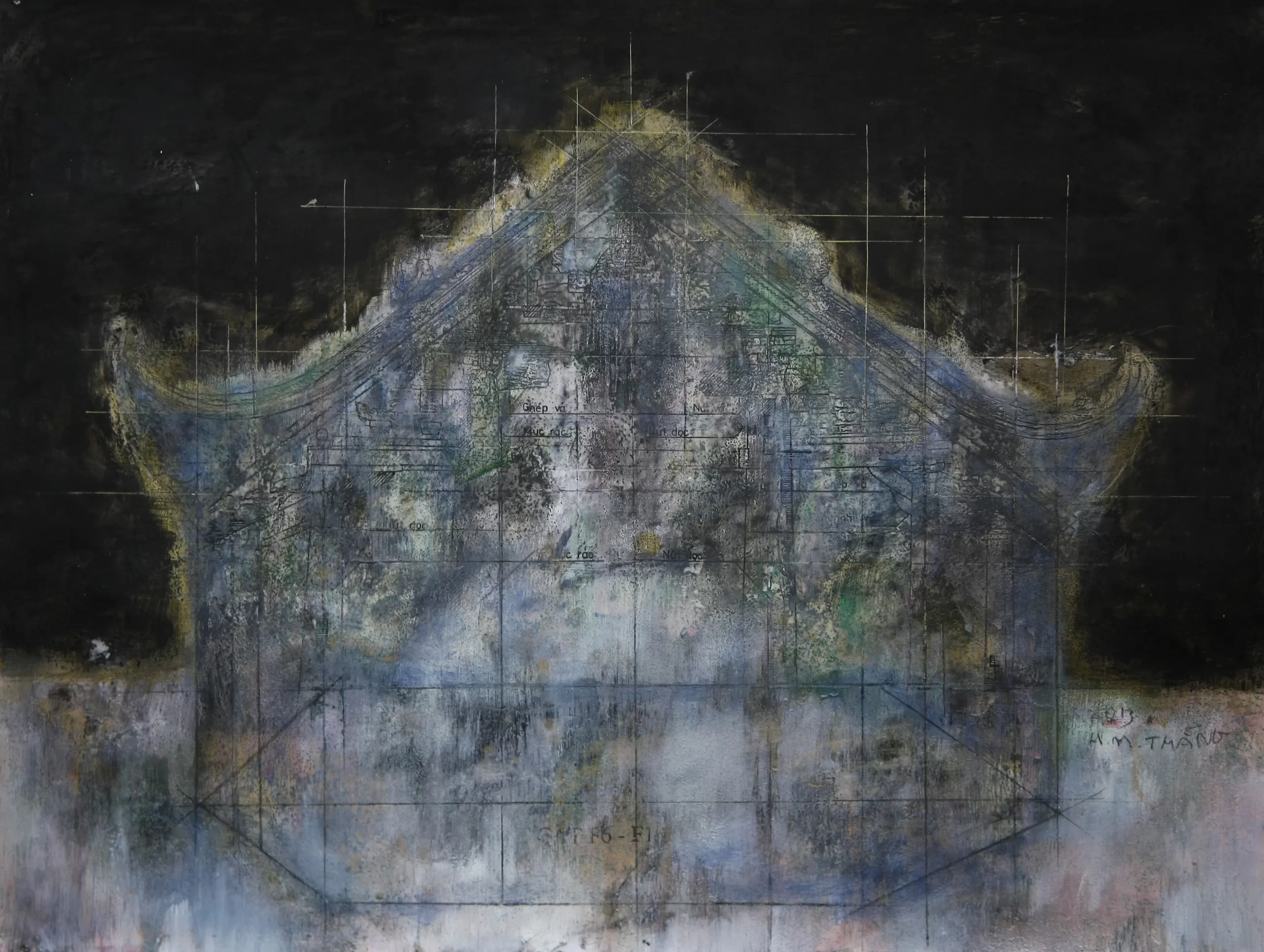
In my most recent solo presentation at Ky Lan’s House in Hanoi, I drew on a poetic conceit from a luc bat (six-eight) poem praising the scenery of West Lake by Duong Khue – a celebrated poet and eminent literatus from Bac Ha of the late 19th century – for the exhibition title Veiled in Smoke, a Thousand Mists. The title of my preceding solo exhibition, held in 2022 by Galerie Quynh in a historic mansion dating from the second half of the 19th century in Saigon, Behold the Mountains, the Waters, the Clouds, also took after a line in Huong Son Landscape Song by the late 19th century literatus Chu Manh Trinh.
Looking back at my artistic journey over the past ten years or so, I realised that the dominant muse has always been poetry.
As shared above, the language and spatial dimensions of classical poetry provide a pathway for me to connect with elements that lie beyond the grip of time in my artistic creation. Reading a verse aloud opens up a distinct realm of space, a way of thinking, a framework for resolving the formal structure of a piece, and in some way, even a suggestion for how an exhibition should be displayed. In the visual arts, painting is a rich and diverse manifestation of various forms, characteristics, elements, materials, and languages. While we can look to poetry for inspiration and linguistic beauty, it is equally vital that we do not conflate the formal boundaries of the two mediums. Visual art ultimately possesses its own unique language and characteristics.
Could you share a specific instance where a poetic conceit or motif shaped your approach to structuring the exhibition space in your past shows?
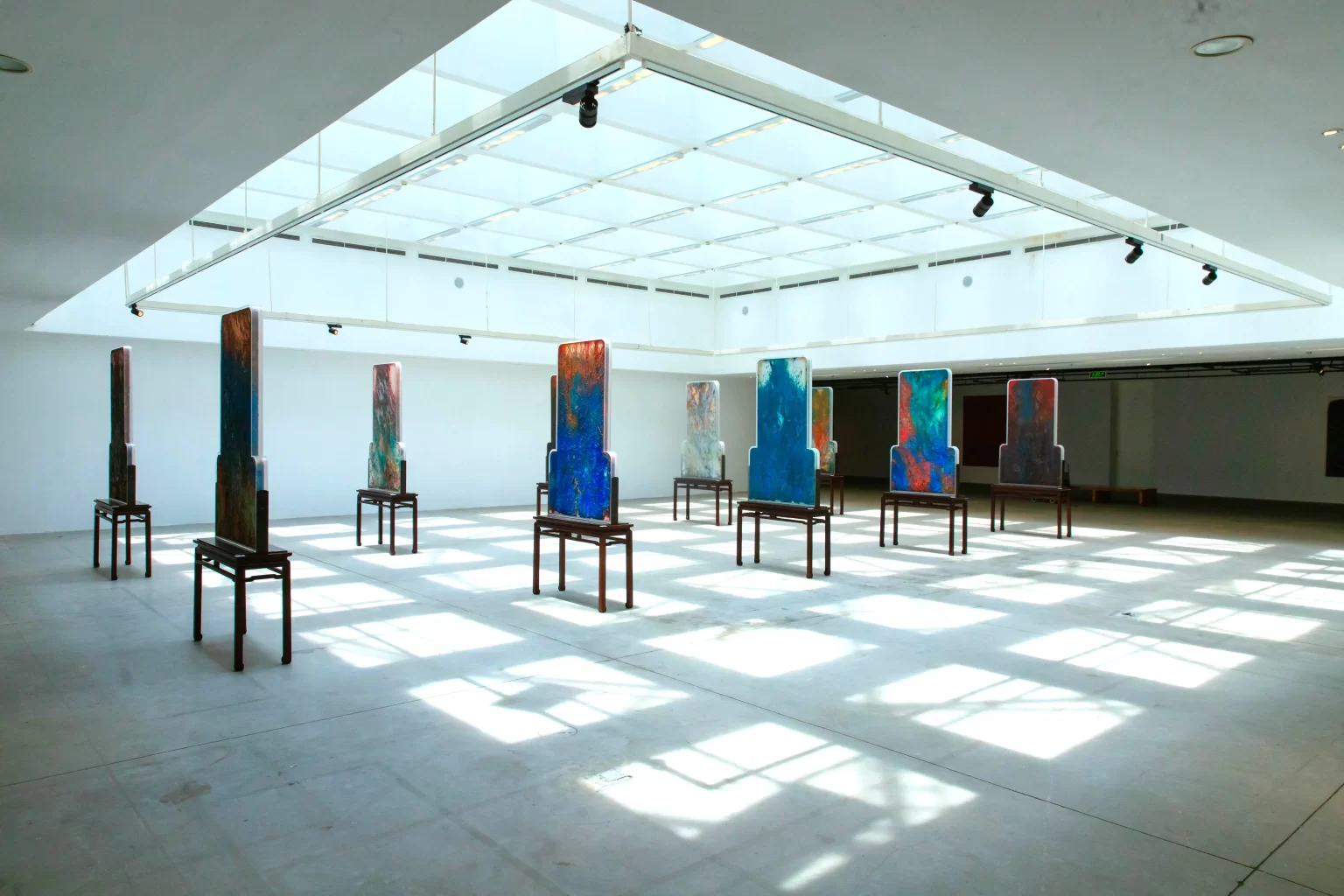
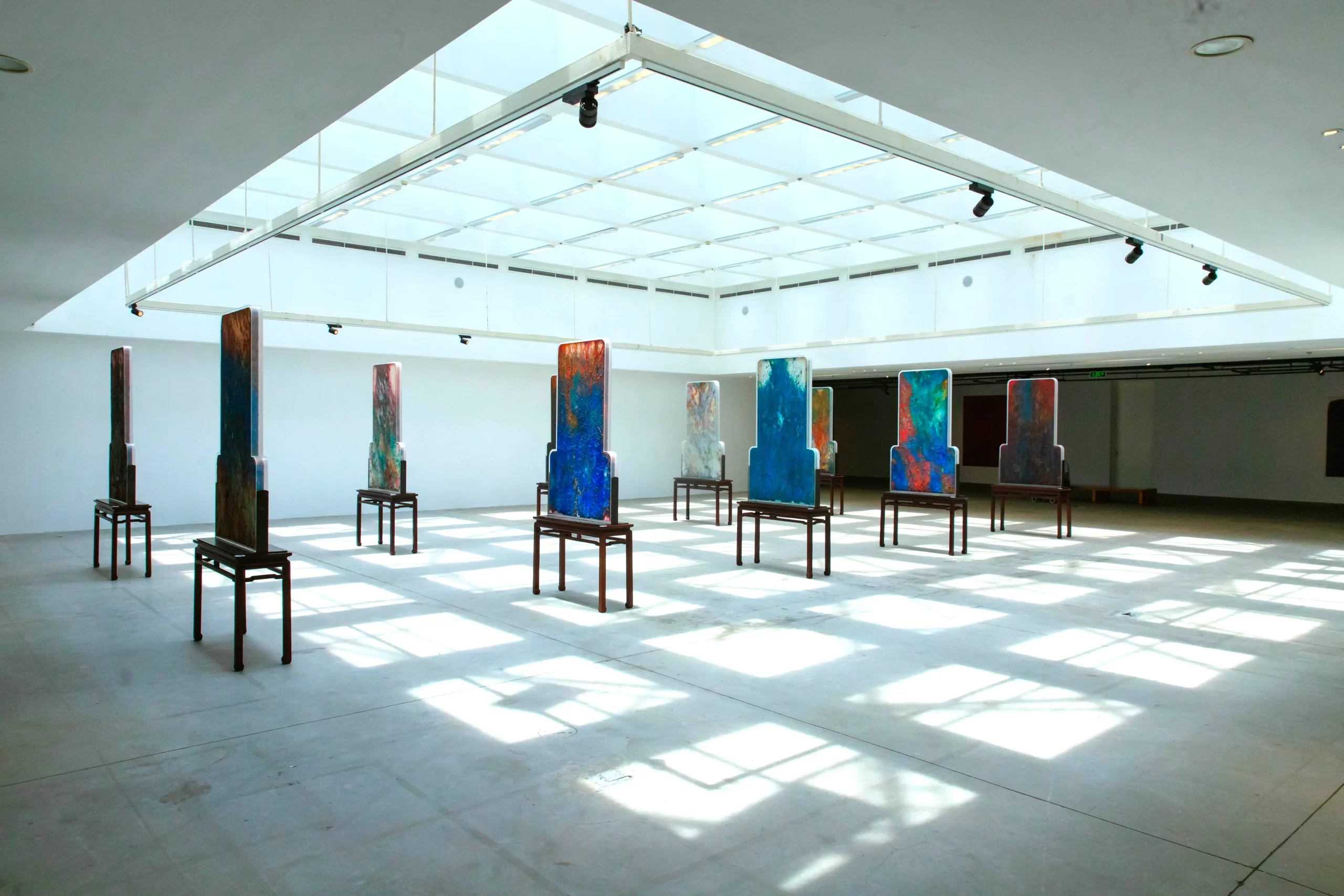
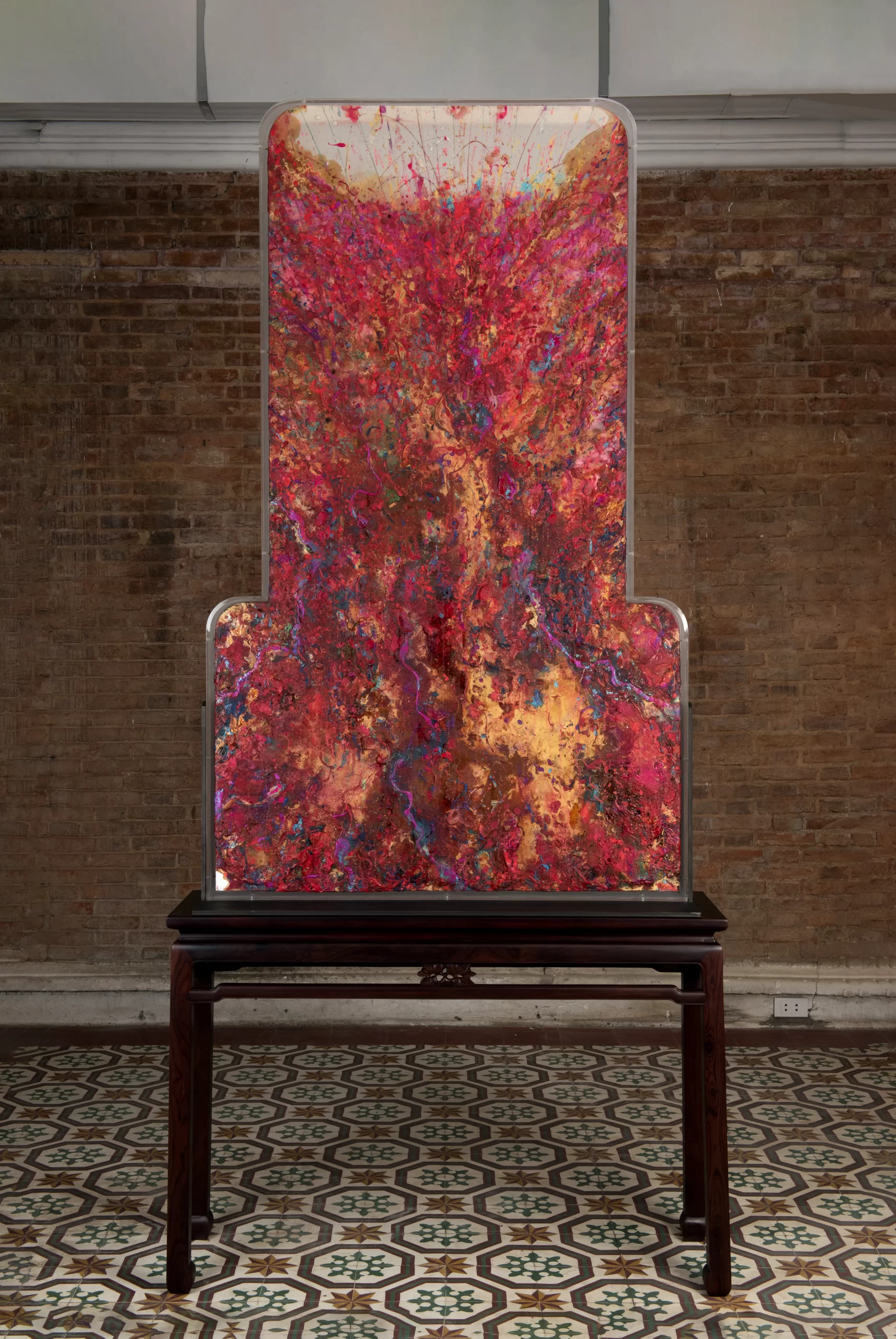
From the ancient stone stele form of the initial pieces showcased in my solo exhibition with Galerie Quynh, titled Landscape / Mindscape, to about three years of continued exploration and research into form, material, surface, and shape, the artworks for the exhibition Behold the Mountains, the Waters, the Clouds finally came into being. It was Li Bai’s jueju quatrain Sitting Alone on Jingting Mountain that suggested the spatial arrangement in which I would display the works:
“All the birds have flown high away
A lone cloud drifts idly on by
We gaze at one another, never tiring
Only Jingting Mountain.”⁴
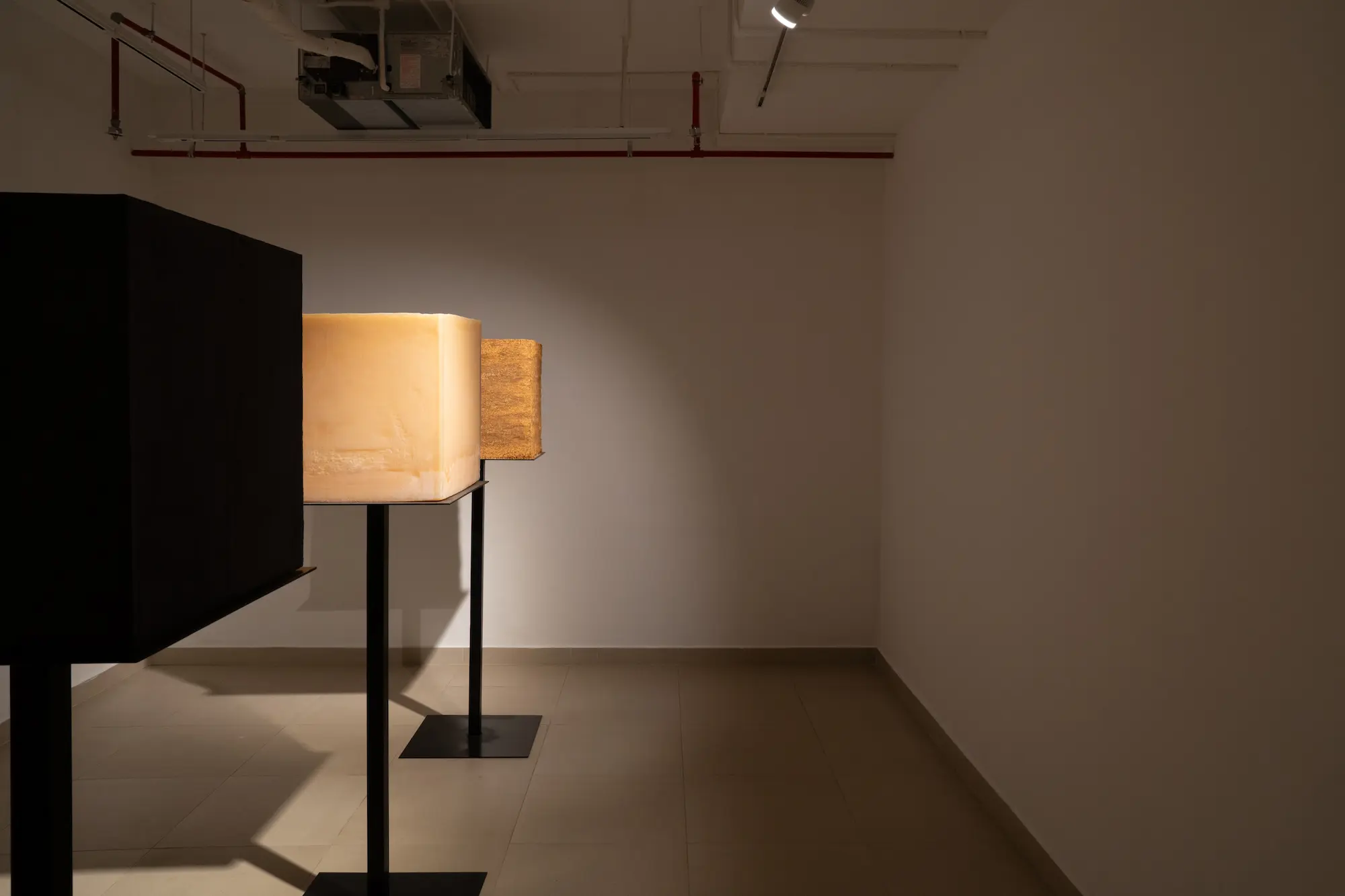
At the historic mansion at 29 Ton That Thiep Street, the works were arranged in two vertical rows, evoking the successive ridges of near and distant mountains. On the acrylic panel behind each work, a classical verse – presented in both its original language and translation – was laser-engraved into the surface. The translucency of the natural silk in the details left visible on the front, combined with the frosted acrylic behind, caused the light and colour visible from the reverse to shift. These ripples moved slowly through the exhibition space as the direction of the natural light outside changed.
As a contemporary artist, you devote considerable time to classical poetry and to collecting antiquities, especially “things that are no longer whole”, as you once put it. How does this dialogue between painting and poetry inflect the dimensions of time and heritage for you?
The American poet Naomi Shihab Nye opens her poem Kindness with the following lines:
“Before you know what kindness really is
you must lose things,
feel the future dissolve in a moment
like salt in a weakened broth.
What you held in your hand,
what you counted and carefully saved,
all this must go […].”⁵
To truly understand many aspects of life, sometimes “you must lose things”. I feel deeply the truth of what she wrote. Time is what leaves us with the greatest sense of regret. In poetry, the splendour of language and its timeless values allow us to believe that consolation remains possible. It is through this nobility that poetry makes us feel more grateful, and life more worth living.
The American historians Will and Ariel Durant wrote with great precision about history: “A knowledge of history may teach us that civilization is a co-operative product, that nearly all peoples have contributed to it; it is our common heritage and debt”.⁶ Heritage is something that may no longer belong to a single people or nation, as the Durants articulated for us. I believe that painting and poetry in East Asian culture have always been parallel dimensions, moving alongside one another. Today, we are fortunate and grateful to those who came before us, because we can encounter the heritage of literature and poetry from many different historical periods in such richness and abundance.
The ancients spoke of poets as masters of conceiving profound emotions upon encountering a scene. Your landscape paintings reflect not only the vistas, but also the affective resonances you experienced through the works of Tan Da, Chu Manh Trinh, Li Bai, Cui Hao and others. Many readers will surely wonder: between the verse and the image, which inspiration comes first, and how does it shape the other as you create?
I believe they occur instantaneously, in the same space and at the same moment. Poetry and image move alongside and complement one another. In those fortunate moments when we fall silent before a scene, poetry is already present within it, and the reverse is equally true. More than a thousand years ago, the literatus Su Shi of the Song dynasty observed Wang Wei: “To savour Mojie’s⁷ poetry is to find painting within poetry; to contemplate Mojie’s painting is to find poetry within painting.”
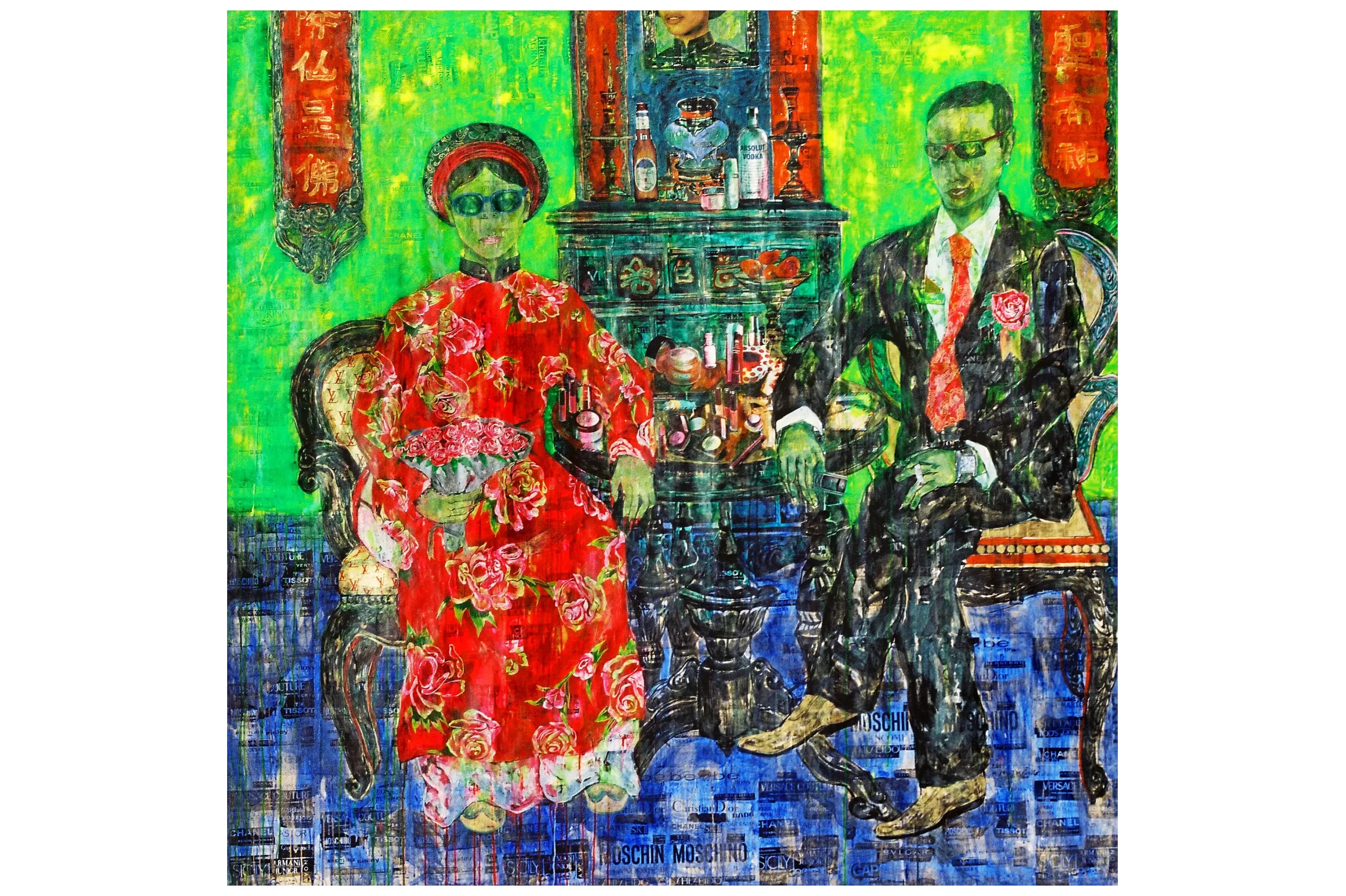
During the first decade of your practice, your work often responded to current affairs, reflecting collisions between traditional structures and modern society, as in the series Bride and Bridegroom (2004–2011) and Not Memory (2008–2010). These structures gradually receded in Vietnam’s Landscapes (2010–2014), before yielding entirely to more abstract, introspective and poetic expressions over the past ten years. How do you envision evolving your practice into the future?
Everything lies ahead. I remain curious, always exploring, and I continue to await whatever is new and challenging along this journey.
Let me end my answer to this final question with the last two lines of Li Bai’s poem:
“We gaze at one another, never tiring
Only Jingting Mountain.”
Departure, perhaps, is also a form of return over the long course of an artistic journey. Once we have crossed the mountain, perhaps all we will see is still just mountains.
Thank you for this conversation!
Words: Nhật Anh
Translation: Art Nation
[1] Will Durant, The Story of Civilisation I: Our Oriental Heritage, Simon & Schuster (1954), p. 713.
[2] Bai Juyi, The Lake in Spring 春題湖上, English rendering by Art Nation’s editorial team.
[3] The courtesy name of the poet Bai Juyi.
[4] Li Bai, Sitting alone on Jingting Mountain 独坐敬亭山, English rendering by Art Nation’s editorial team.
[5] Nguyen Duc Tung, For whom is poetry, Writer’s Association Publishing House (2015), p. 138.
[6] Ariel Durant and Will Durant, The Lessons of History, Simon & Schuster (1968), p. 31.
[7] The courtesy name of the poet Wang Wei.