Đọc phiên bản tiếng Việt tại đây.
Looking back on more than 36 years with tranh kieng (southern Vietnam’s reverse glass painting), did you ever think that your years as a combat engineer in the Cambodian theatre of war had trained the meticulous painter Tran Van Nhanh we see today?
I think everything in life comes down to affinity and fate. Around 1976–77, I studied portrait painting in the Cau Mat area of District 8, Ho Chi Minh City. At the time, I only thought of learning a trade to make a living. Then in 1982, I enlisted and was assigned to the 549th Engineering Regiment. Because I could draw, I was posted to the office that made teaching aids for weapons training and drew tactical maps.
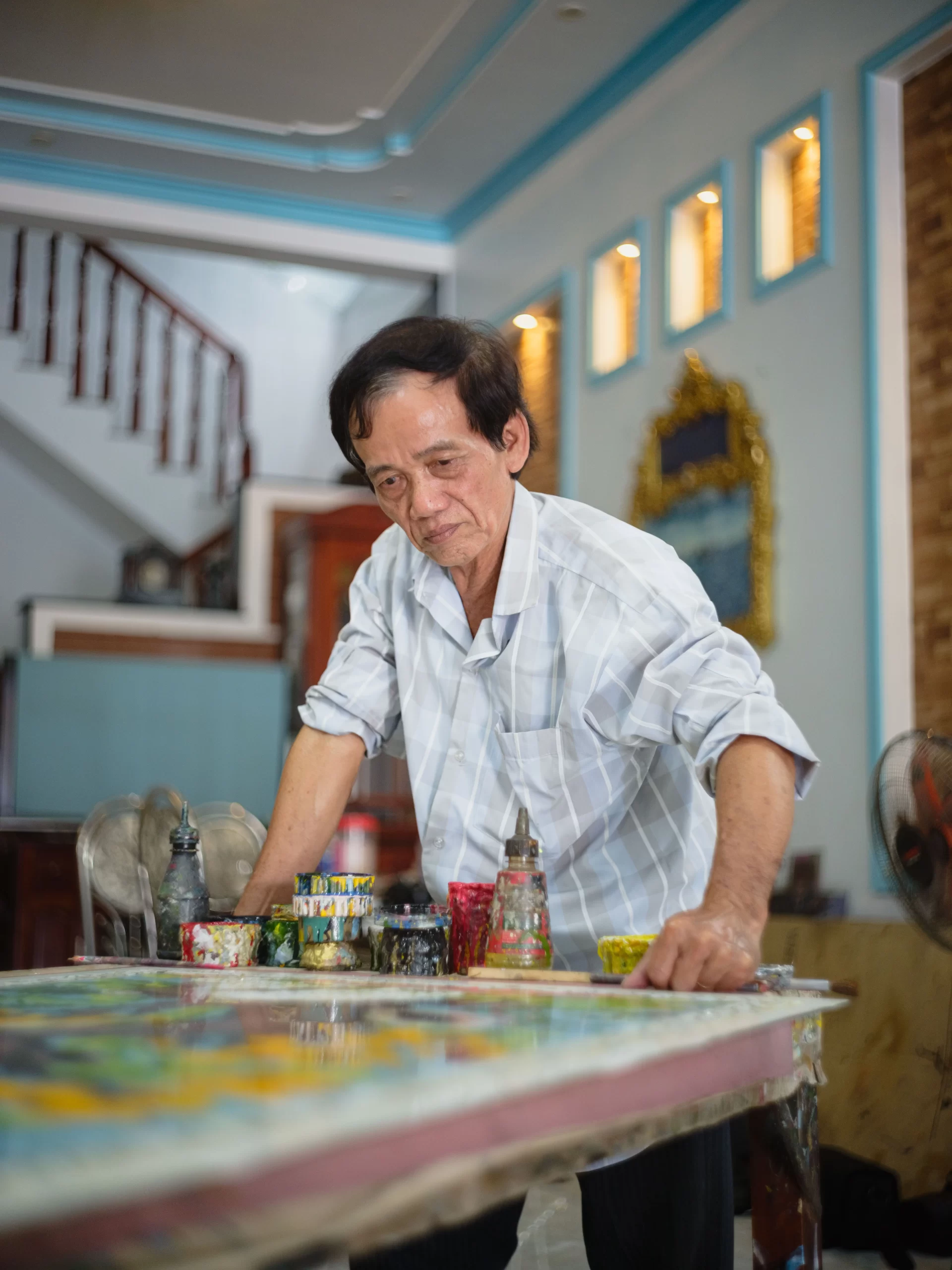
A combat engineer’s drawing work demanded absolute precision: one tiny mistake could throw everything off course. That discipline, that exactitude in every line of a diagram, somehow got into my blood. When I was discharged and returned home in the late 1980s, at a time when the economy was still difficult, I took whatever painting jobs I could find. From wall murals to painting on fabric, until the day I encountered tranh kieng, I realised I could not approach it carelessly. The meticulousness of a soldier helped me survive in this trade, because with tranh kieng, one wrong line on the back can ruin the entire work on the front.
There is a very moving story about how you kept the memorial portrait of your comrade’s father from 1986 all the way until 2023. What made you treasure someone else’s keepsake for so long?
It was affection; for soldiers, nothing is more precious than comradeship. Just before I was demobilised in 1986, Dien asked me to enlarge a photograph of his father to make a memorial portrait. The order to return home came so suddenly that I brought the photograph back to Vietnam, intending to finish the painting and send it to him. But in those days communication was difficult. I was back in Long An, he was far away in his hometown, and then decades slipped by.
All that time, I kept the photograph carefully in my old toolbox. I thought: this is a memorial keepsake, something sacred to another family. Once I had accepted it, I had the responsibility to return it. It was not until 2023, with my son’s help connecting online, that I met Dien again. On the day I handed the photograph back, seeing that my friend was still well, and that my wish after 37 years had finally been fulfilled, I felt very light inside. Painting has fed me, but it is feelings like these that make me see the nobility of my trade.
Tranh kieng is a “reverse” craft. How did you teach yourself this reverse-glass painting technique when no one in Can Duoc was doing it at the time?
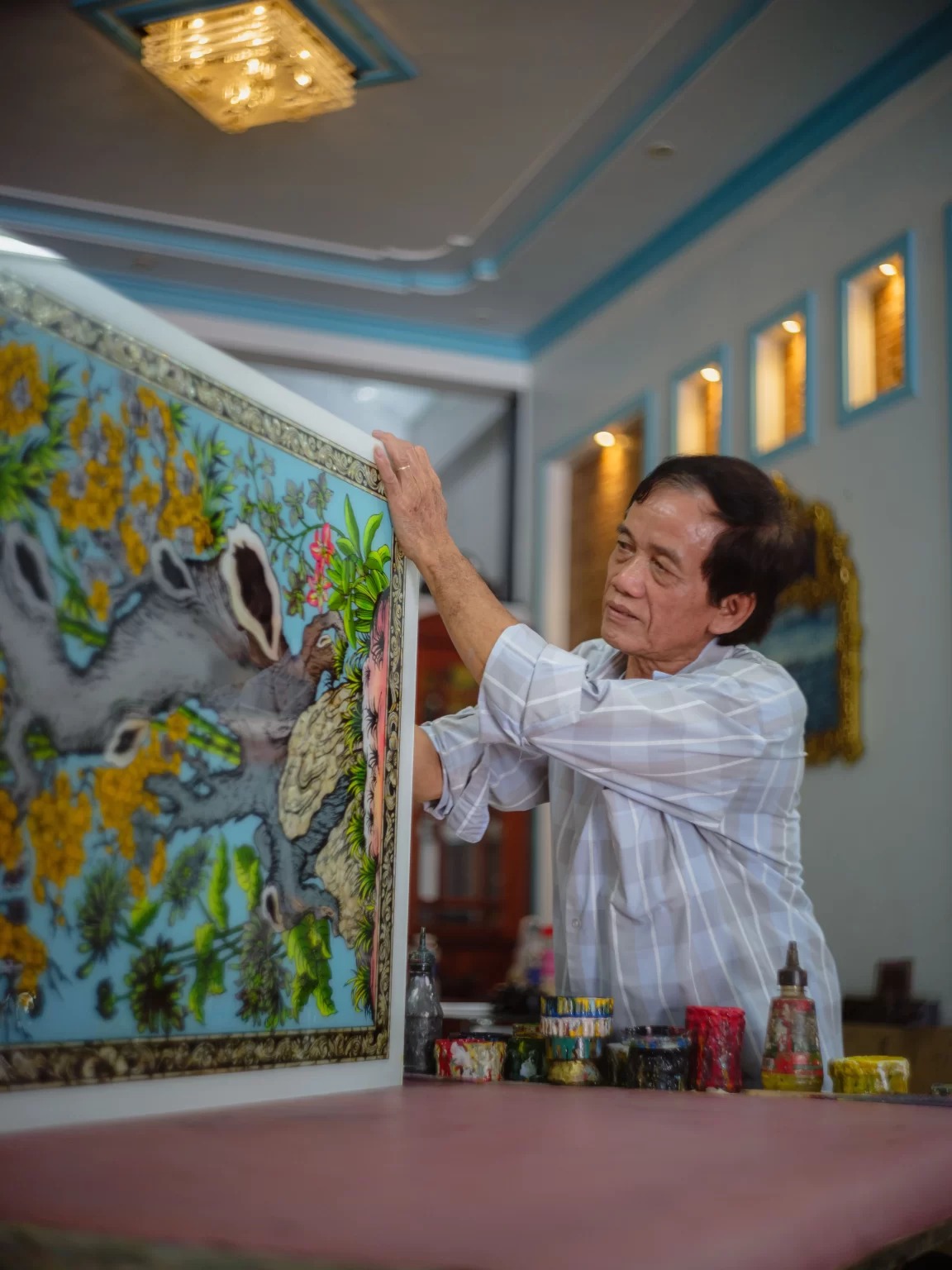
Back then, I mainly observed tranh kieng works depicting houses with lien doi (paired calligraphic couplet panels), mostly made in Cho Lon. When customers brought old paintings in for repair, I would remove the backing to see how people had drawn the lines and applied the colours. Tranh kieng is exacting because you paint on the back while the viewer looks from the front. The finest, brightest details have to be painted first, before the background layers are built up behind them. I taught myself in those days, collecting old glass, scraping it clean and painting again. No workshop taught this trade, especially not to an outsider. Glass was expensive then, too; if a family had an old damaged painting, they would bring it to me to repaint.
Many times, halfway through a piece, I had to keep turning the glass over again and again to check how the colour was spreading, whether it was even and pleasing to the eye. The colours had to be harmonious, not too harsh, but with enough depth. I also had to make my own tools. Brushes sold at the market were not always right, so I trimmed the hairs myself and bent the handles to create specialised brushes for fine outlines or soft colour washes. People in my trade believe in the saying: “Master one craft and it will bring you honour.” If you choose the craft as your means of living, you have to live and die with it, to understand it as you understand yourself. I think perhaps the craft chose me.
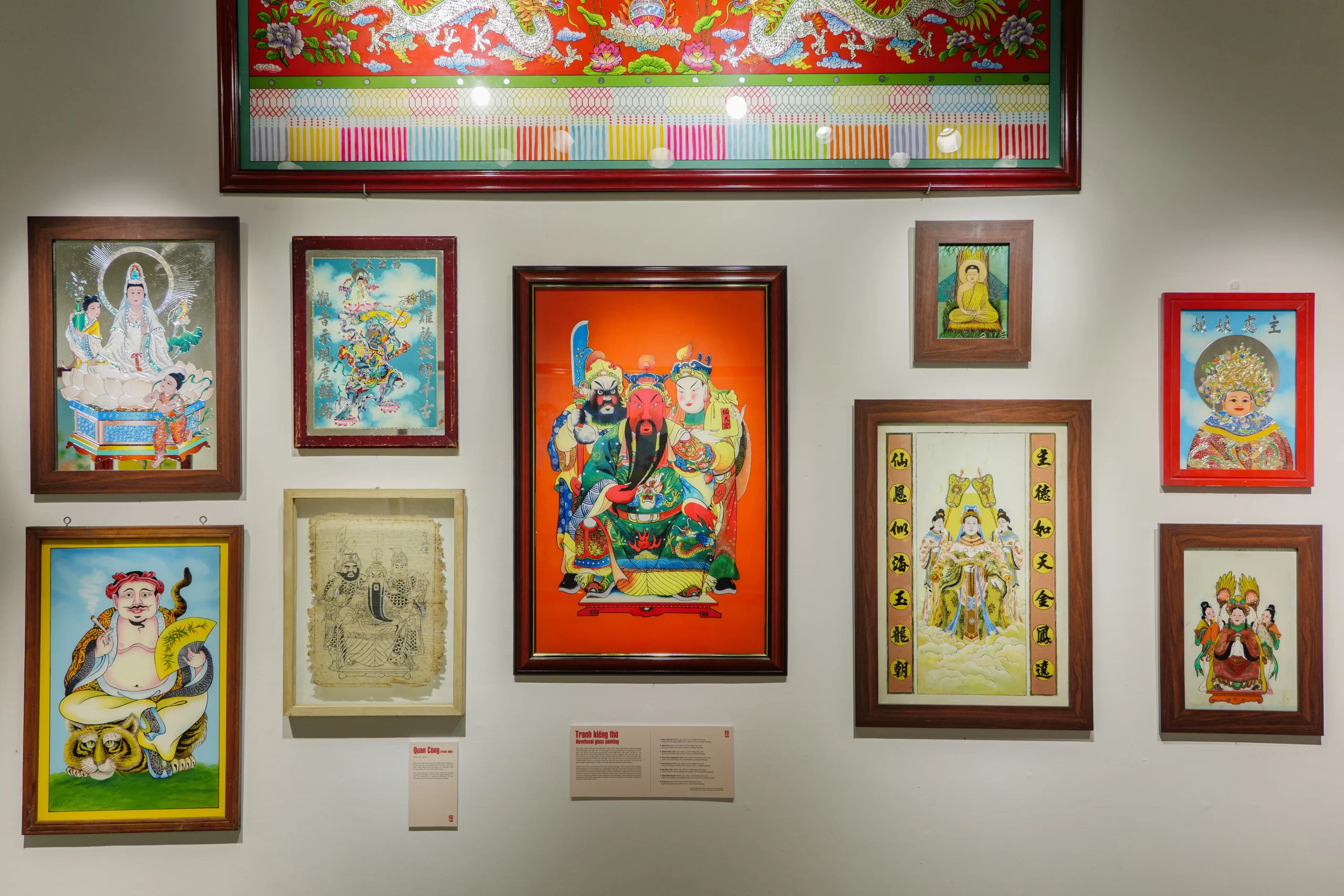
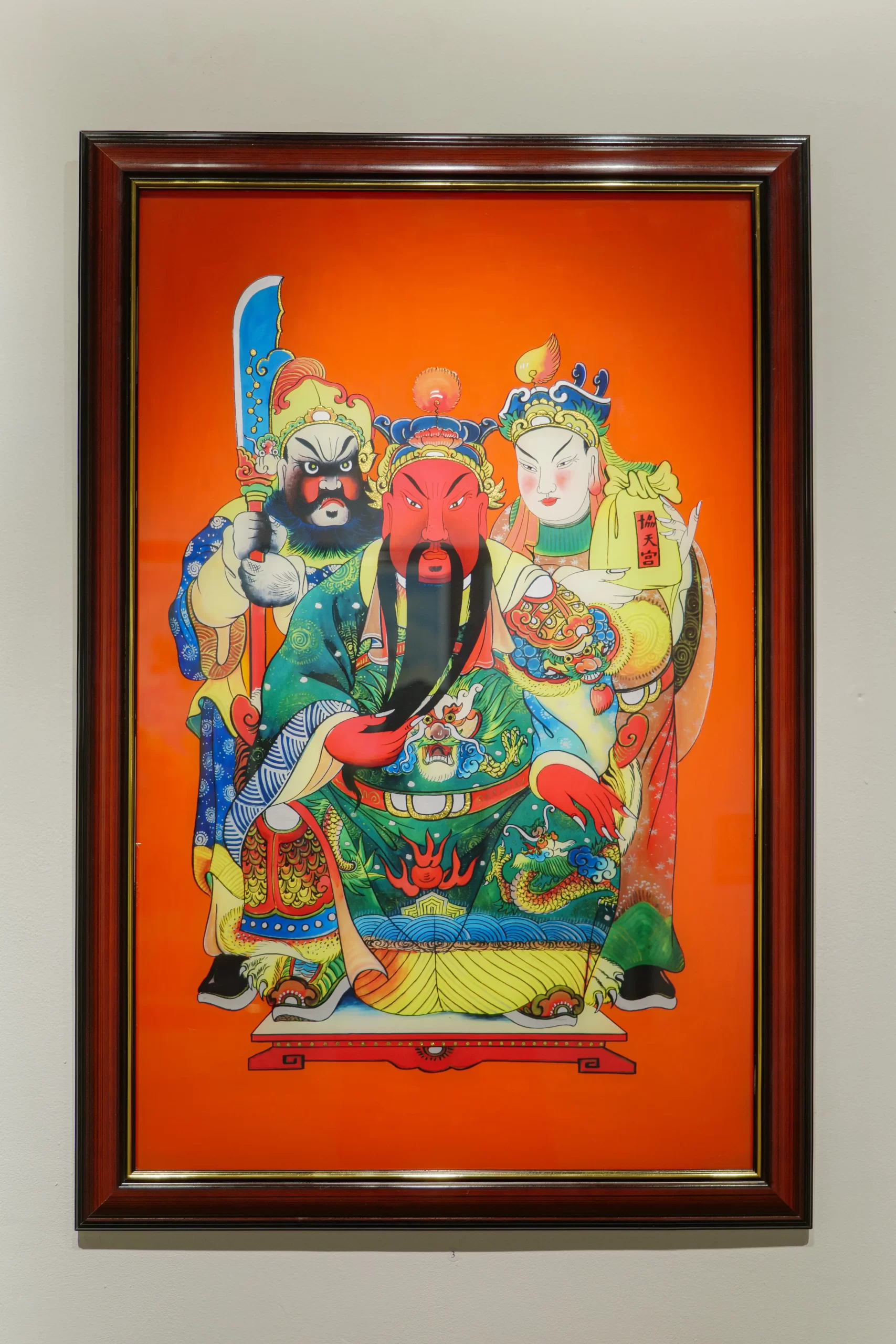
You once mentioned reconciling traditional models with new tastes. How do you make altar paintings with mother-of-pearl appliqué, vehicle decals or glitter retain their antique spirit while still looking beautiful in a modern way?
I always respect traditional models, because they are the tradition left by earlier generations. But customers’ tastes change from one period to another. I study those models, then improve them with mother-of-pearl appliqué, vehicle decals and glitter to give the painting more shimmer and refinement. If each era favours different designs, then one’s creative practice must also have a sense of the times.
Before I put brush to glass, I often read about the story or figure I am about to depict. When painting a deity or a saint, you have to find a way to breathe life into that figure. A successful painting is one in which the customer can see majesty, protection, and the essence of a figure in their eyes. That is why I never work dishonestly. To make something for others is to make it for myself. If I cut corners, it shows; especially with tranh kieng, if you are careless, the colour clumps and the image becomes stiff.
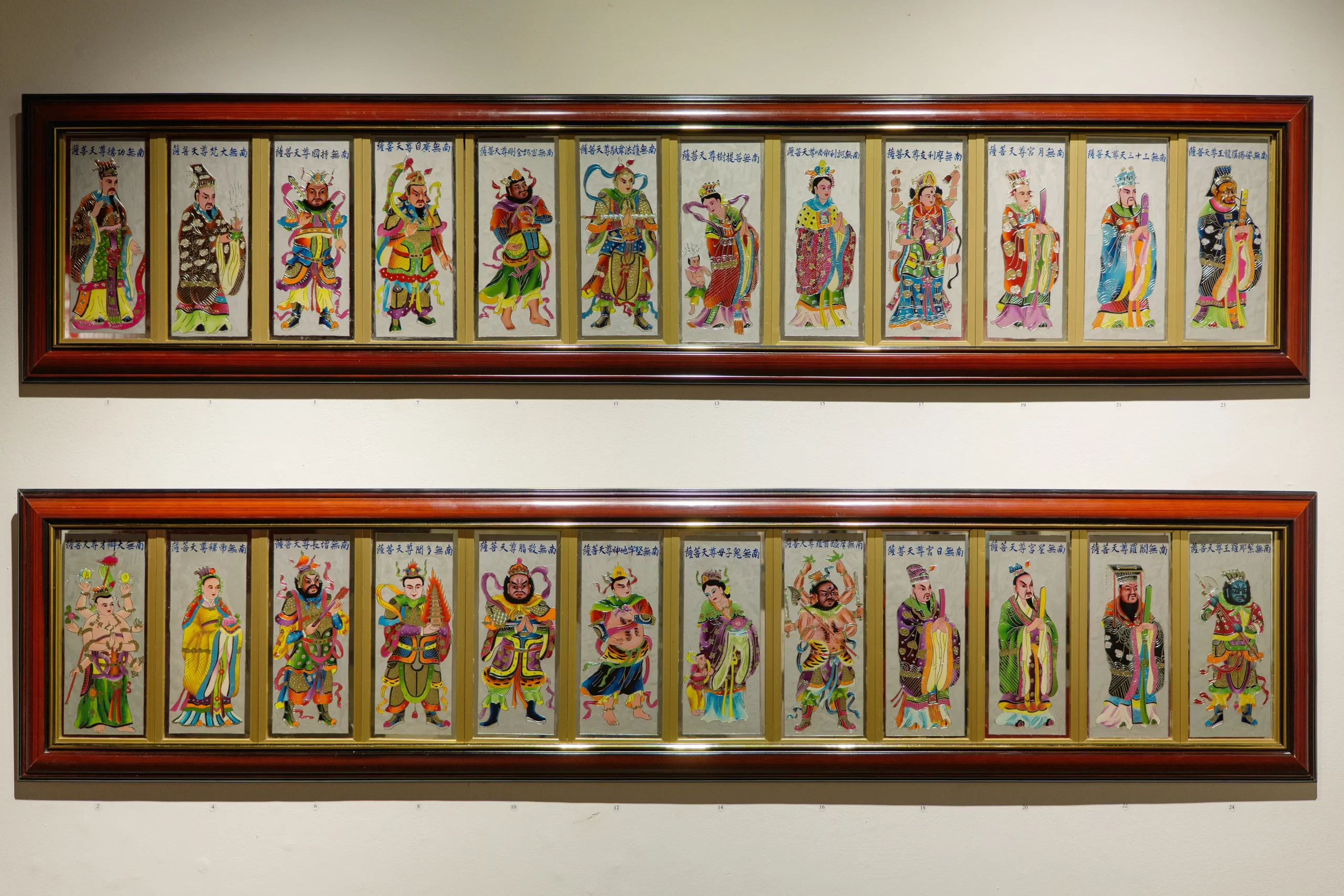
Recently, the community was surprised to learn that you were the artist behind the reconstruction of the Hue Imperial Court tranh kieng featured in the exhibition “Nam Su Hoa Kieng”. How did that opportunity come about?
It was truly the greatest challenge of my working life. A group of young people devoted to Hue culture came to find me. They had documents, images and enthusiasm; I had experience in the craft.
To be honest, when I heard about Hue Imperial Court tranh kieng – a kind of painting that, in the old days, had to be ordered from China – I felt some pressure. But then the professional instinct rose up in me. I wanted to test how far my ability could go. When I succeeded, the feeling was immense happiness. It was like overcoming myself, and also, in some small way, joining the young people in reconnecting a cultural thread that had once been broken. At this age, to be able to do that makes me feel fulfilled.
As someone who has practised the trade across many decades, do you feel saddened to see traditional hand painting gradually being replaced by mass-produced machine printing?
Of course I feel regret. Hand painting has been part of the culture of the South for more than a century. Machine-printed images are fast and cheap, but they have no soul; every sheet looks the same. Hand-painted works have their own character, including human irregularities, and it is precisely those qualities that create artistic value.
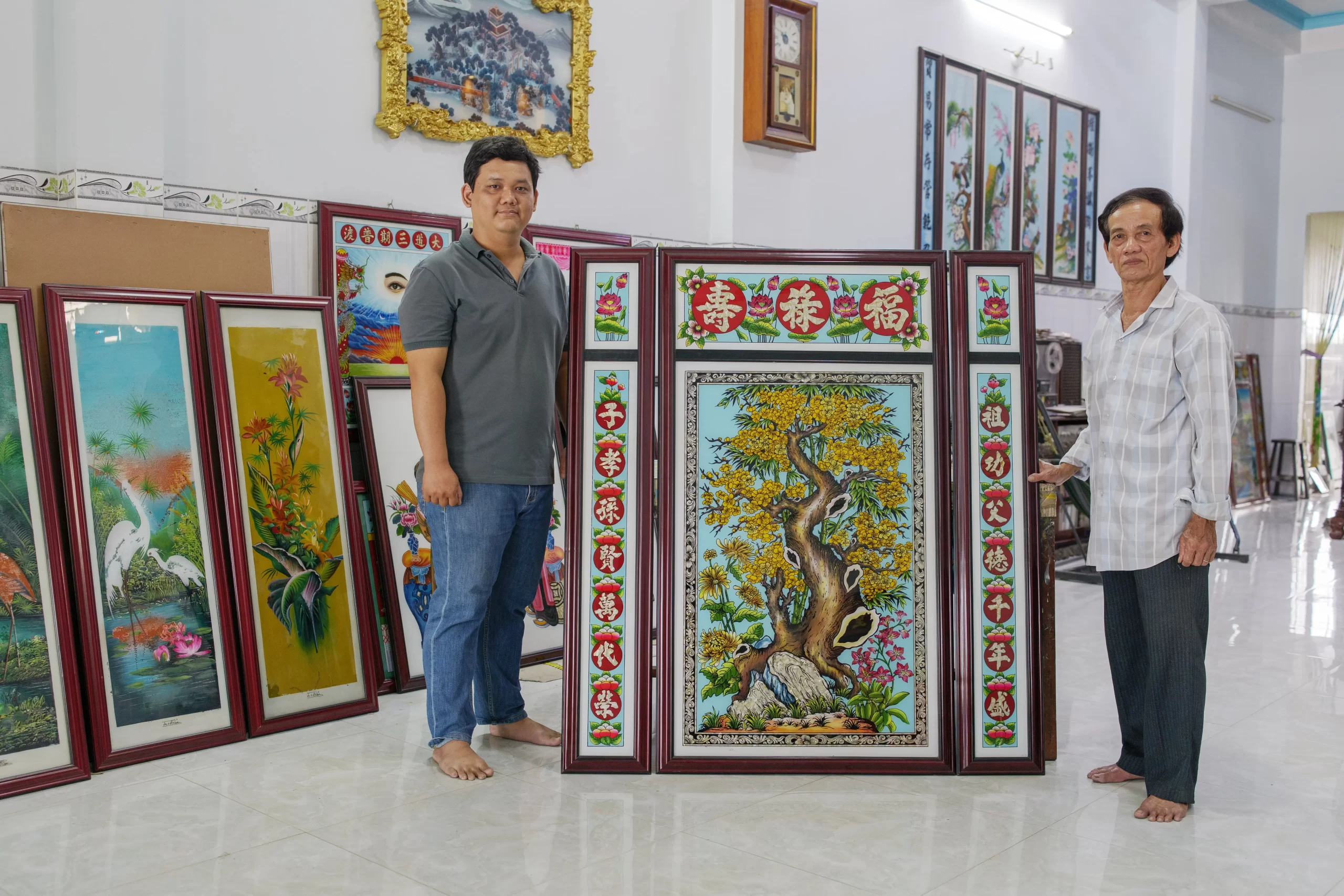
That said, I’m also happy that younger people are taking interest in traditional culture again. My son is also following this trade and helping me. I always tell him: “As long as there are still customers, the culture remains.” If we keep working meticulously and honestly, customers will not abandon us. The customer’s money is a result of their sweat and tears; when we take it, we must give back with our own conscience and virtue. This trade allowed me to raise my children and send them to school, so I treasure it deeply. I do not even know who the founding master of tranh kieng truly was, but painting with sincerity is also my way of showing gratitude to those who came before me.
If you had one message for young people hoping to pursue traditional crafts, what would you say to them?
I would only say this: be patient. This applies to any craft, but especially to traditional craftwork – nothing can be rushed. Art is a lifelong process of cultivation. If you put your whole heart into it, the work will eventually speak for itself. Do not be afraid that traditional crafts will disappear, for anything bound to the identity and soul of a people will always find its place.
Thank you, Mr Nhanh, for your invaluable reflections. We wish you good health as you continue preserving this folk tradition.
Words: Nguyễn Huy
Translation: Art Nation