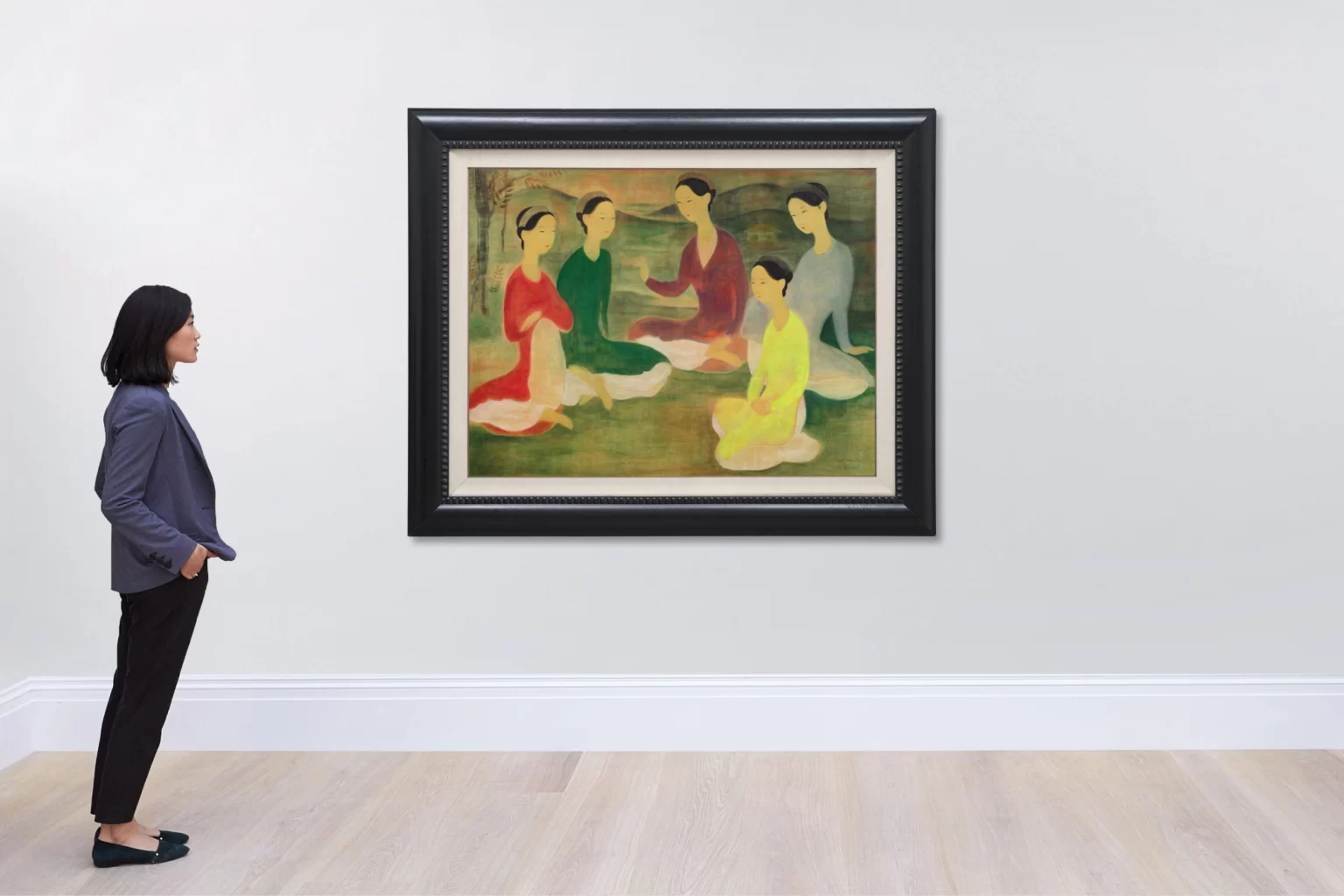
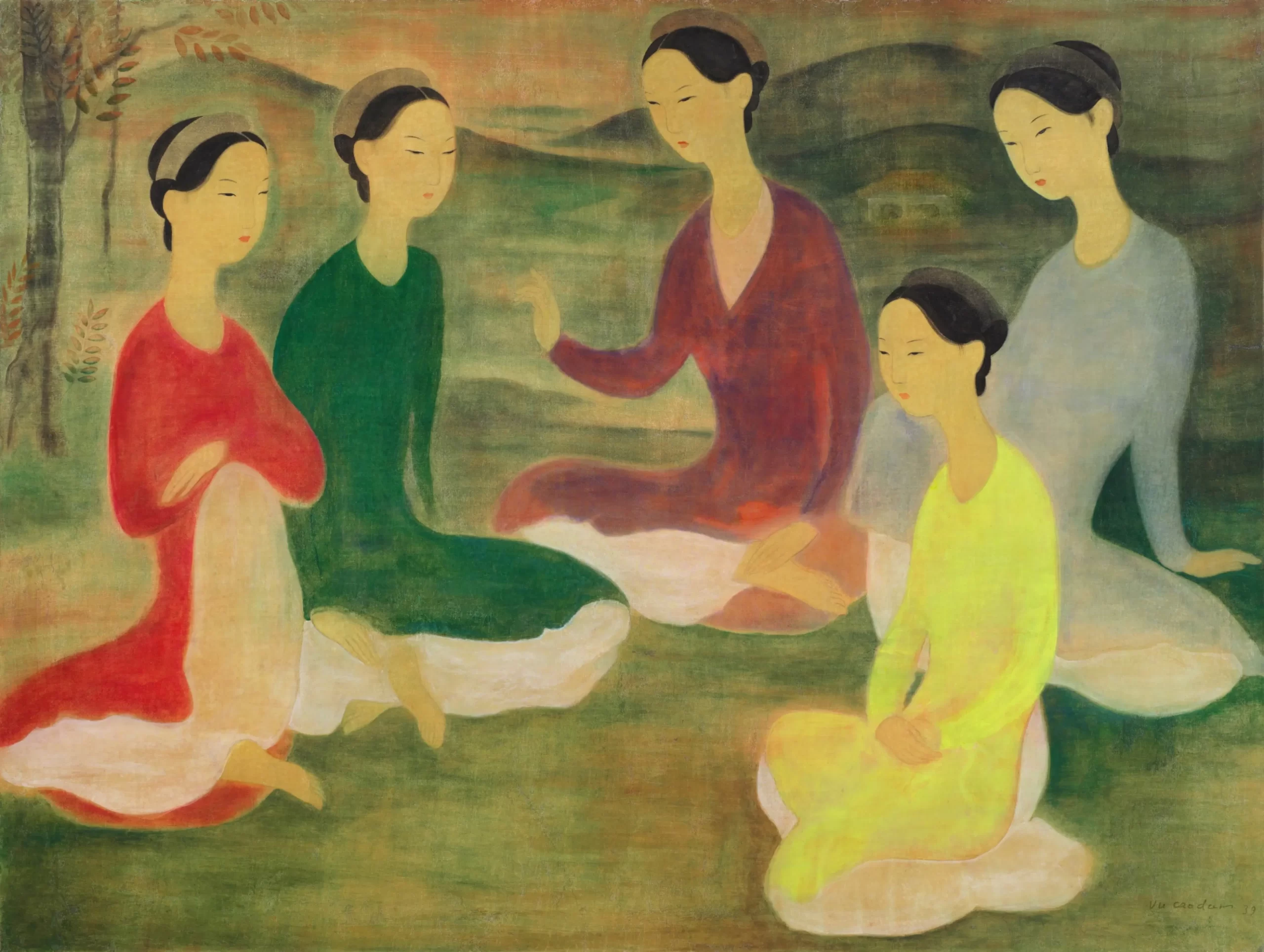
Thank you, Ace Le for joining us, and congratulations to Sotheby’s on these unprecedented auction records. From your perspective as a researcher, what were the fundamental factors behind the record US$3.69 million achieved by Elegant Gathering in the Garden by Vu Cao Dam? Was it its monumental scale, its documented museum exhibition history or the current market situation the decisive factor?
Probably all of the above. But regardless of market fluctuations, the most important consideration when we vet and value an artwork remains its historical and art-historical significance. Accordingly, even at the estimation stage, Elegant in the Garden was already the highest-estimated Vietnamese artwork in history, with an estimate of HK$8–19.6 million. It ultimately hammered at an astonishing 51% above its high estimate. In terms of provenance, the painting has a transparent history of ownership. It was exhibited at the Indochina Economic Agency (Agence Économique de l’Indochine, Agindo) in the very year it was created, with authenticated archival photographs documenting its exhibition history.
In terms of artistic value, this is an exceptionally rare, monumental silk masterpiece by Vu Cao Dam. It demonstrates the artist’s talent, who was originally trained as a sculptor, while its subject matter is intimately connected to his emotional life and family on the eve of the Second World War. Taken as a whole, Elegant Gathering in the Garden is a consummate masterpiece that encapsulates Vu Cao Dam’s inner world during a turbulent period of his life abroad.
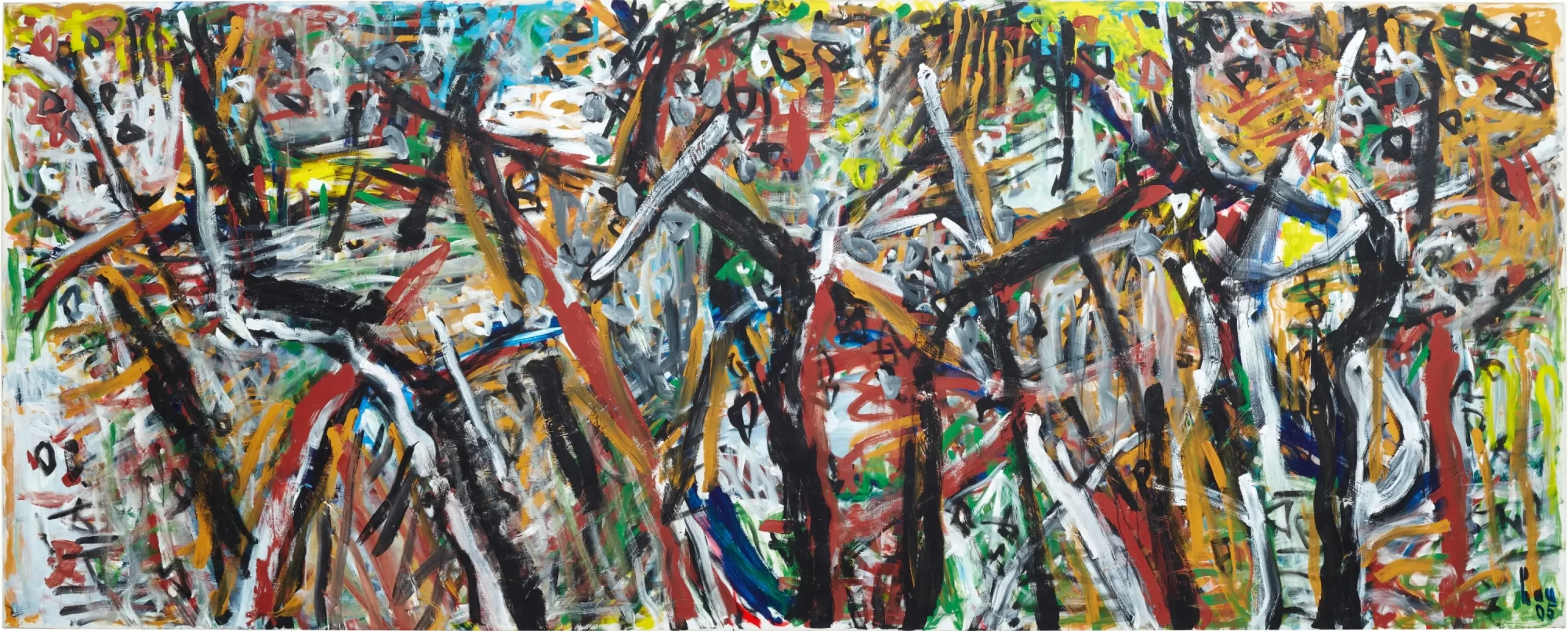
Alongside Vu Cao Dam’s achievement, the US$360,000 milestone reached by the renowned painter Tran Luu Hau with Park 15 has brought out considerable excitement. Does this suggest a shift in collectors’ preferences? Has the time come for paintings by the Resistance artist generation to establish a new price benchmark commensurate with their significance, rather than remaining in the shadow of Indochina-era painting?
This is a market development that was bound to happen. With the repatriation movement for significant artworks having gathered momentum over the past two decades, the supply of Indochina-era paintings remaining overseas will inevitably become scarce. The passage of time also gives both researchers and the collector community the necessary distance to identify the artists and works of significance.
The Resistance generation immediately followed the Indochina generation. Their post-Renovation works are highly individualistic, employ contemporary modes of expression and benefit from substantial documentary records against which they can be assessed. I discuss these characteristics in greater depth in the essay I wrote specifically about Tran Luu Hau for this auction. The new record established by Park 15 is both a welcome and necessary development. An art market achieves long-term sustainability when liquidity is distributed across different historical periods rather than concentrated in a single segment.
In your commentary on the auction, you made a particularly interesting observation about the composition of bidders, noting a healthy shift towards domestic participation. Could you elaborate on the profile of the new generation of Vietnamese collectors who participated in this sale? What motivates them to spend millions of dollars bringing Vietnamese masterpieces back from overseas?
I must respect the confidentiality of individual collectors, but I can certainly speak about broader trends. Over approximately the past 15 years, positive developments in Vietnam’s infrastructure have created the conditions for a new generation of domestic collectors to emerge. These include economic growth, the gradual establishment of a policy framework for the arts, and increasing attention to academic institutions and arts education. Together, these developments have fostered a generation of collectors with the financial resources, art-historical knowledge and long-term vision required to repatriate significant artworks from overseas. Naturally, when confronted with a masterpiece of Vietnamese painting, Vietnamese collectors are likely to feel a particularly strong emotional connection. That connection can translate into greater determination when bidding. Compared with two decades ago, Vietnamese buyers now overwhelmingly outnumber regional and international bidders competing for Vietnamese paintings.
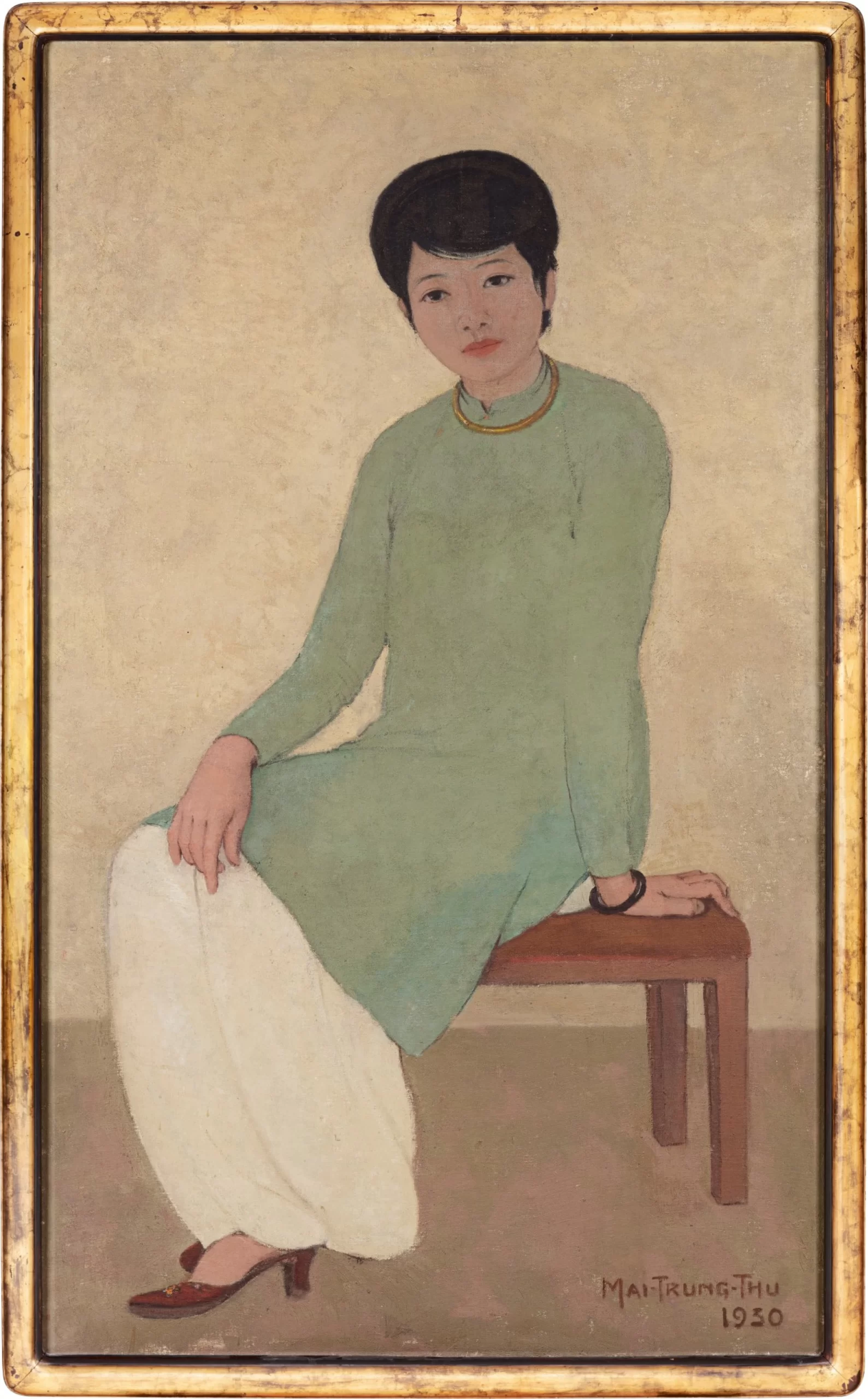
Mai Trung Thu, “Portrait of Madam Phuong (Portrait de Mademoiselle Phuong)” (1930), oil on canvas, 135.5 × 80 cm. Photo: Sotheby’s.
A 100% sell-through rate, with all 18 artworks finding buyers, is certainly a remarkable result. From a market perspective, however, could this growth also entail risks that deserve attention? How can the market maintain its integrity and long-term sustainability amid the current macroeconomic conditions?
At a reputable auction house such as Sotheby’s, sell-through rates typically fall within the 90–100% range because consignments have already undergone a rigorous vetting process. In recent Sotheby’s auctions, the Vietnamese segment has consistently achieved the highest sell-through rates in the region. This provides a much-needed foundation of confidence for consignors and buyers alike, while reinforcing the auction house’s role as an intermediary. However, if a 100% sell-through rate were to occur regularly at smaller auction houses lacking specialist expertise in Vietnamese painting, particularly when the works themselves raise questions, it could be a warning sign of questionable practices. One possible example would be sham transactions designed to legitimise artworks of dubious quality.
With four of the five highest auction records for Vietnamese paintings held by Sotheby’s, the auction house occupies a commanding position in this segment. As their Senior Consultant, how would you assess the importance of international auction houses engaging local specialists to unlock and shape Vietnam’s art market?
I have had the honour of being the first Vietnamese professional appointed by a leading auction house such as Sotheby’s as curator and Senior Advisor for Vietnamese art, a role I have held since 2021. Over the past five years, several other organisations have begun adopting similar strategies. This is a particularly clear indication that the international market has recognised both the importance of Vietnam’s art market and the expertise of Vietnamese professionals. Authentication and curation are the backbone of an auction house. An international specialist who cannot read research written in Vietnamese, or who lacks access to a network of researchers capable of reading Nom script, will struggle to fulfil the authentication responsibilities involved in selecting works for auction.
Looking ahead from the milestones established at this year’s autumn auction, how do you envisage the Vietnamese painting market developing over the next three to five years? Could the capital flowing into record-breaking works by the Indochina and Resistance artists generate a ripple effect, creating opportunities for Vietnamese contemporary artists to achieve breakthroughs on the international auction market?
I am confident that Vietnamese art will continue to flourish across the Indochina, Resistance artists and contemporary segments. As I often explain in my lectures on the art market, Vietnamese artworks occupy a distinctive position. On the one hand, Vietnam shares a colonial history with the rest of Southeast Asia. On the other hand, Vietnamese art possesses an aesthetic language that resonates with audiences across the Sinosphere. Therefore, it has considerable potential to extend its reach, both domestically and internationally. This provides a foundation for developing strategies aimed at building long-term market liquidity.
Words: Luu Nguyet Linh – Ngay Nay magazine
Translation: Art Nation