Đọc phiên bản tiếng Việt tại đây.
Your work maps out the way personal stories and memories are stored in everyday, re-purposed objects through using kinetic installations. What role do kinetic and sound elements play in your practice?
In my practice, movement introduces temporality and instability into everyday objects. A chair, a table, a cabinet, a piece of wood, or a household material can hold traces of particular ways of living. Memory is never static; it changes depending on when and where you encounter it, and who you have become since the memory happened. Kinetic works allow me to introduce this instability into the objects themselves. They can repeat in actions, but that repetition is never completely neutral. There is rhythm, duration, interruption, and anticipation. By removing an object from its familiar context and making it move, sound, or behave differently, it is interesting to witness what happens to these recognitions.
Around 2024, I started incorporating musical elements much more consciously into my work, becoming more aware of how sound, the body, and the movement of the body based on sound can move through a space. For me, sound functions almost as “glue” and “clue”, inviting and triggering something familiar before your consciousness even takes hold. A familiar sound could evoke personal memories while also holding a collective recognition. There is something powerful, even romantic and democratic, in the way people can sing, scream, or share the same song. I thought of karaoke as a good example: it is completely ordinary and entertaining, but could deeply move a group of people sharing the same language and melody.
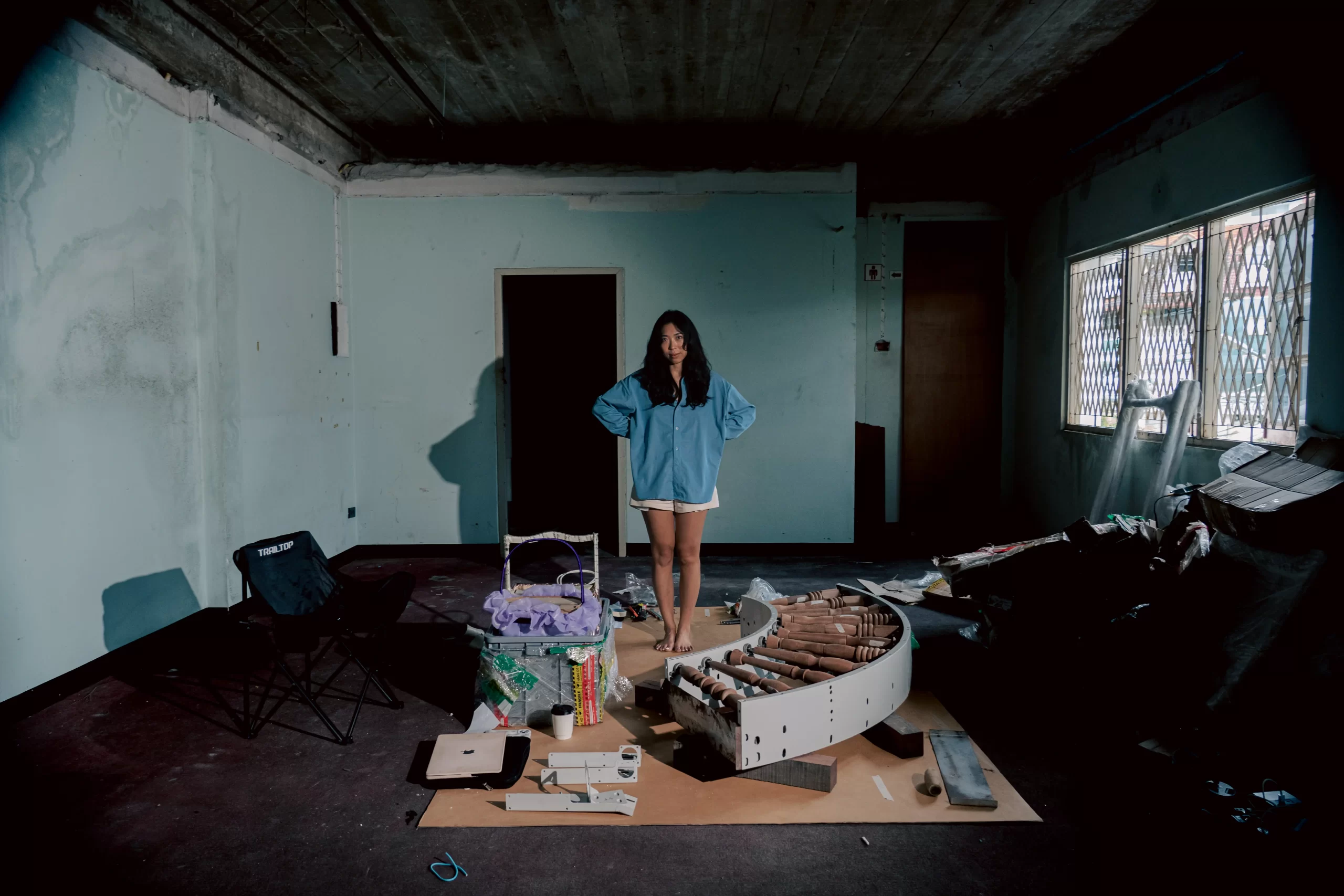
This “moment of recognition” is a notion that consistently surfaces across my work, by placing familiar music in unfamiliar contexts. In 2024, for example, I used the famous opening of Whitney Houston’s I Have Nothing in an installation about early education and upbringing, alongside mainly stainless steel sculptures. The fragment of melody immediately creates an expectation, but the expected chords never arrive. Then, you anticipated the drama before it happened. Similarly, working with Tchaikovsky’s December, in another installation allowed me to particularly examine how a piece of music is interpreted, practised, and remembered through different bodies. A composition is never definitive; it is continually translated through someone’s particular experience.
There is a kind of ping-pong relationship between the personal and the collective. A sound can carry a social or temporal clue because it belongs to a particular generation, period, or place; while still triggering something completely private in another person. It doesn’t tell you what to remember, but rather gives you something to recognise, and from that, perhaps your own memory begins to enter the work.
Could you elaborate on the mechanics and spatial sound of your three-piece installation in And This Is Us (2025)?
Presented at Frankfurter Kunstverein, And This Is Us (2025) engages directly with institutional authority and the structures of power.
The work centres on three main objects: a cabinet, a conference table, and a rotating office chair – specifically modelled after pieces of furniture from the Independence Palace in Vietnam. These pieces are what I considered as “decision-making objects”, they carry a certain authority and, designed for powerful figures. I then rescaled and simplified them into something slightly uncanny, almost like props from a children’s theatre. Their original materials and details are stripped down into a very minimal language of mirror-polished stainless steel, fake leather and metal. So they retain the image and posture of institutional weight, but their authority becomes inherently unstable.
These three decision-making objects then serve as skeletal structures for the music-box mechanisms. The mechanism is based on the switching system of a traditional music box, but distributed across the three pieces of furniture, playing the same tune at slightly different tempos. The melody comes from Heartbreak, originally by Al Bowlly, a romantic song that was later sampled by The Caretaker in Everywhere at the End of Time, a project that explores the experience of dementia and memory loss. The song itself undergoes movement: shifting from romantic heartbreak towards a kind of gradual deterioration and forgetting.
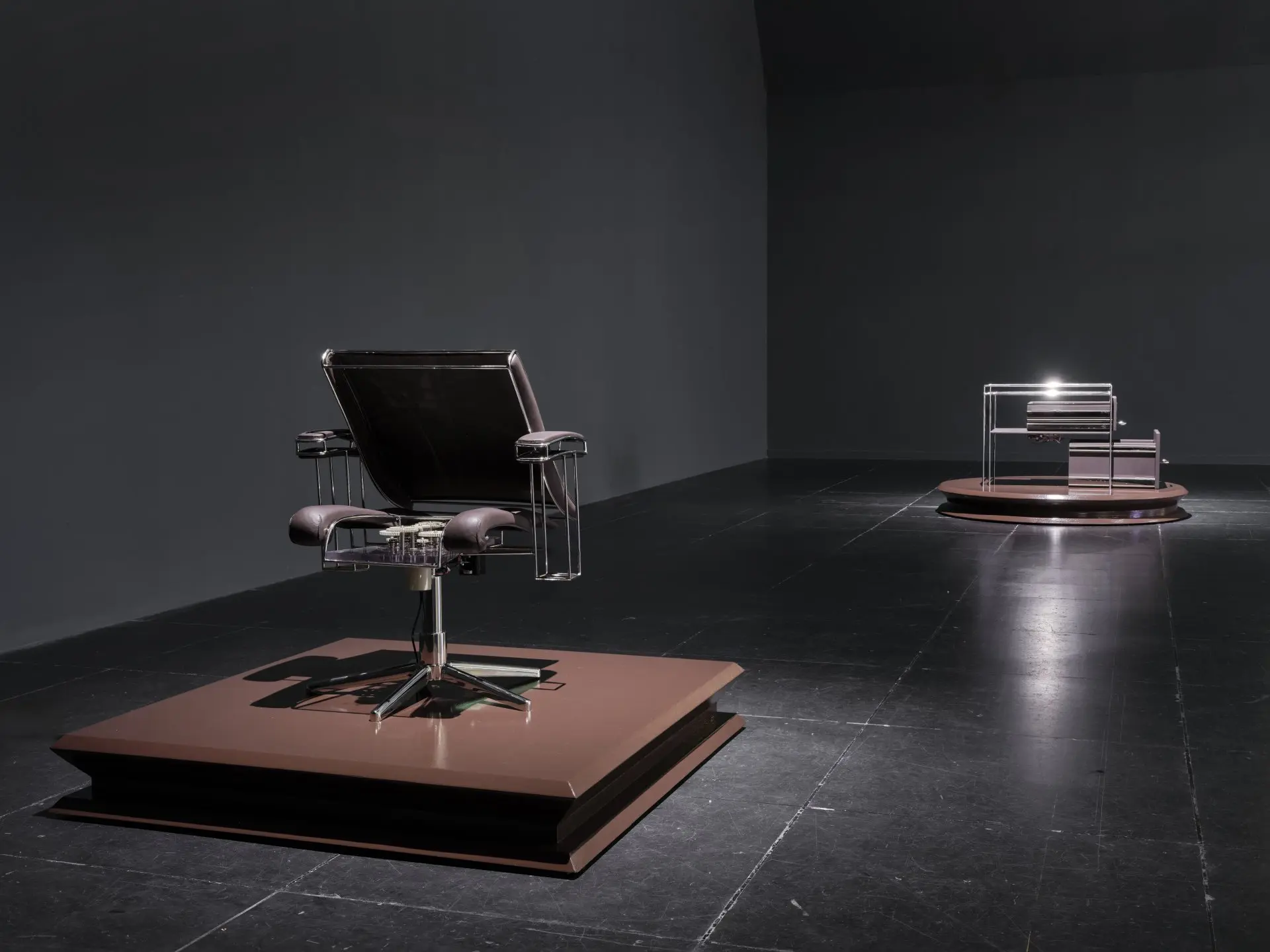
The composition determines when the melody enters and leaves. Sometimes only one object is playing, sometimes two, sometimes all three play together. When they try to play altogether, one melody is constantly chasing another. They are attempting to come into a chorus but never quite succeed. Sometimes this interaction creates a delay, resembling a chorus, or reverberations, resulting in a slightly chaotic orchestra.
The different tempos are connected to different forms of power and different voltages across cities. So the furniture is not simply producing music; it is performing a kind of relationship between different centers of decision-making, each of its own time, rhythm and position. There is a feeling of absurdity and humanness in the way the melody mechanically repeats and continually fails to synchronise, imbuing a kind of emotional baggage to the romantic melody.
Your installation Press Club (2025) is a skeletal conveyor belt installation that mixes Vietnamese, Thai and British vernacular objects and sound. Could you elaborate on the sound scape of this work?
Before talking specifically about the sound, I think it is useful to say a little bit about what Press Club is doing as a whole.
The work takes the form of a skeletal conveyor belt. Commissioned by Gasworks London and the Thailand Biennale Phuket 2025, the installation brings together modular polished steel with carved wooden fragments that was found and salvaged in Phuket – including pieces from balustrades, boats, and door frames. There are also vernacular objects from Vietnam, Thailand and Britain moving through the structure. The conveyor belt serves as a system of circulation, an apparatus that associates with factories, airports, logistics, and efficiency, designed to move goods from one place to another as quickly and systematically as possible. But in Press Club, the system doesn’t work that way. Things move forward and backwards, repeat themselves, and sometimes seem to be going nowhere. The movement becomes almost choreographed rather than efficient transportation.
The title holds several meanings: “Press” can suggest pressure, compression, circulation; the press as news and media; or the act of things and people being pressed into a shaped system of movement, labour, migration and circulation.
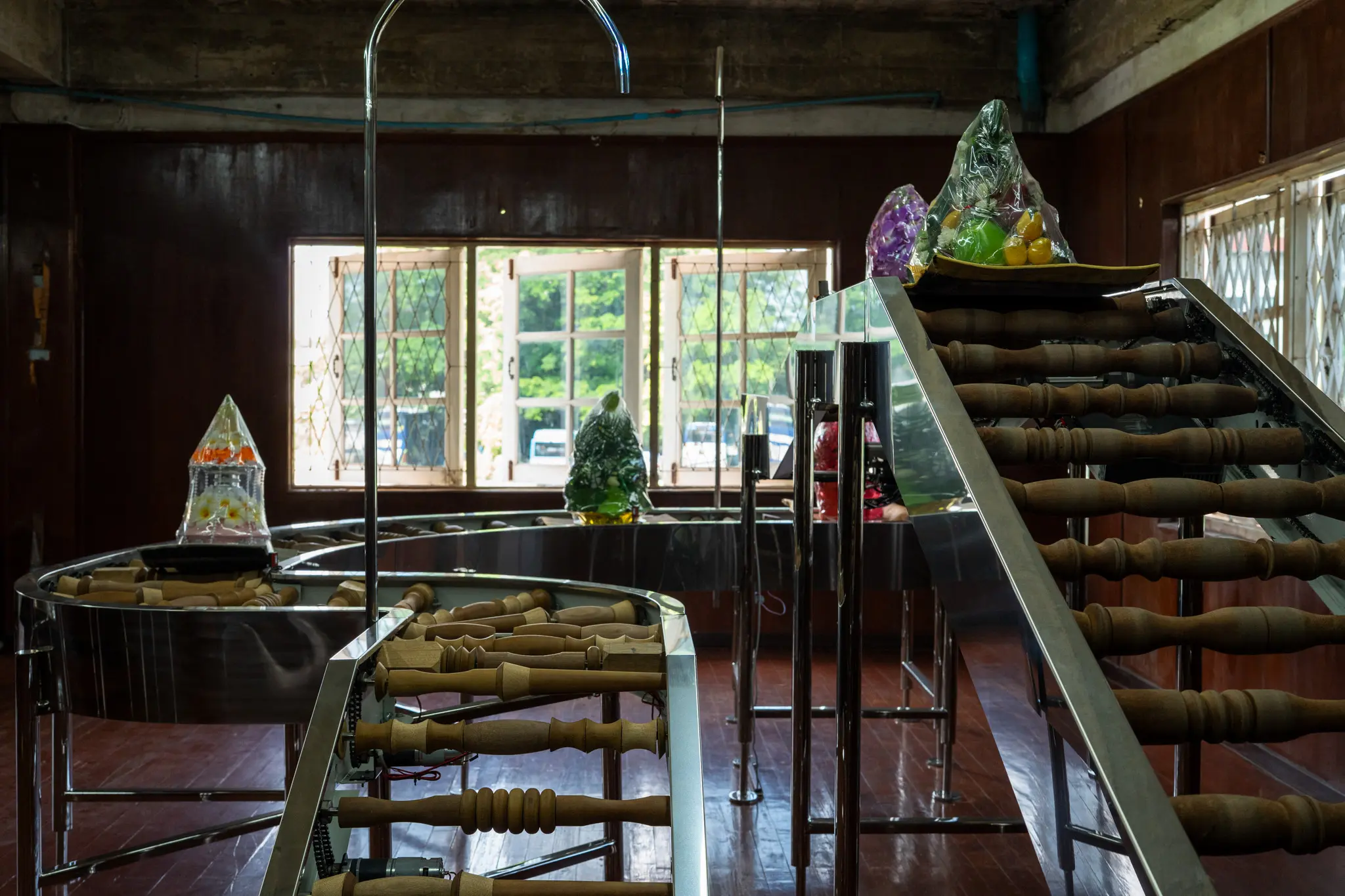
The sound is part of this movement. In Phuket, the soundscape developed very much through what I was encountering locally. One important source was music chosen and performed by local drag queens. I heard a lot of songs by artists such as Lady Gaga and Whitney Houston, but rarely simply as the original versions. They were performed, remade, exaggerated, and inhabited by the performers. That idea of inhabiting a song became very important to me. The performer is not simply reproducing the song; there is a process of becoming someone through the song. There is glamour, desire, transformation, and also a certain aspiration in it.
The sound element introduces something glamorous and almost seductive into this very skeletal, industrial structure. The conveyor belt looks quite severe, but then you hear pop music, drag performance, elevator music, radio fragments. They almost feel like ghost broadcasts moving through the system that resonate different kinds of tension: between glamour and debris, between efficiency and failure, between being someone and becoming someone else. The objects move, the songs move, and the meanings move with them so nothing really arrives in its original form.
What drew you to the early 2000s Vietnamese pop song featured in La the moi khi cach xa anh (What it feels like every time we part) (2025)?
There is actually a very personal reason why I chose this particular line “I have learned the meaning of loneliness during time apart”– from Uoc gi (I wish) by My Tam. This song was my mother’s favorite karaoke repertoire as I heard her sing all the time growing up. The song carries a very particular memory of my mother, particularly in the way she gracefully and emotionally inhabited the song. Music was one of the ways I came to understand her not simply as my mother, but as a young woman with her own desires, memories and a life that existed before and beyond motherhood.
The song is personal to me, but it is also not only mine. Uoc gi is one of the most popular songs that has travelled across generations. The early 2000s marked an amazing moment in Vietnamese popular culture, with the rise of music television, music programmes, live shows, karaoke, and local pop stars. Many of the artists and songs from that period have remained very present in people’s memories. It creates a strange kind of intimacy and collectivity: two people from different generations can suddenly sing exactly the same song together, becoming a shared memory between us.
Pop music is also my personal favorite era of music, I find pop songs incredibly sentimental and personal, it can evoke feelings over a lover, a particular summer, or a particular room; it can also belong to an entire generation, dominates the public by its tune, then disappear only to return years later as a memory.
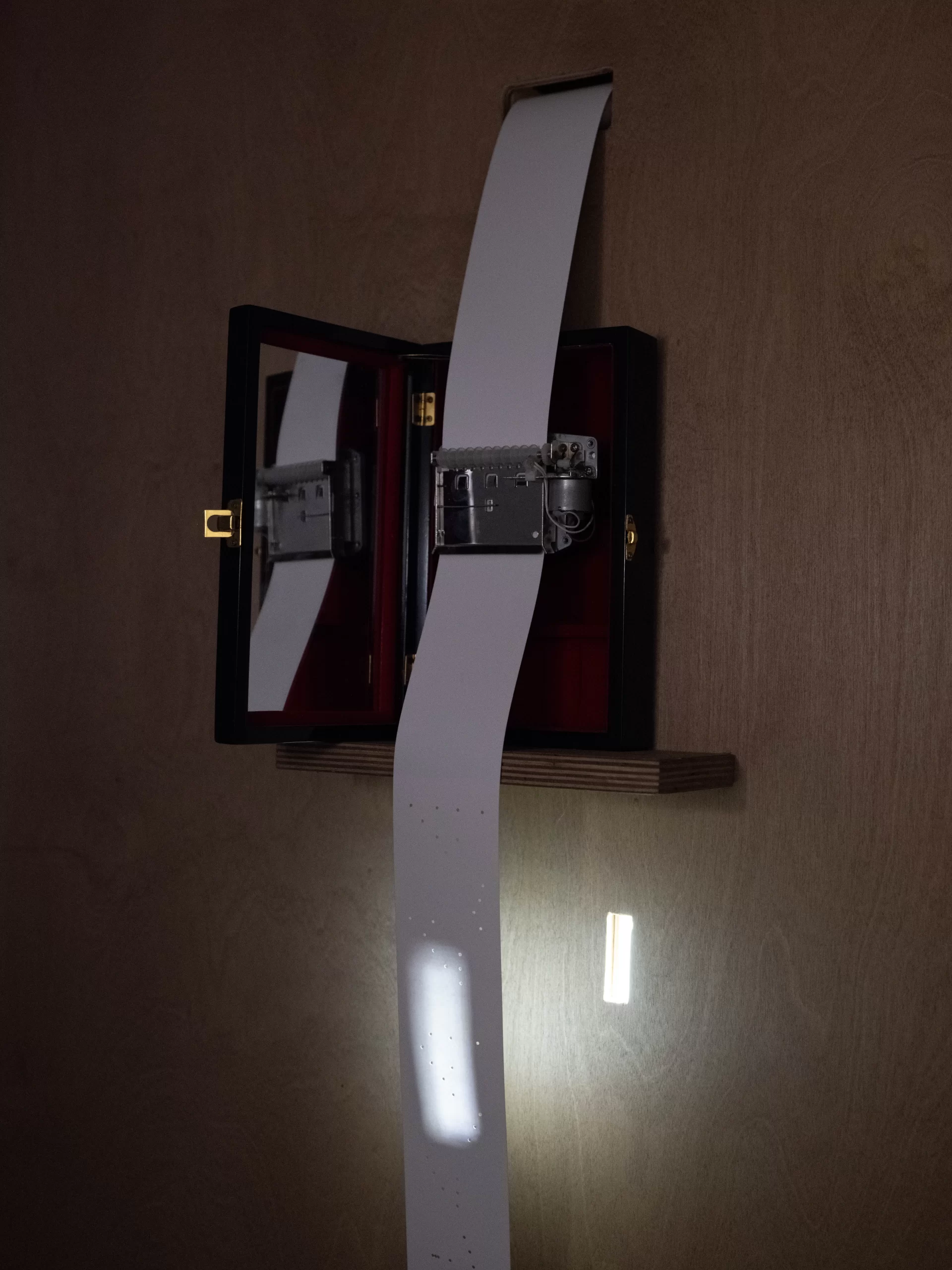
During my residency at VAC Art Vietnam, I decided to make the whole project around this song and the different lives it has had. In La the moi khi cach xa anh, the song – translated into a five-meter-long music sheet, embedded in an old jewelry box – exposes its own mechanics and melody. When exhibiting the work at SLSQ Gallery London in the group exhibition No Place Like Home III (2026) as part of the Backyard Biennale, the viewer has to physically turn the handle and wind the music themselves. The song is therefore no longer simply something you listen to; it becomes something that requires a bodily action to activate. Because the viewer controls the movement of the long-stretched music sheet, they can only hear fragments of the melody, making it difficult to recognise the song immediately. You may hear a few notes and think, “I know this,” but cannot complete the song in your head.
I didn’t want the music sheet to simply reproduce the song in another form, but rather create a strange distance between recognition and forgetting. The song is very familiar to anyone, but the work makes that familiarity slightly unstable.
You are the finalist of the Dogma Prize 2025 with the work Untitled (Notes on romance and cities) (2025). How did you approach the relationship between city soundscapes and the shared social and cultural history?
The Dogma Prize 2025 is special for me because it gave me the opportunity to develop a new work from the beginning. Untitled (Notes on romance and cities) came very much from my personal relationship with Saigon.
I lived in Saigon throughout much of my twenties, after graduating and before moving to Germany. It was a very formative period of my life where I built many everyday memories. Returning to Saigon years later meant revisiting not only the city but also a particular version of myself. The concept grew from these small, fragmented memories. Rather than trying to build a miniature of the city, I wanted to revisit the way a city can exist inside someone’s memory: through very specific situations, sounds, images and gestures.
The work was divided into six boxes within the architecture of the Dogma space, each box represented almost like a miniature stage. Each contains a small situation, with its own narrative and its own clue. These small situations together form a kind of emotional geography. The sounds are an important part of that geography.
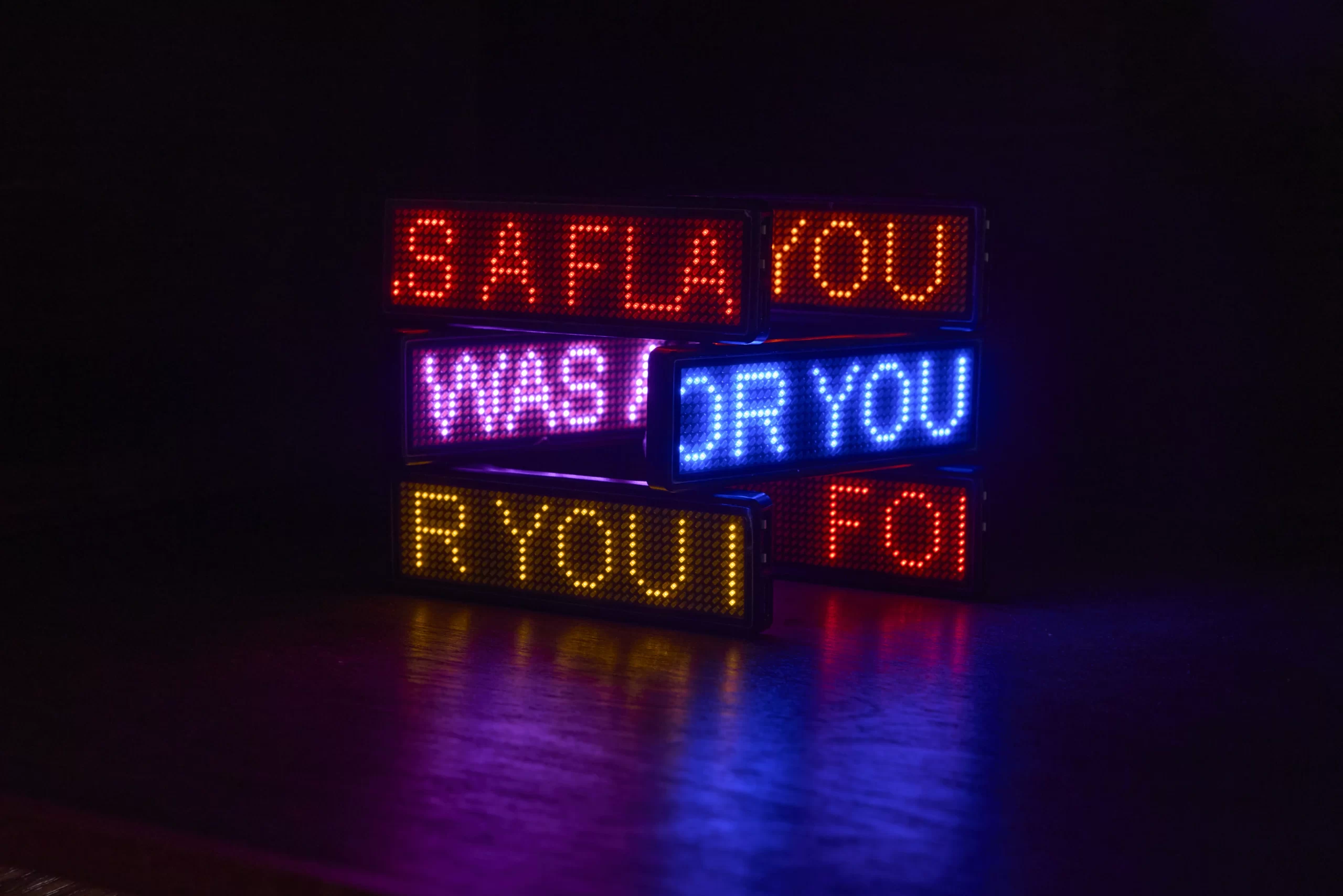
I am also interested in how romantic memories become attached to the city, through ordinary rituals of being young and in love: meeting someone around a lake, sitting somewhere without doing anything in particular, riding around on a motorbike with no destination, or waiting for someone to arrive. These un-monumental events become powerful memories precisely because they are ordinary.
The relationship between the urban soundscape and its scenery merged into our private recollections of memory, and over time it became difficult to separate. Rather than documenting a shared history, the work is more about how a city gives us a vocabulary through which we experience our own. In that sense, Untitled (Notes on romance and cities) to me, becomes a kind of container for these memories, and the sounds are some of the things that allow those memories to return.
Would this sonical aspect remain as a character in your work looking forward?
I think sound will remain vital in my practice, but not necessarily as a fixed signature that every future work has to contain. What interests me is what sound allows me to do at a particular moment.
In my upcoming solo exhibition at Siegen Kunstverein, sound is presented under the notion of disruption and rehearsal. I am looking into sound not only as something that is performed or played, but also in the moments when something goes wrong, repeats, pauses, or has to be rehearsed again.
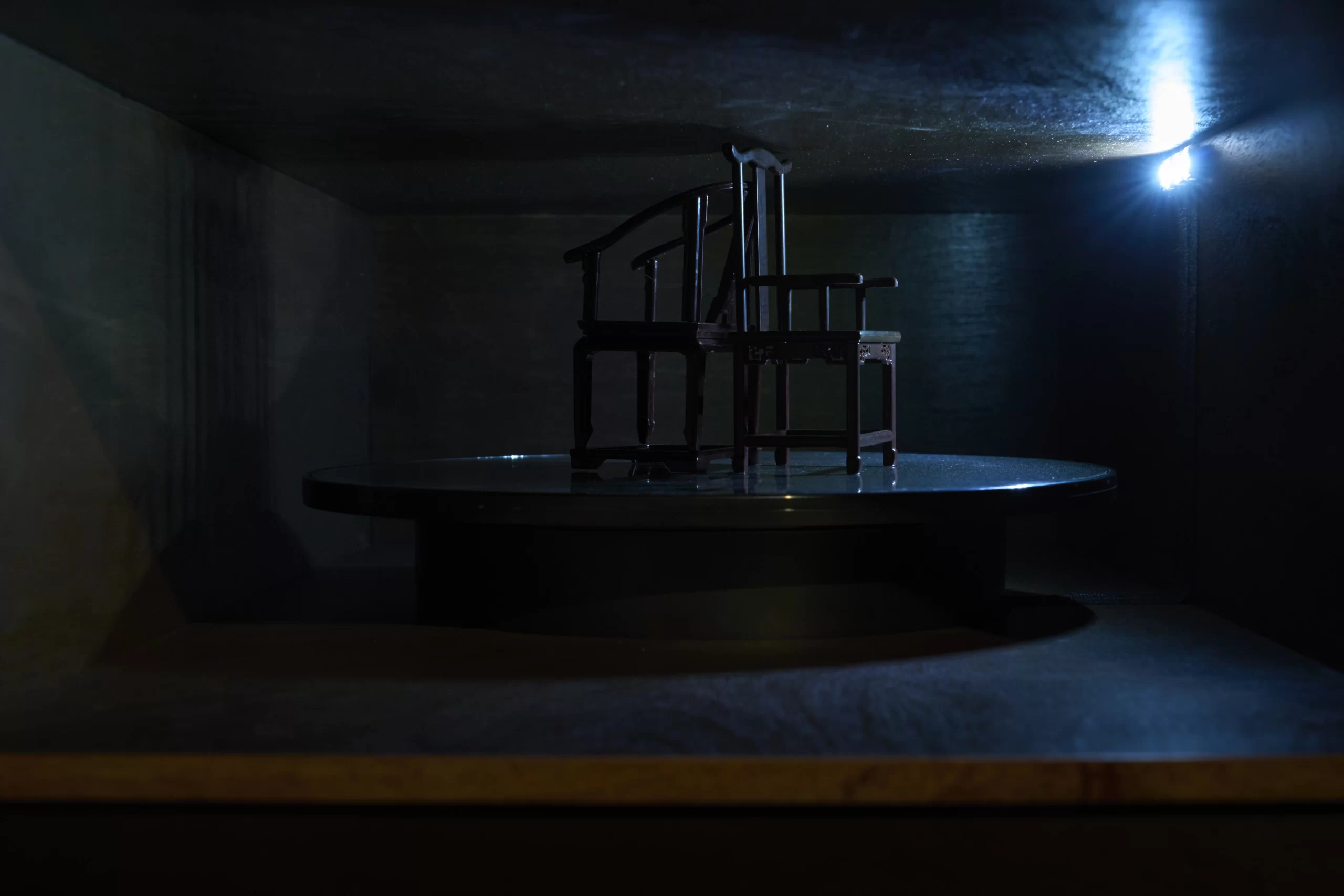
The future iterations of sound may not always be presented in the same form. What excites me is the unknown, and the process of continuing testing out the interactions of sound with objects, space, movement, lighting and the body; whether it becomes a score, a mechanism, a rehearsal, a repetition, or a way of encoding time.
Words: Mary Lê
Translation: Art Nation