Đọc phiên bản tiếng Việt tại đây.
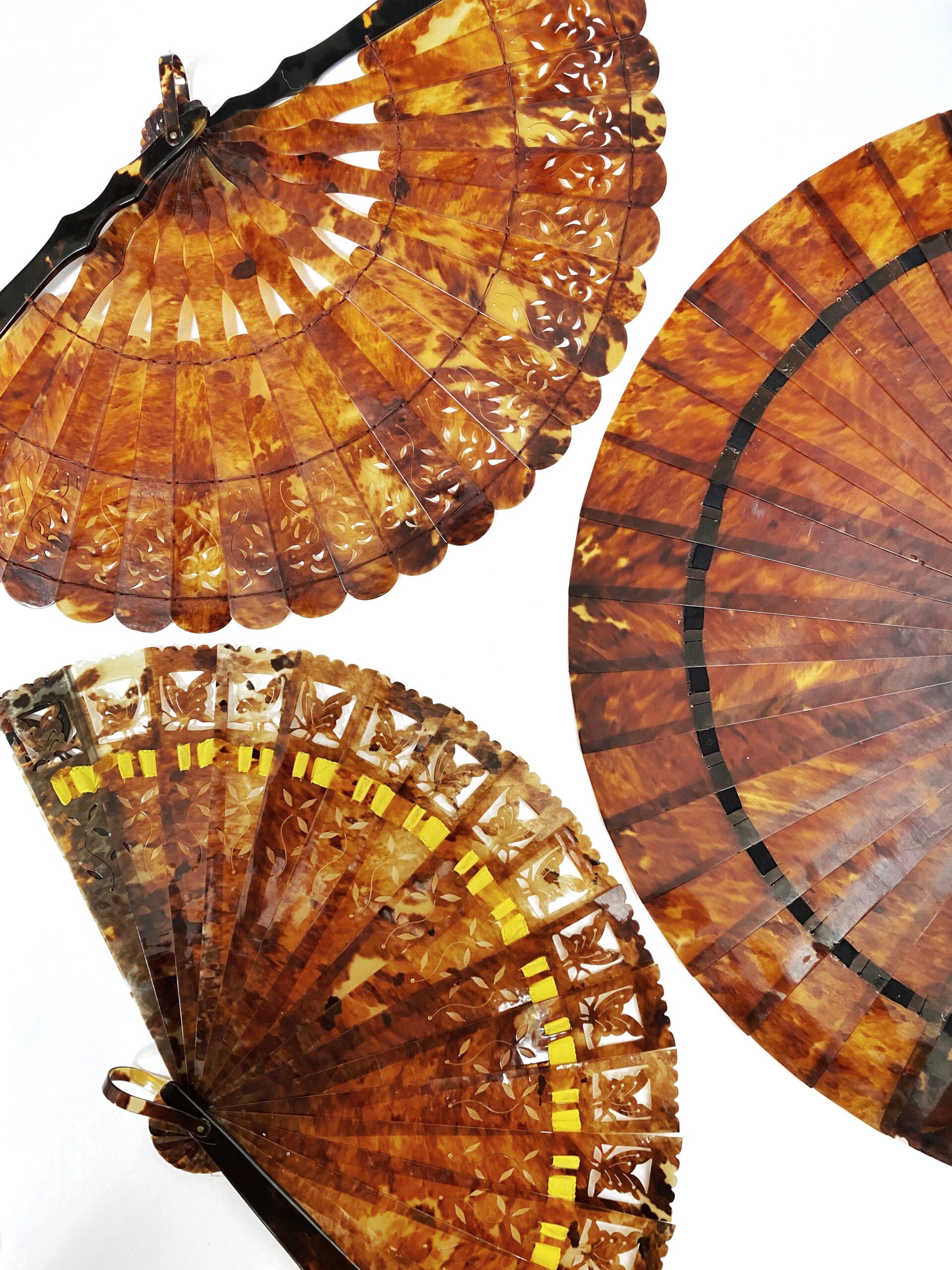
Before the Second World War, tortoiseshell handicrafts from Ha Tien were highly sought after by both domestic and international connoisseurs alike. These household items showcased their magnificent and opulent beauty thanks to their use of hawksbill turtle scutes, whose hues of amber, brown, and deep brown endowed them with an inherent luxury and depth.
In the 1950-60s, the possession of a tortoiseshell vanity box or an intricately carved comb marked a household’s status of wealth and social standing, or at least their elegant past. In some villas in Phu Nhuan and Ba Chieu, dried tortoiseshell specimens can be found mounted on the walls with their faces turned upwards, polished scales gleaming with a striking lustre.
Shortly after 2000, during a business trip to Phu Quoc Island, I still found these wall-mounted specimens available for purchase at the local airport for over 2 million VND each. Could this be the “thin-fleshed” turtles, as some people may have called it?
Tortoiseshell products have long been a fancy, high-end genre of handicraft in Southern Vietnam. Issue 29 of the French periodical “Indochine, Sud-est asiatique (Indochina, Southeast Asia)” in May 1954, while focusing heavily on the Battle of Dien Bien Phu, still dedicated a four-page spread by François Nivolon to the Southern tortoiseshell craft. Later, the 5th issue of the magazine “The Bright and Dazzling South” (May 1963) also featured an article by Pham Sanh Thien and Trinh Thien Tu on the Ha Tien tradition of tortoiseshell craft. According to the authors, the most well-known tortoiseshells hailed from the Ha Tien region, but they were also brought in from neighbouring areas. Ha Tien fishermen who wanted to catch turtles would have to venture to Tho Chu Island or other smaller isles. In the Gulf of Thailand, fishermen from the villages of Samit and Luc Son – Vietnamese villages in Cambodia, 9km from Ha Tien, were recorded as having the highest number of yields.
Although hawksbill turtles could be caught year-round, people would usually delay fishing until the animal’s nesting season onshore, typically around the end of the eleventh lunar month. A local proverb goes: “When the coral tree blooms, the hawksbill builds its nest,” meaning that when the coral tree is about to blossom, it is time to prepare tools for the season ahead.
Four harvesting techniques
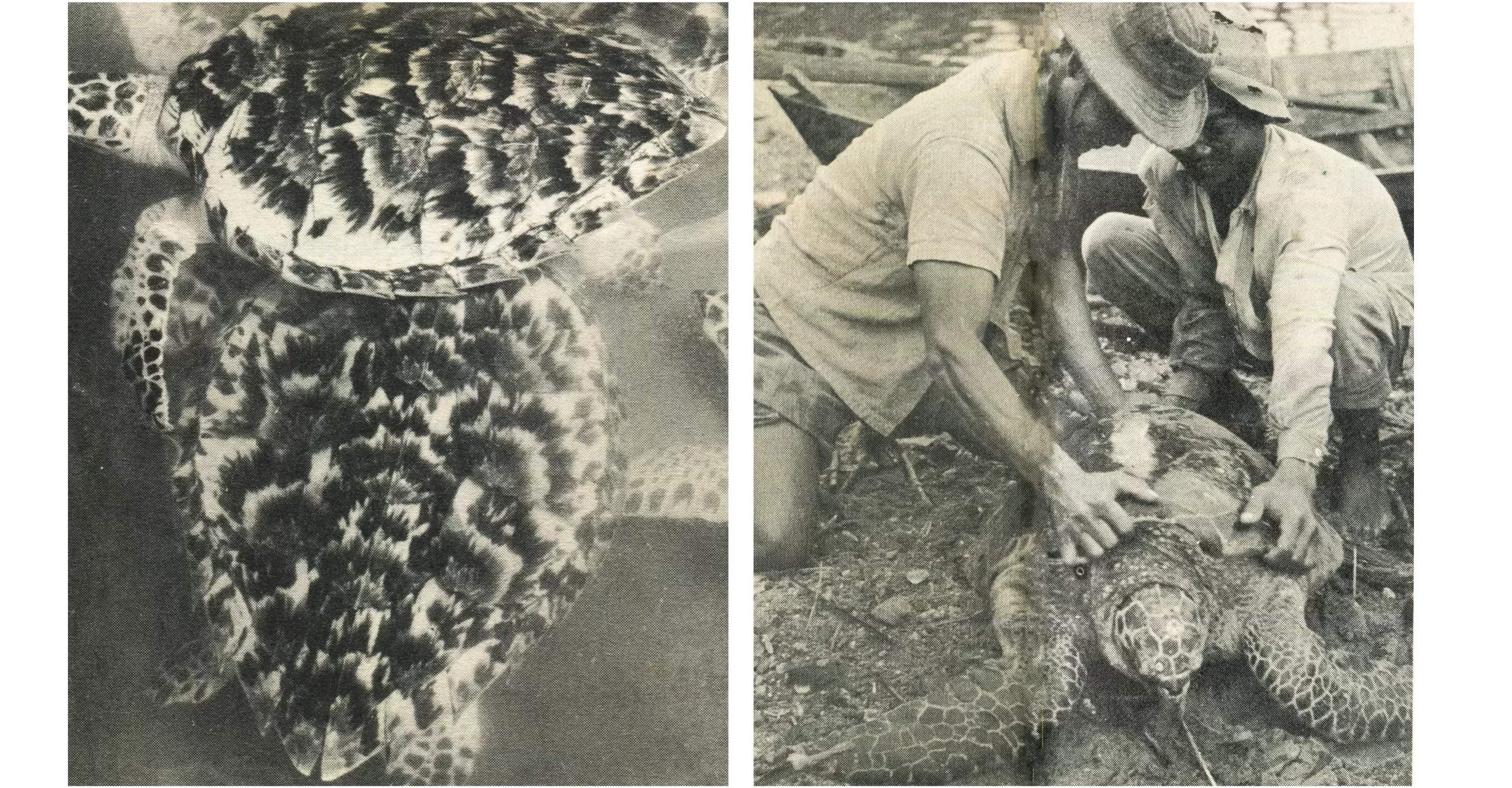
1. Shore capture: From each eleventh to the second lunar month of the following year, the hawksbill will nest three times, only at night. Each turtle may lay 120–150 eggs in the first clutch, 80–120 in the second, then down to 60–100 by the final round. Experienced fishermen know which beach the turtles will come up to lay eggs and wait until nightfall, then approach very quietly. After digging in the sand to lay eggs, turtles use their flippers to cover up the pit and press their chest down to flatten the surface. It is customary to wait until after the nesting to catch the creatures, so as to capture more eggs for hatching. When shone upon by the glare of a flashlight, the animal cannot move and will flip onto its own back, unable to recover itself. The catcher will then leave it alone and move on to the next one, then repeat until morning, when the entire night’s catch is collected and put into a cage. This method only requires one strong catcher and a flashlight, though the yield depends on luck.
2. Netting: This method uses a net several hundred metres long and three metres wide, with mesh openings of around forty centimetres wide, lead weights at the bottom and floats on top. Four fishermen board a boat to locations where hawksbill turtles are found; carrying provisions is a must since they will be gone for an entire month before returning. The net will be cast around this area, while divers descend at the centre to stir up the water, causing the turtles to swim outwards to all four directions and get caught in the net.
3. Hook lining: Hawksbill turtles tend to inhabit rocky reefs, where food is abundant and currents weaker. Here, fishermen will set a row of hooks roughly thirty centimetres apart around the reef close to the seabed, and wait for turtles to get caught in the bait as they swim over foraging for food. The more they wriggle, the more they get caught in surrounding hooks.
4. Spearing: The spear used in this method has barbs to prevent it from slipping free when piercing into the flesh, and a long rope attached to the rear and secured to a boat or a float. Upon spotting a turtle surfacing, the hunter throws the spear and releases the float, letting the creature swim away to exhaustion, before hauling them back in. Some exceptionally skilled hunters can even strike without damaging any scute, thus preserving the price when selling the turtle.
The latter three methods can be carried out throughout the year, though very few people specialise in this work, as most of them are fishermen who only go turtle-fishing only when they readily have the means or during the season. On average, a group might catch around 100 turtles per season.
Crafting the artefact
Each hawksbill has about thirteen scutes, often collectively referred to as a “co” (set). A turtle that is approximately 90 centimetres long and 70 centimetres wide tends to have scutes measuring 20 by 15 centimetres. After removing the flesh, the artisan will heat the carapace over an open flame to warm it up and peel off the plates. The older the turtle, the easier it is to remove the scutes.
The value of the shell varies depending on the colour, ranging from cherry pink, tinged red to yellow, reddish-brown, to black-mottled amber, and black. The annual production of scutes averaged 200 kilograms.
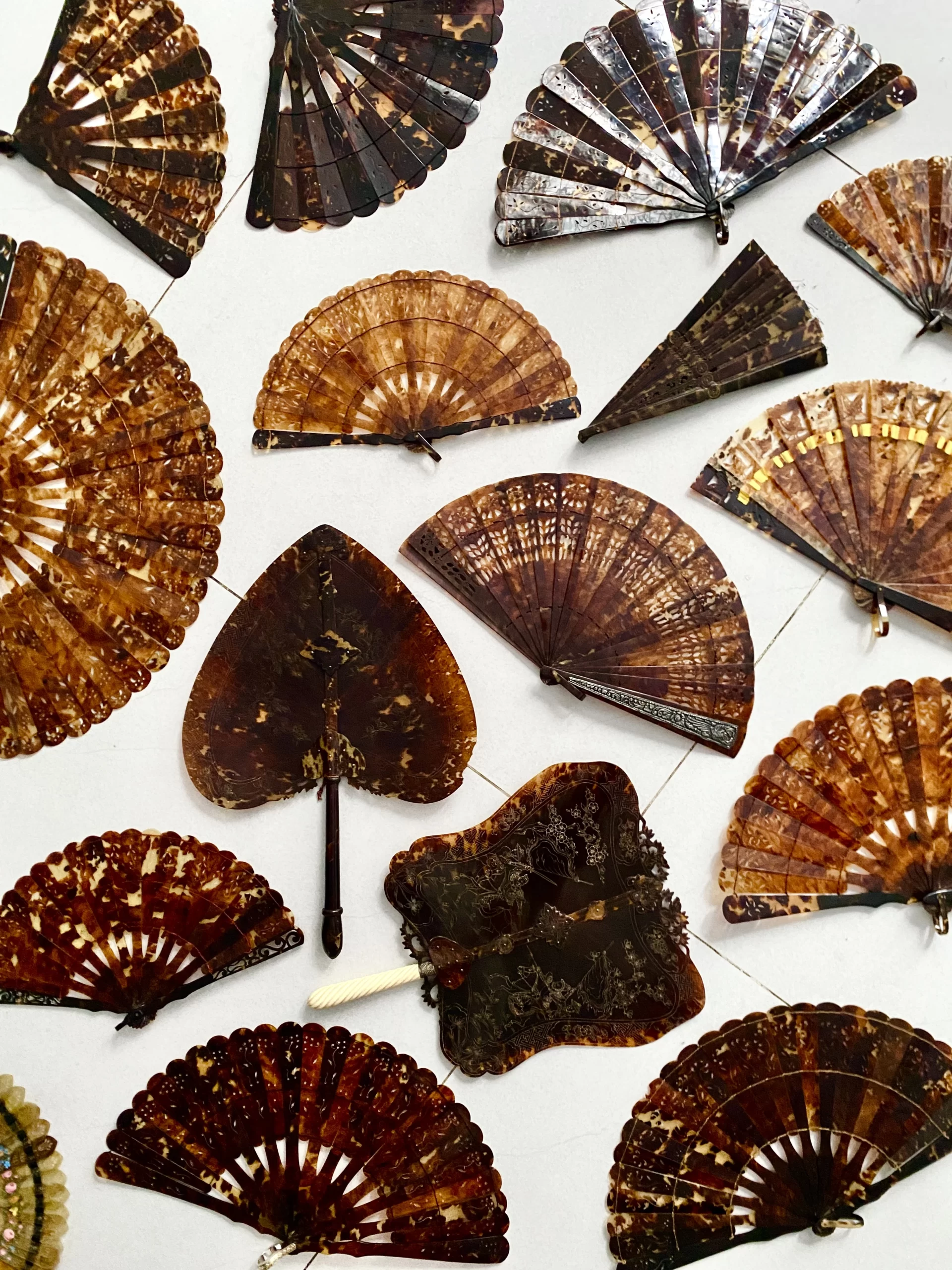
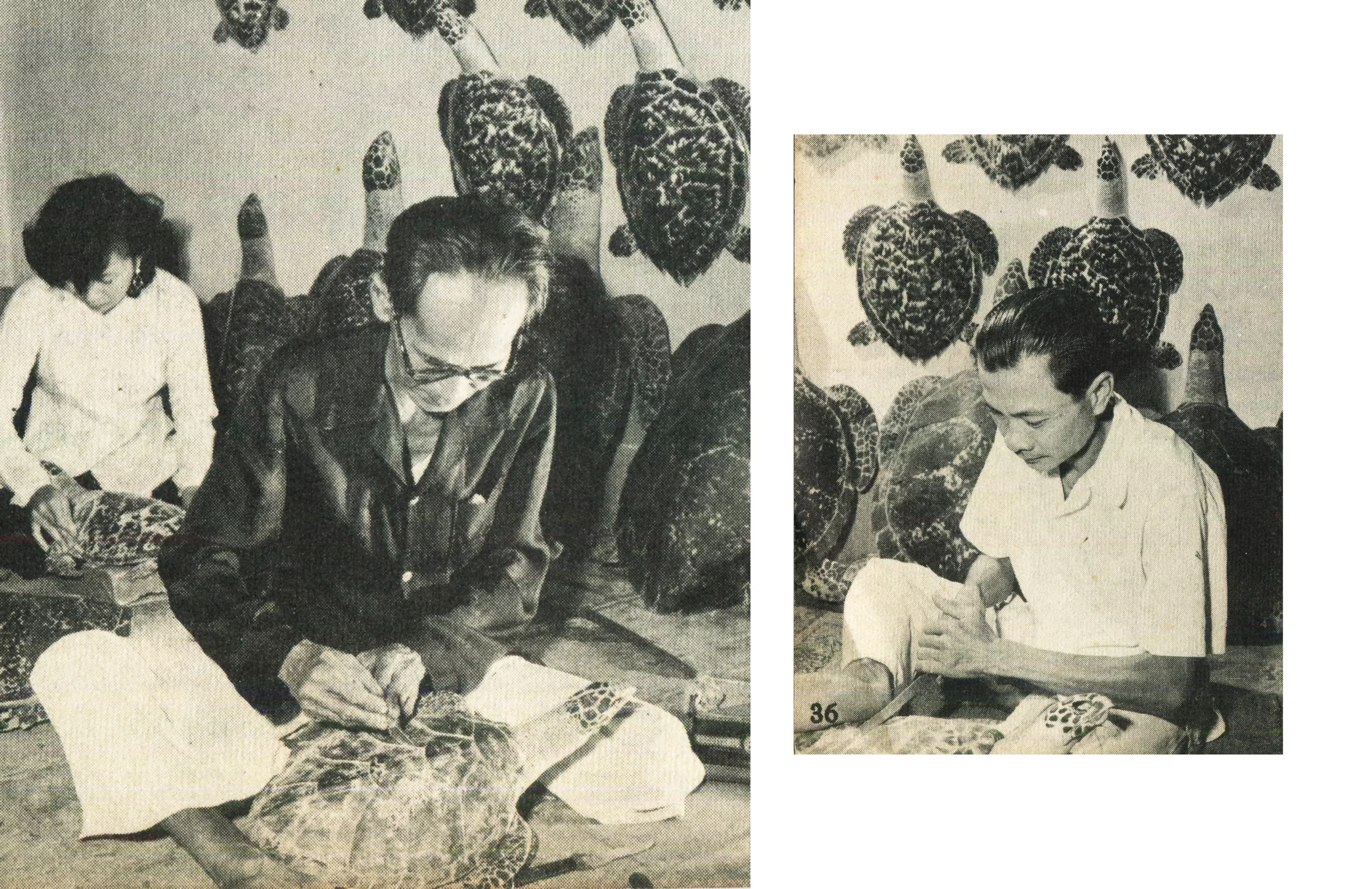
By the 1960s, Ha Tien was home to around five workshops, each employing around a dozen master artisans. Their methods were categorised generally as follows:
Wall-mounted specimens: Turtles were gutted, cleaned, and soaked in a medicinal solution for several days before being sun-dried for three or four days. During the drying process, the heat would cause the scutes to curl upward. After trimming, use a knife to scrape off a thin layer of the scutes, then polish them with a mixture of leaves – a process known as “gioi bong” (polishing). According to author Pham Kim Khanh in his article “Tortoiseshell” in “Free World” magazine (vol. XI, no. 7), four rounds of polishing are needed: first, with rough, hairy leaves from the Streblus asper tree,, followed by the finer “chieu” leaf, then the ultra-fine “ngai” leaf. Finally, finely ground and sifted lime powder is sprinkled onto a soft cloth and applied to the scutes. This time, the scutes will become glossy as if coated with oil paint, its vibrant colours emerging.
Everyday items: In making a product, scutes were heated over fire or soaked in hot water to soften, become easier to bend, then put into a mold. After three days, they’d be taken out for polishing. To make intricate items such as fine-toothed hair combs, use a very small saw blade and saw gently. Larger scales were transformed into handbags, while smaller fragments became guitar picks. For women, there were also hair brooches, fans, bracelets, rings, etc., and for men, cigarette cases, pipes, cufflinks, and the likes.

For various reasons, this industry, despite its long history and increasingly sophisticated products, remained small-scale. Some were sold abroad. Domestically, however, since the 1960s, the emergence of colourful, mass-produced electroplated alternatives had led to a steady decline in the number of tortoiseshell consumers.
Ha Tien is also home to two relatives of the hawksbill: the “thin-fleshed” turtle and the “grass (olive ridley)” turtle. The former resembles the hawksbill in shape but possesses smaller scutes, polished primarily for wall displays. The latter has shells with only lines, not distinct raised joints like those of the hawksbill.
Hawksbill turtles were also raised indoors. In the 1960s, there were about ten families in Ha Tien and a few in nearby islands like Hon Dam and Hon Ngang who raised them. Typically, hawksbill raised in direct sunlight would develop deep crimson tones in their scutes, while those kept in the shade exhibited golden hues with flecks of pink or red.
Echoes of a bygone era
In the past, each individual could catch over a thousand eggs per year to eat, leading to a gradual decline in the population of hawksbill turtles. Therefore, since the French colonial era, the Government of Cochinchina had issued a decree on 21 April 1923, prohibiting the “collection, consumption, and sale of hawksbill turtle eggs” from the French colonial era. Despite these measures, people kept catching baby turtles, so a supplementary decree on 25 April 1925 was enacted to prohibit the “capturing, by any means, of young hawksbill turtles during the period between 1 January and 30 April,” that is, between the post-nesting season and the emergence of hatchlings.
Before 1990, hawksbill turtles were still a common sight along Vietnam’s coastal provinces. However, due to intense exploitation for the souvenir trade, their numbers eventually depleted severely. As a result, the hawksbill was entered into the Vietnam Red Data Book in 2000 under the highest level of protection. All acts of exploitation and trade are illegal.
Words: Phạm Công Luận
Translation: Hồng Ánh