Đọc phiên bản tiếng Việt tại đây.
Built by the French in 1927, Ho Chi Minh City Museum of History originally operated under the name the Musée Blanchard de la Brosse. In 1956, it was renamed the National Museum in Saigon, with scholar Vuong Hong Sen serving as its first Vietnamese principal keeper. Since 1979, the institution has officially borne its current name, housing a collection of over 43,000 artefacts, including 12 National Treasures. Its displays are organised around two principal strands: the historical development of Vietnam, from prehistory through the Nguyen Dynasty, and thematic exhibitions on the cultures of southern Vietnam and other Asian countries.
As the Nguyen Dynasty was the final monarchical dynasty in Vietnamese history, the Museum has paid particular attention to the collection of artefacts from this period. Before 1975, many court antiquities from Hue were moved south and placed in its care. The Museum later expanded these holdings and received a number of antiquities from the collections of Vuong Hong Sen and Duong Ha, laying the groundwork for the reorganisation of the Nguyen Dynasty gallery in 2021, which reopened with a fresh look in 2022. The following sections introduce and examine several representative pieces, each attesting to the skill and refinement of artisans of the past.
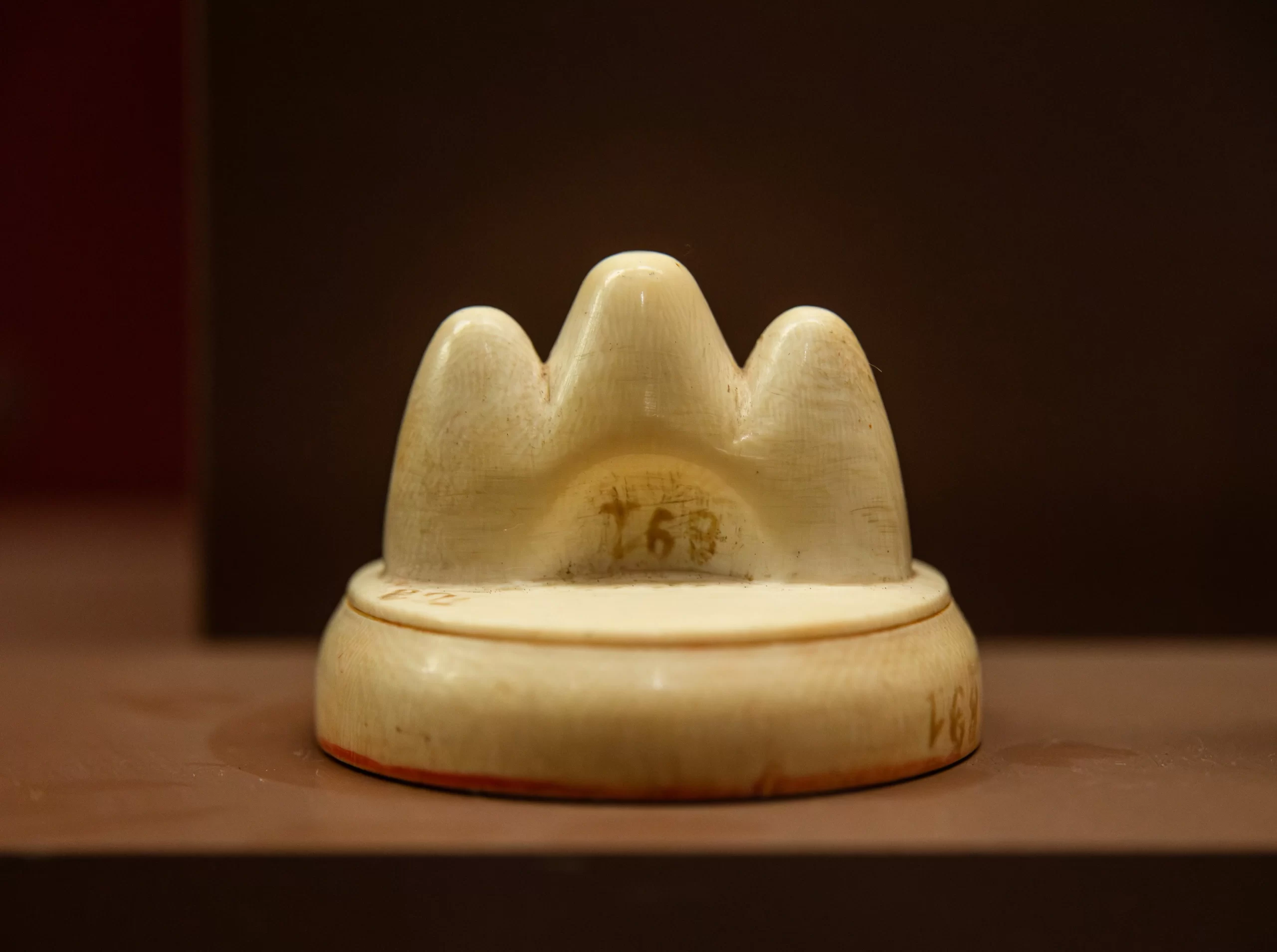
Imperial seal of the Khanh Ninh palace
Carved from ivory, the seal features a circular face and a knob shaped like three mountain peaks. Its outer border is engraved with a motif of paired dragons flanking a solar disc, while the face bears four Chinese characters in seal script “慶寧宮寳”, which translates to “Treasure of Khanh Ninh Palace” – a palace that once stood north of the Ngu Ha canal, within what is now the inner citadel of Hue. It was built in the seventh regnal year of Emperor Minh Mang (1826) as a residence for the emperor while preparing for the annual Tich dien (royal ploughing) ceremony, and later became a place of worship dedicated to Emperor Minh Mang. When the imperial capital fell in 1885, French troops occupied Khanh Ninh Palace, prompting the court to declare the site no longer ritually appropriate due to being defiled by the French. In 1887, Emperor Dong Khanh ordered the palace dismantled. The seal is one of the imperial objects associated with the lost palace fortunate enough to survive, having been used to stamp the covers of Emperor Minh Mang’s two poetry volumes First Collection of Minh Menh’s Imperially Composed Poems and Collection of Imperially Composed Poems.
Cloisonné enamel table screen
Made in the eleventh regnal year of Emperor Minh Mang (1830), the table screen measures 105 cm high by 58 cm wide. It consists of two main parts: a wooden base carved with animated, three-tiered cloud formations, and a precious-wood frame finely worked with mother-of-pearl inlay in alternating Eight Treasures and Four Friends motifs. Within the frame, geometric frets and “卍 (wan, meaning ‘myriad’ or ‘auspiciousness’)” motifs form the ground for three distinctive decorative fields arranged along the screen’s central vertical axis. At the top is a pomegranate flanked by lively floral sprays; its centre is engraved with three characters in seal script, “御製詩 (Imperially Composed Poem)”. The middle field features a yellow roundel framed by bats spreading their wings on four sides and an encircling band of curling cloud lines, encasing Emperor Minh Mang’s imperially composed poem In Praise of the Lotus, comprising 40 Chinese characters in five-character eight-line regulated verse. The lower field depicts a butterfly with its wings fully spread; above it is another poem by Emperor Minh Mang, In Praise of the Camellia, a qijue quatrain comprising 28 Chinese characters.
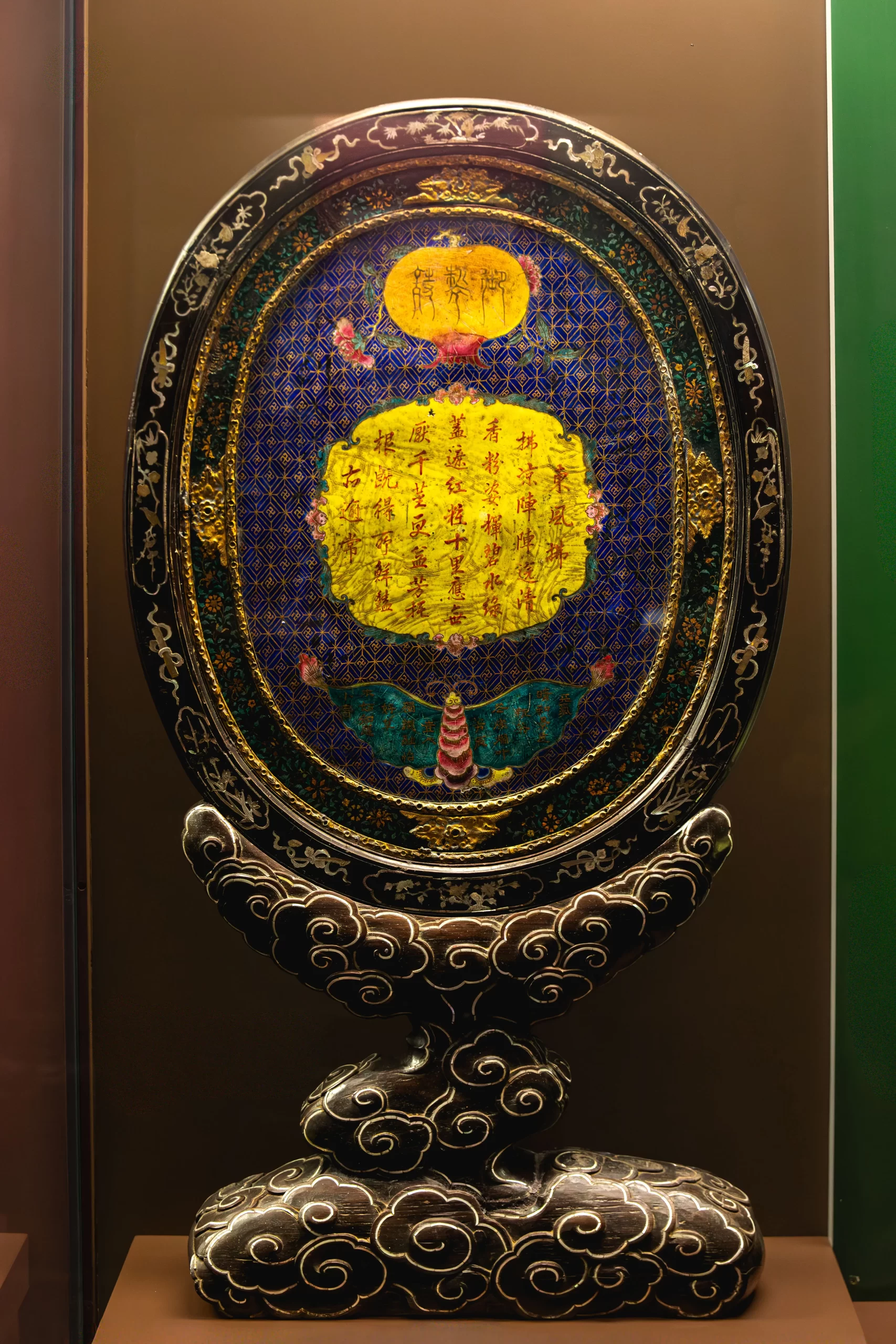
The table screen is an epitome of royal cloisonné from the height of the Nguyen Dynasty. Its survival through nearly two centuries of upheaval offers invaluable evidence of the structural ingenuity and harmonious colour palettes achieved by the artisans at the Imperial Cloisonné Workshop.¹
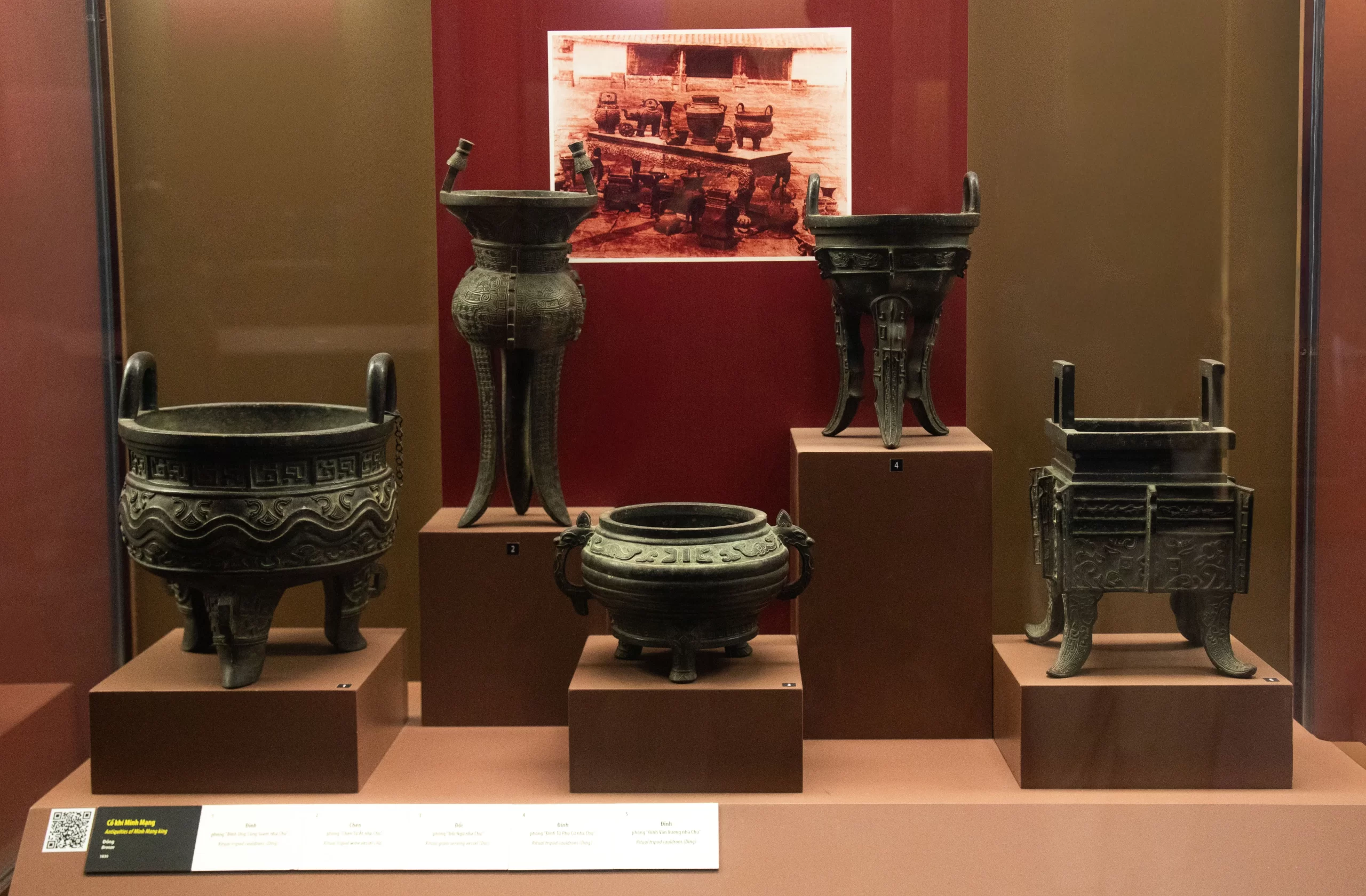
Archaistic bronzes of the Minh Mang era
“Archaistic bronzes” is the collective term for 33 types of bronze objects produced in the twentieth regnal year of Emperor Minh Mang (1839), modelled on objects associated with the Three Dynasties (Xia, Shang, and Zhou) and the Han period in China. Each bronze bears inscriptions in Chinese, together comprising a collection of texts titled Illustrated Record of Imperial Inscriptions on Archaistic Bronzes (御製銘文古器圖), drawing upon Confucian classics as well as the emperor’s imperial compositions to articulate ideals of protecting the state and safeguarding the people’s welfare, while serving as moral admonitions to descendants and officials alike. The bronzes were placed on altars throughout the temple system of the Imperial City of Hue. After successive upheavals, only 12 of the original 33 objects survive in the museum’s holdings. Although incomplete, the ensemble remains a distinctive example of its type and offers insight into Emperor Minh Mang’s expansive conception of rule, as well as his vision in building Dai Nam into a peaceful and powerful state.
Carved wooden standing screen
The carved wooden standing screen is a masterpiece of Nguyen Dynasty craftsmanship, displaying a high level of technical accomplishment in its balanced combination of relief carving, incised carving and openwork carving. Its two lateral wings vividly depict a plum-blossom-and-birds motif and a pine-and-deer motif over interlocking tortoiseshell lattice. Most notably, the screen includes the image of a five-clawed dragon, an emblem of imperial authority.
The focal point of the central panel is a grand banquet, rendered with striking animation in a composition repeated on both faces. The scene unfolds in a square pavilion with a double-tiered roof. Between the two roof tiers are four Chinese characters in relief, “祥雲捧月 (auspicious clouds supporting the moon)”. On either side stand banner poles bearing the seal-script inscription “萬壽 (longevity)”. Within the pavilion, a noblewoman in formal ceremonial dress wears a tall headdress and a tablet at her neck. She sits upon a throne carved with phoenix heads, attended by a palace maid holding a feather fan. Outside the pavilion, 16 male and female attendants line the two sides, carrying fly whisks, lotus flowers and ruyi sceptres. Five retainers stand in front: two hold ceremonial canopies; two carry processional placards carrying the characters “肅靜 (decorum and silence)”; and one kneels reverently to present a dish of peaches of immortality.
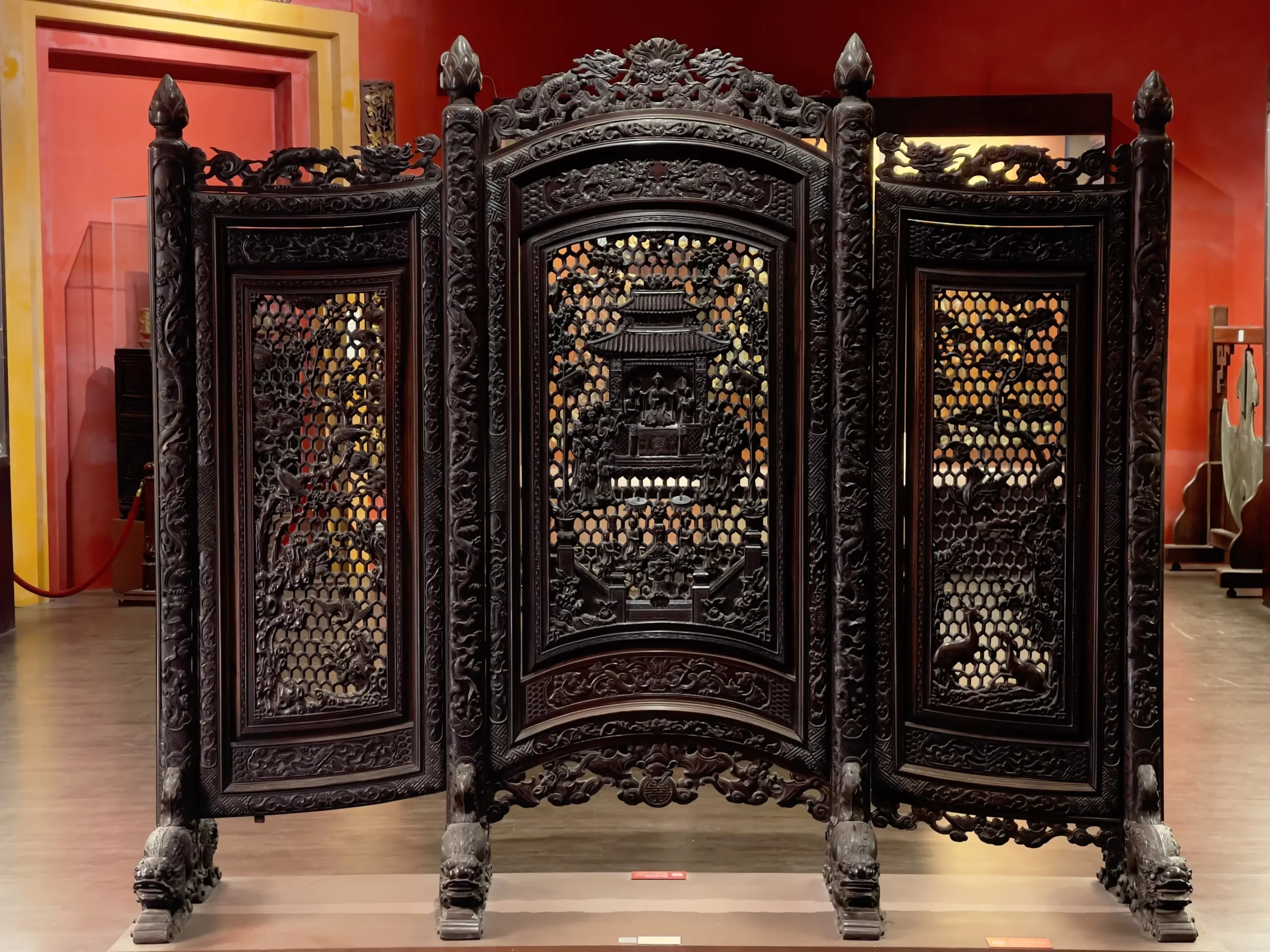
The screen’s most distinctive and subtle feature lies in the differing patterns on the central woman’s robe on its two faces, through which a deeper intention is conveyed. On the front, her robe bears rosette motifs, while the immortals gathered around her stand upon ethereal clouds. Together with the kneeling figure offering peaches of immortality, these details identify the scene as the Banquet of the Peaches of Immortality in Daoism, where the immortals assemble to offer birthday wishes to the Queen Mother of the West. On the reverse, however, the woman’s robe is patterned with gridded “壽 (longevity)” characters. This accords with the prescription for the court dress of the exemplary mother of the realm in The Collected Statutes of Dai Nam (欽定大南會典事例): “The robe shall be made of summer gauze in orthodox imperial yellow, embroidered with the character for longevity in five-coloured threads enriched with gold […]”, confirming that the principal figure on this face is an empress dowager of the Nguyen Dynasty.
These clues have led to the hypothesis that Emperor Tu Duc may have presented the screen to his mother, Empress Dowager Tu Du, on her birthday. By casting his mother as the Queen Mother of the West, supreme sovereign of the Jade Pool Palace in the Celestial Court, the poet-emperor deftly embedded both a wish for her long life and well-being and an expression of filial devotion in an enduring work of art.
Nguyen Dynasty dragon robe
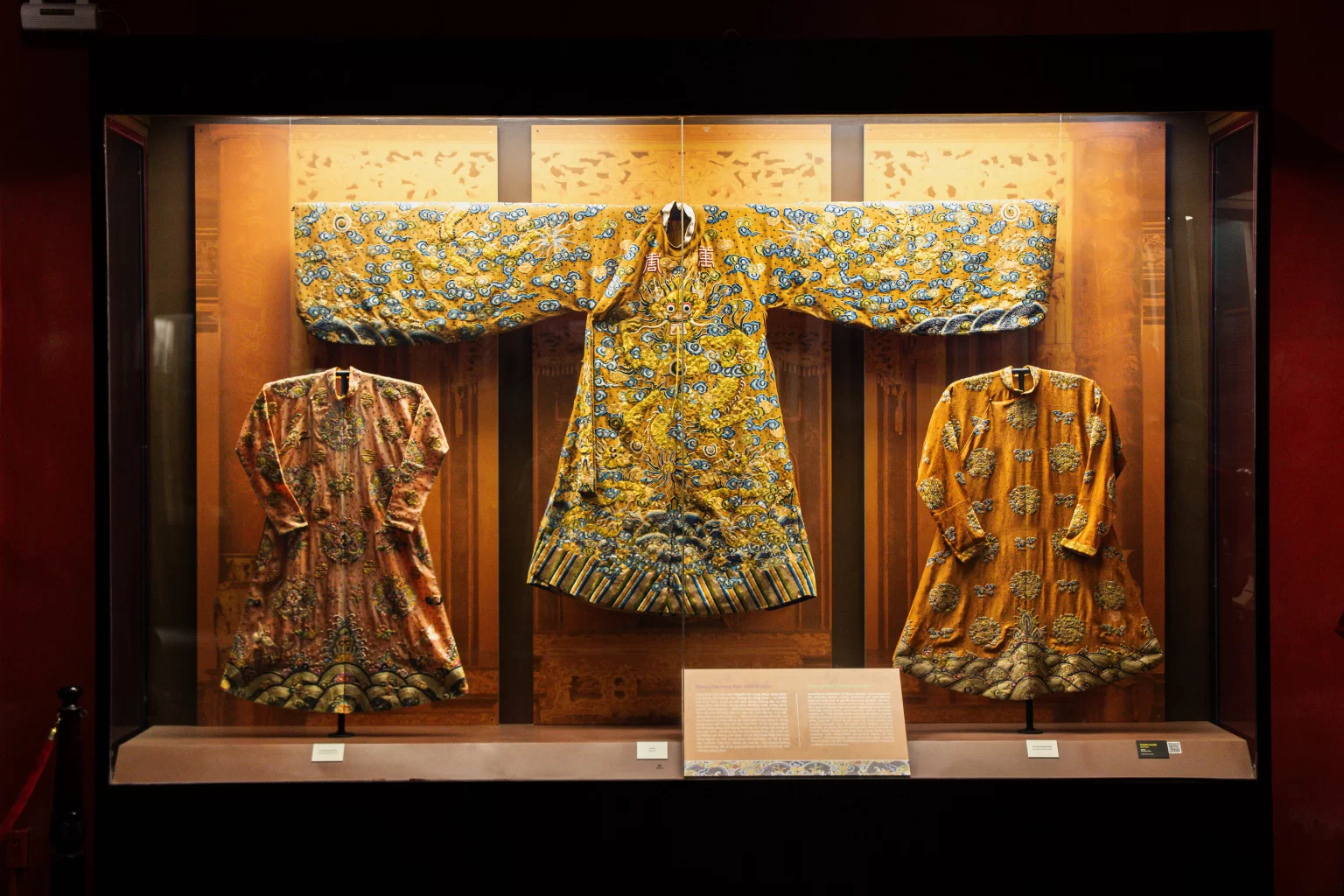
The imperial dragon robe currently on display is a reconstruction based on the original robe, which has suffered considerable damage. Read against the records in The Collected Statutes of Dai Nam, the Nguyen dragon robe clearly inherits the cut of the Restored Le period while also reflecting the influence of the dragon-and-cloud grand-assembly design programme of Ming-Qing China.
The robe is made from satin in orthodox imperial yellow, the colour associated with the central Earth phase of the Five Phases. Across the front and back, both shoulders and the inner skirt panels, nine dragons are embroidered in gleaming gold thread, symbolising the supreme imperial status of the emperor. Two rear panels are made from deep sapphire-blue bat ty² silk, while the collar is of smooth, snow-white bat ty satin. Two hanging collar streamers are embroidered with dragons and clouds. Beneath the collar, the two characters “萬壽 (ten thousand years of longevity)” stand out prominently in seal script. The hem is ornamented with a three-peaks-and-waves border, together with coral and flaming-pomegranate motifs painstakingly assembled from intricate, minute beads and jewels, and combined with clouds and polychrome standing-water bands.
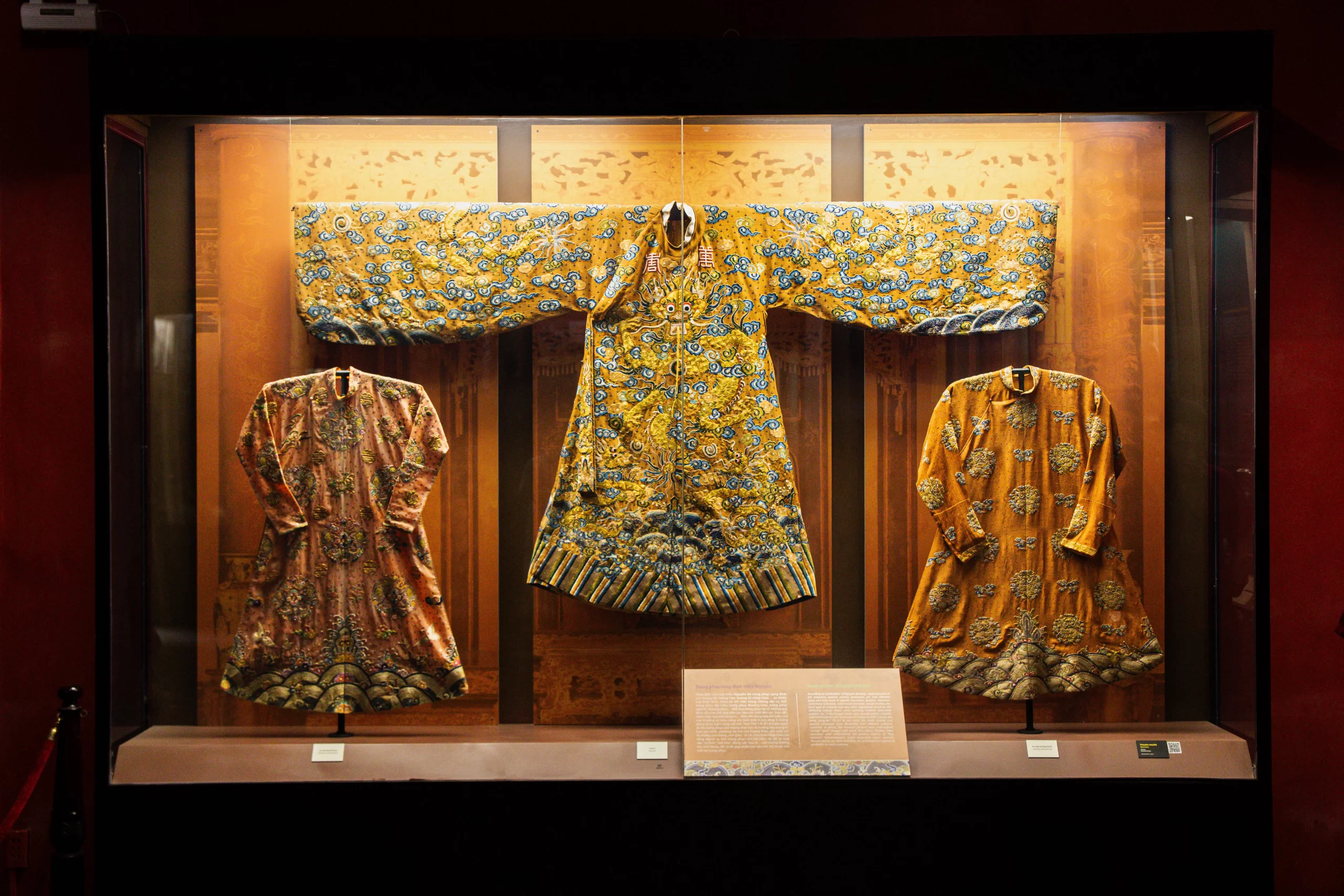
The embroidered dragons display characteristic Nguyen-period forms: high, protruding foreheads; large, round eyes; long whiskers springing from beneath the eyelids; manes that sweep and curl behind the head; and tail tufts coiling open like blossoms. Most importantly, a dragon on the emperor’s robe must be portrayed with five claws, the supreme symbol of an imperial object reserved exclusively for the Son of Heaven and the imperial family. Under these strict conventions, the dragon robe was not only an exalted ranked court dress worn for formal audiences and major state ceremonies, but also a symbol of the absolute power of the sovereign within the monarchy of the period.
A legacy of style and wisdom
Taken together, these representative antiquities show that the Nguyen-period collection at the HCMC Museum of History consists not simply of silent antiquities, but of priceless, symbolic objects embodying the cultural memory and civilisation of an era. From openwork carving in precious woods and modelling in ivory and bronze to the needlework of ranked court dress, every element reflects the masterful craftsmanship and aesthetic intelligence of artisans of yore. Each decorative programme carries not only formal beauty, but also the ideas, aspirations and spirit of an age. To preserve and interpret the value of this heritage is to connect the consciousness of past and present, enabling today’s generation to imagine more fully the former splendour of court art.
Words: Trần Nguyễn Tuấn
Translation: Art Nation
[1] A specialised workshop established by Emperor Minh Mang in 1827 to manufacture phap lam wares for royal ritual and decorative purposes.
[2] Bat ty satin (八絲) is a high-grade silk woven from threads made by combining eight silk filaments, frequently used as the embroidered background for historical imperial court attire due to its thick texture and smooth luster.