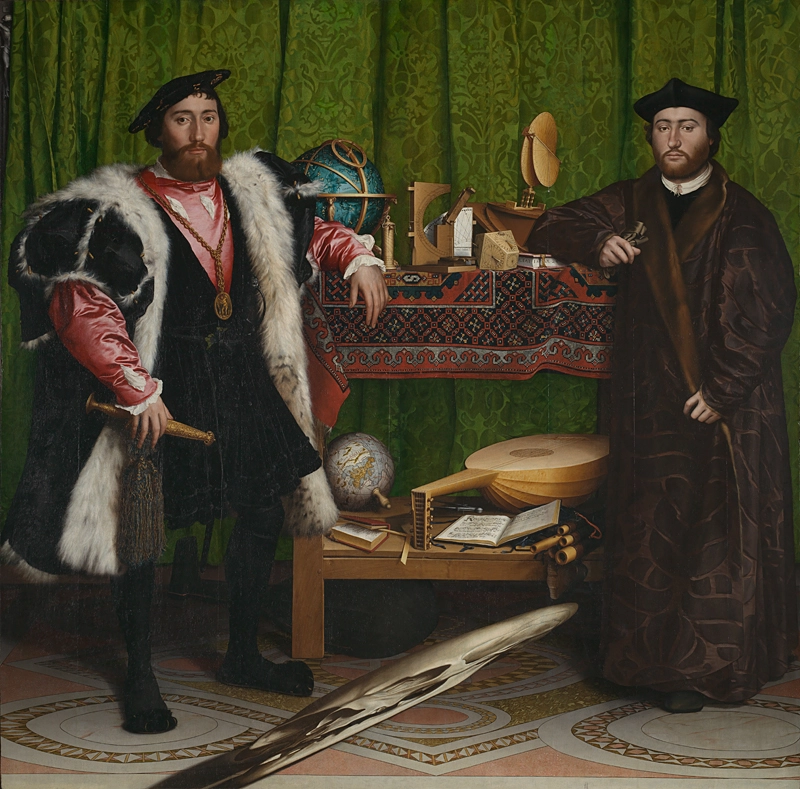
During the sixteenth and seventeenth centuries, the vanitas motif became particularly prevalent in German and Flemish painting. In The Ambassadors, Hans Holbein the Younger depicts two diplomats standing beside a luxurious array of objects – astronomical measuring instruments, a globe, a lute, flutes, books and weapons – together with a skull stretched as though subjected to acceleration. The painting presents an easily deciphered allegory: power, wealth, knowledge and beauty will all fade, leaving humanity as bare as bleached bones in a creation that both bestows everything and takes everything away. What remains in the painting is the peculiar gaze of the two figures – a gaze in which humility and an awareness of all that is slipping away open the way towards humane conduct, guided by religious sentiment.
As religion gradually recedes in the modern era, the burden of giving meaning to death – and therefore to life – increasingly falls to art. Without the guidance of the Bible, artists seek answers through the particular experiences of their own lives and those of others. In this sense, the vanitas paintings of the Renaissance and Baroque periods have found worthy successors in the installations of Xuan Ha, an artist closely connected to Quang Nam. If novelty constitutes the content of time – the new inventions displayed in profusion before Holbein’s two dignitaries, just as they are before the inhabitants of the modern world – then time has only one form: loss. To make time perceptible through the barest of means, an artist needs only place losses side by side. With her acute awareness of losses complex enough to encapsulate an entire region or historical period, Xuan Ha has used this minimal vocabulary to pursue questions on a grand scale.
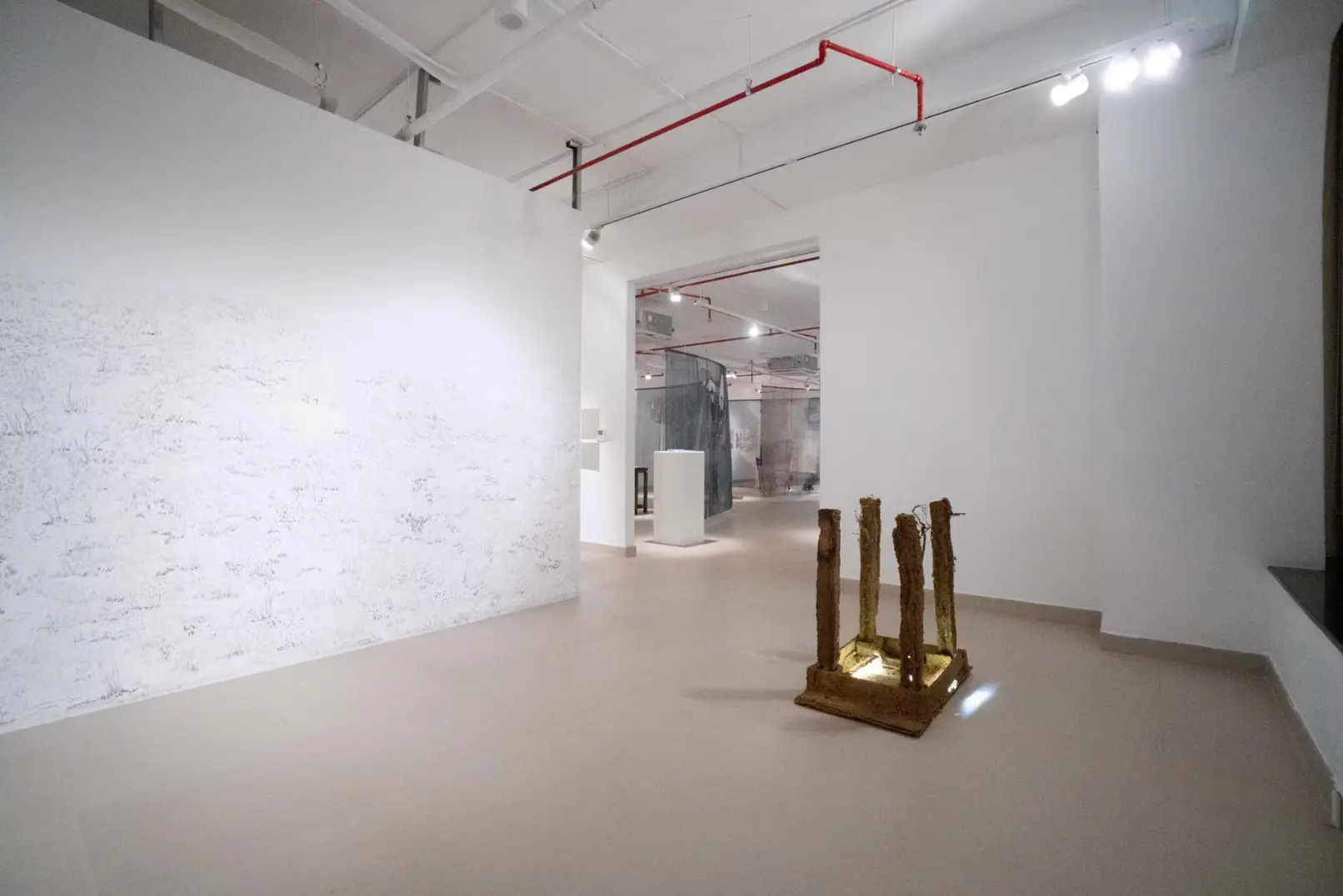
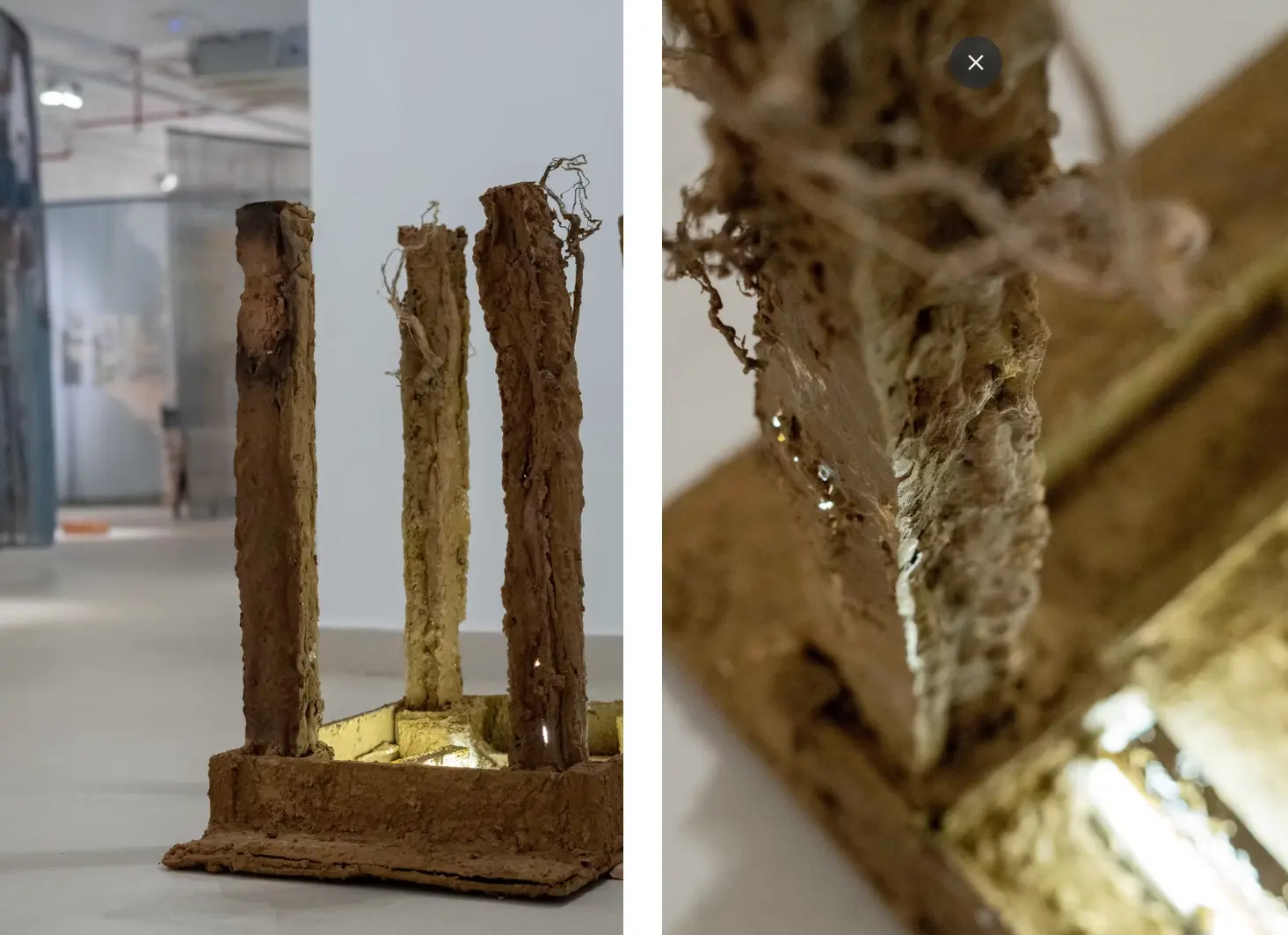
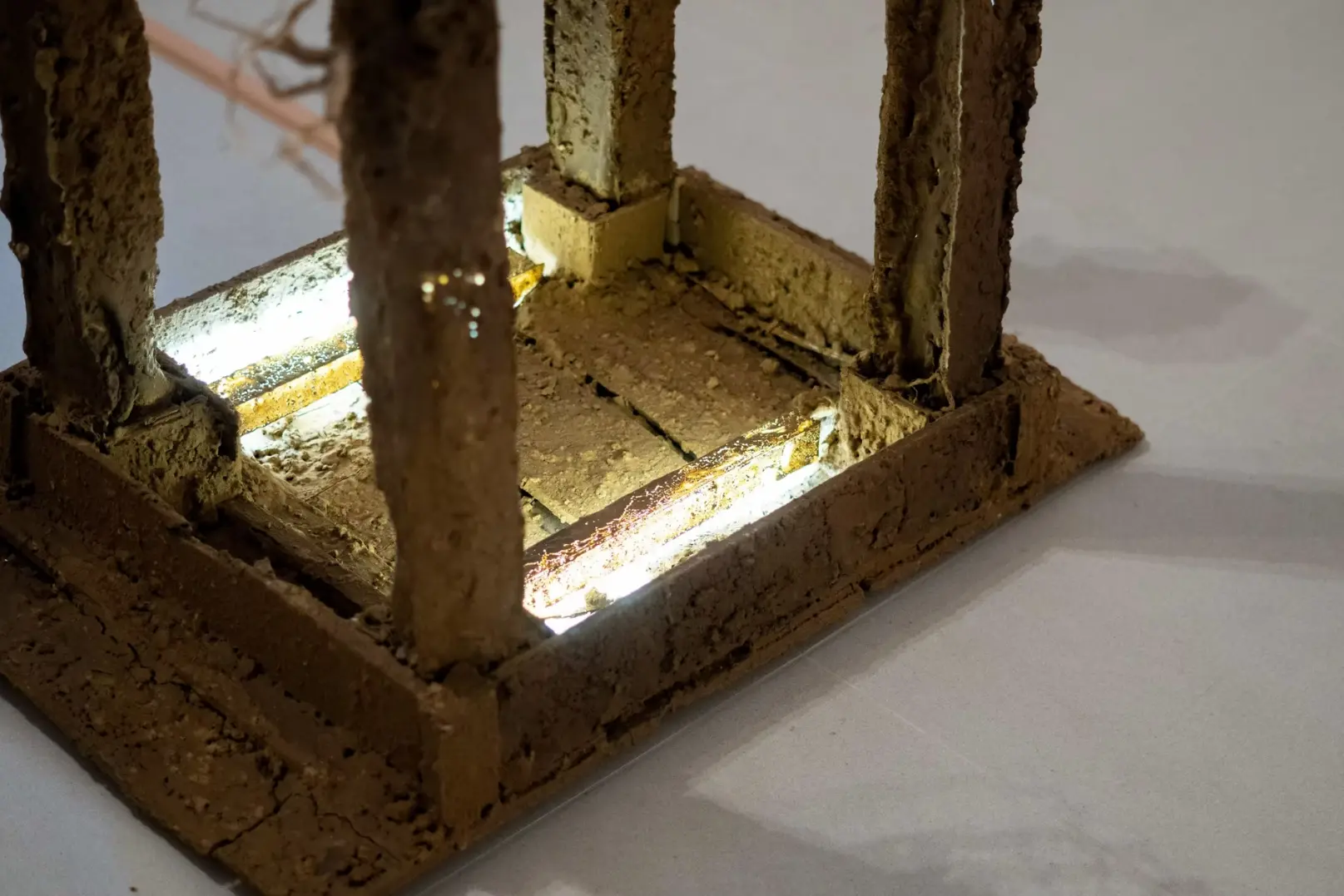
Consider a minimalist installation: an overturned table. In Centralization (2022), to express the conflict between rampant urbanisation and the forced displacement of agricultural communities, she turns an old table upside down, covering it with soil, gravel and roots. At first glance, the table resembles a construction site with four tower blocks: a new way of life is rising, lifting people to heights they have never reached before. To achieve this progress, the old sacred order once bound to the land must be overturned. This is the spiritual order of agricultural communities: love for the nature that sustains them; love for the land to which they commit themselves through the graves of their ancestors and, eventually, their own; and love for neighbours who sit as equals to discuss how to live together rather than compete for dominance – all of which will be lost forever to urbanisation. Torn from the earth, the roots of spiritual life now point skywards, anchoring themselves in the ambition to rise – an ambition that can grasp nothing tangible, only empty space. Once the table’s stable horizontal order of bàn / bằng / bình (a Vietnamese wordplay linking the table, levelness, balance and equality) has been overturned, a vertical order embarks on the path of centralisation – the sacralisation of the power held by whoever stands highest.
In visual terms, the work conveys loss not only through the weathered appearance of the wood, the barren grey of the soil and the unsettling void around the roots pointing skywards, but also through the negation of an object’s purpose. Modern cities emerged from a spirit of coexistence among equal citizens, while the functionalist architecture of modernity arose to meet the basic needs of an ever-growing population. When urbanisation betrays these purposes merely to perpetuate itself, it resembles the overturned table: not only counterproductive, but deprived of its very identity as the qualities of bàn/bằng/bình are erased. The abyss at the heart of the contemporary spirit is the loss of an ultimate end: people are compelled to turn means into ends, until the world becomes a vast accumulation of means, endlessly expanding to fill its own emptiness.
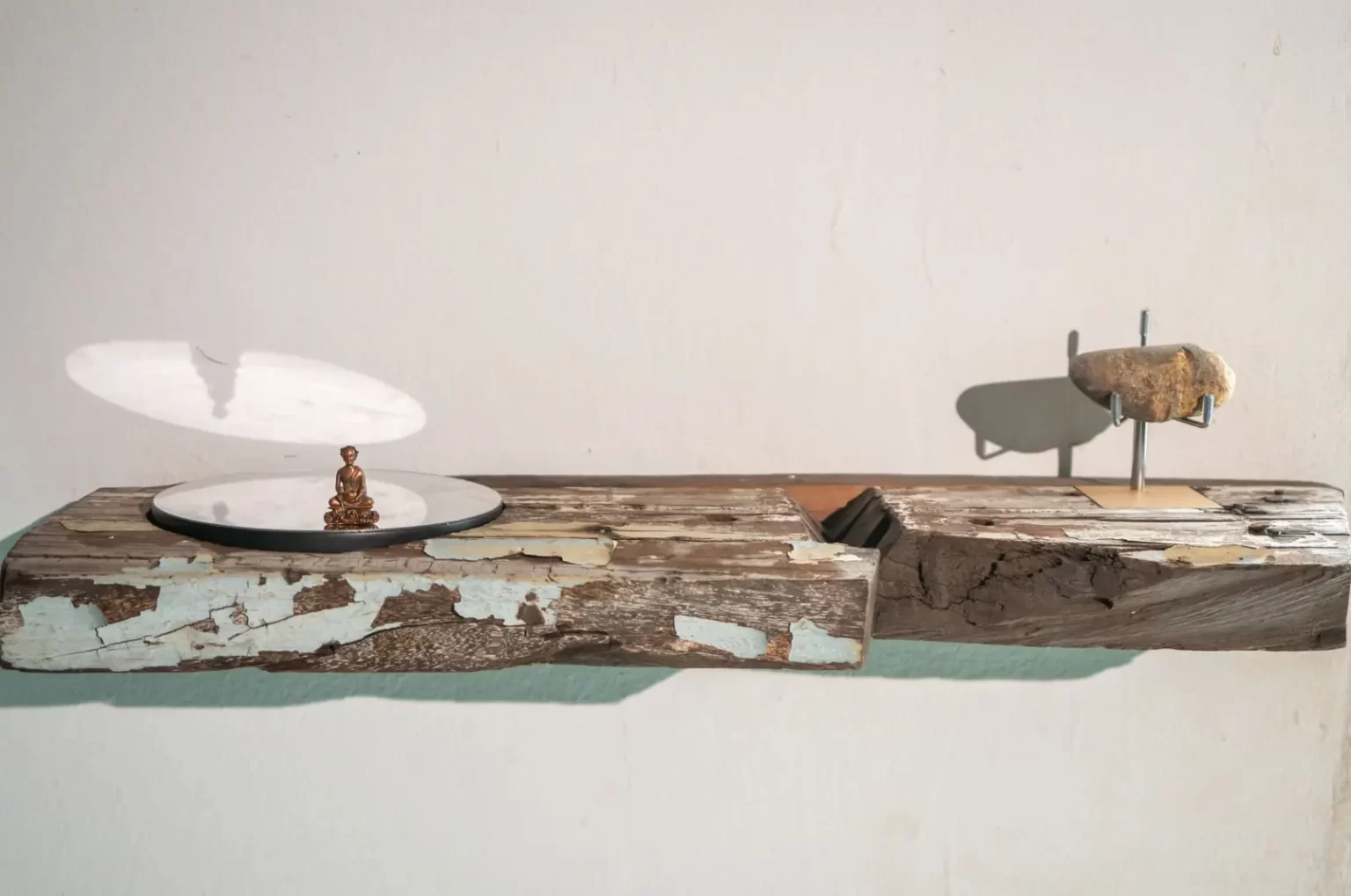
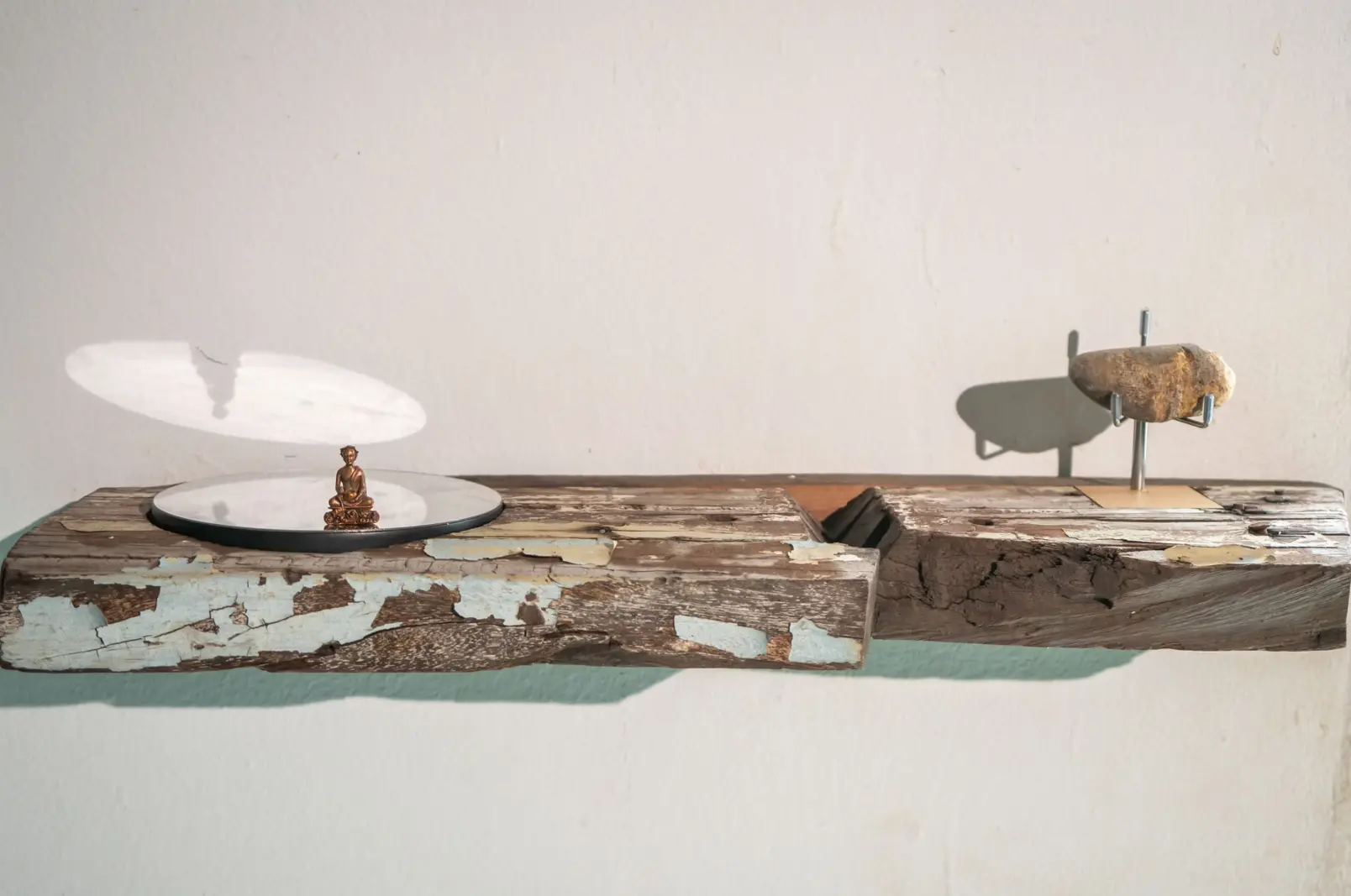
Loss does not come only when something reaches the end of its life. It occurs whenever life is unfolding, mingling and transforming things, causing each to lose the wholeness that the human mind attributes to it. This subtle observation runs through many of Xuan Ha’s installations, including The Letter R (2025), commissioned by Noir Row Art Space in Thailand. At two now-closed sites originally built to serve the American military during the Vietnam War – Vista Rama Cinema and Ramasun Station – she constructed an installation by assembling surviving fragments: wooden doors, magazines and film posters, together with a Buddha statue and a fossilised dinosaur tooth once owned by a former employee of the station. The irony of the work lies in the film posters: all advertise adult films – a taboo in Thailand’s conservative society at the time, yet freely screened at night in cinemas serving American communities. The work reconstructs a strange, makeshift coexistence between the invading American forces, Thailand’s fossilised monarchy, adult films and the Buddha. When freedom, morality, faith and monarchy appear as provisional means of sustaining the many-sided nature of life – a life that will betray and strip each of these ideals of its meaning – ideals lose their sanctity, life loses its sanctity, and even desacralisation in the name of ”impermanence” loses the aura it once possessed.
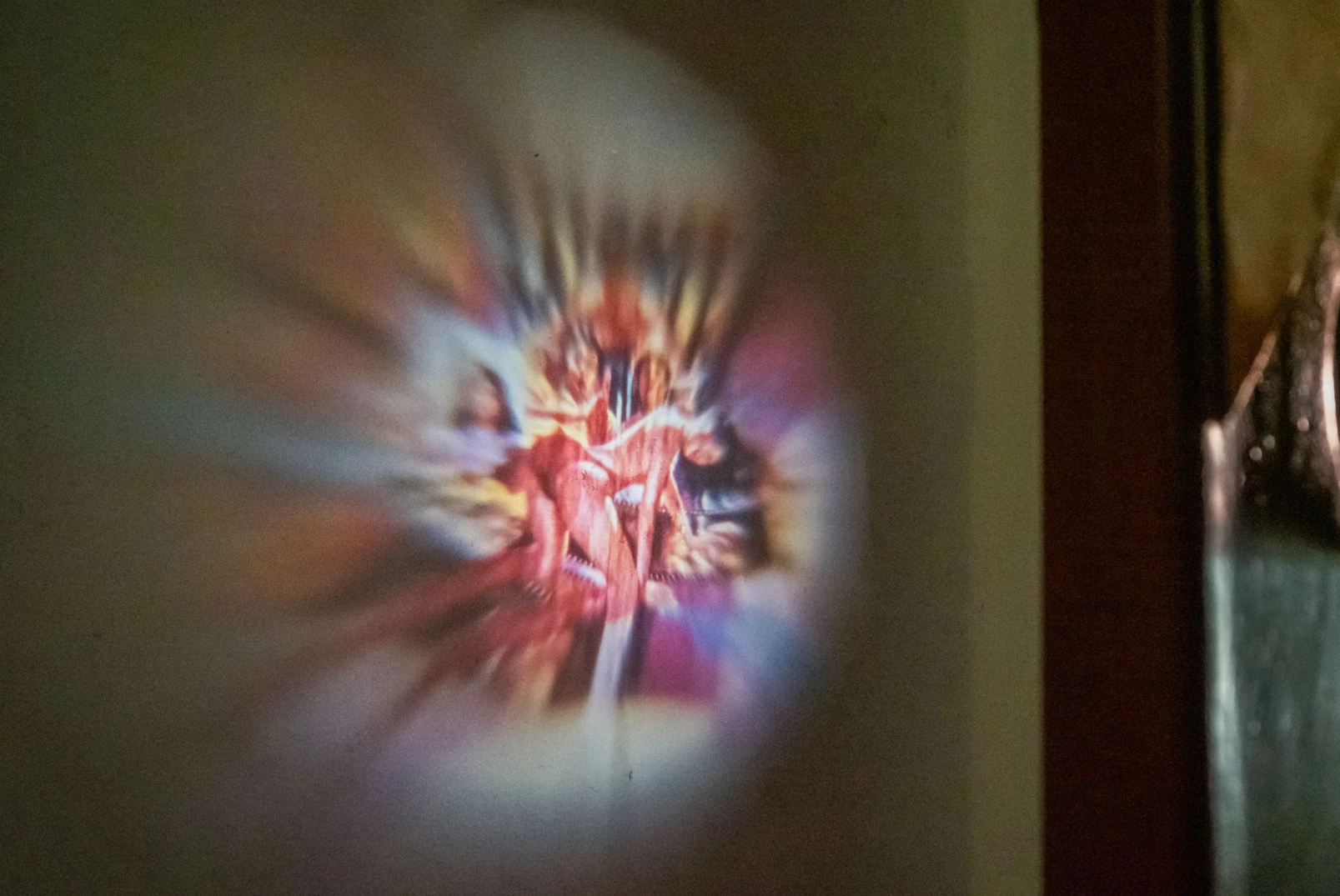
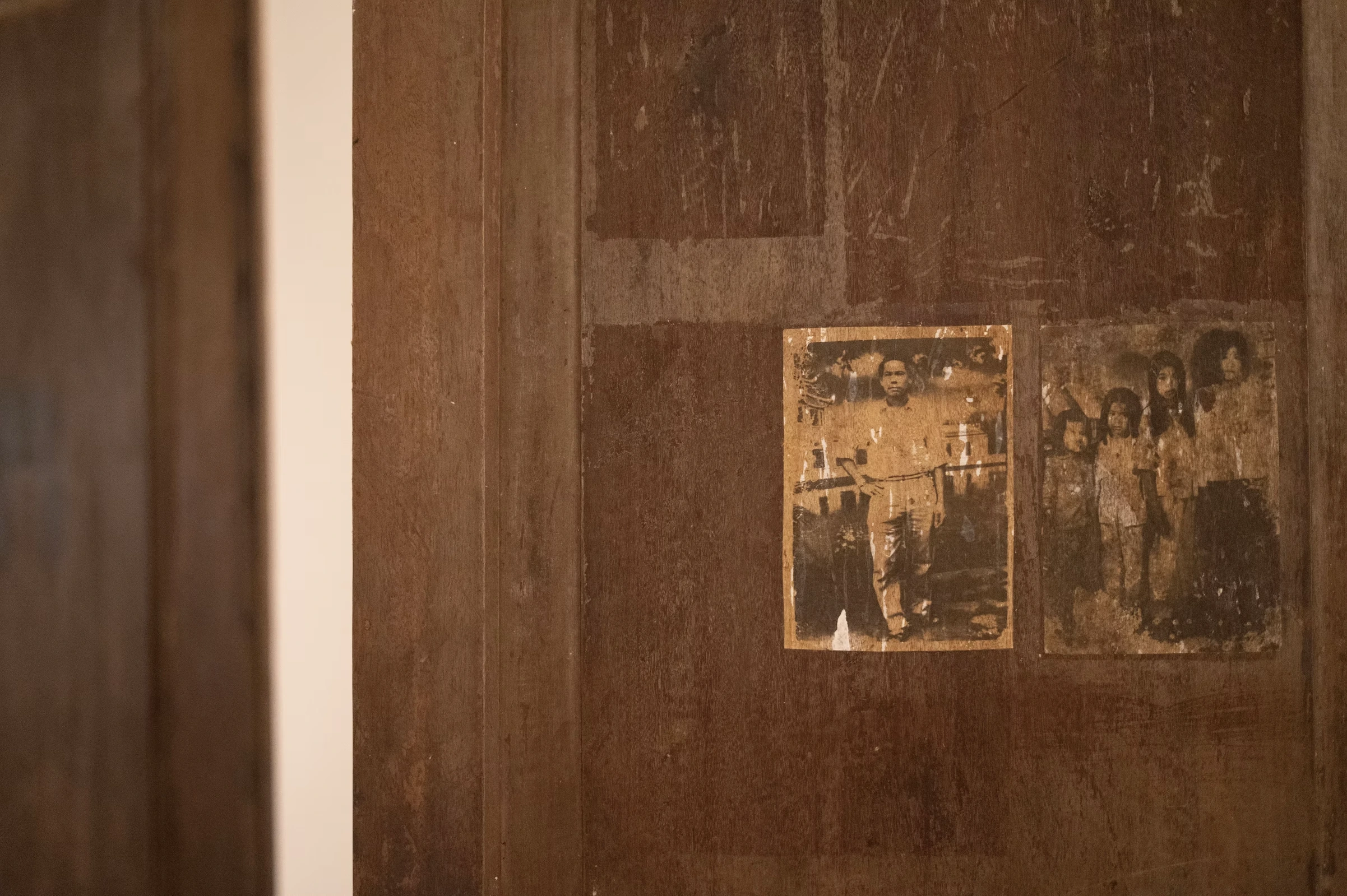
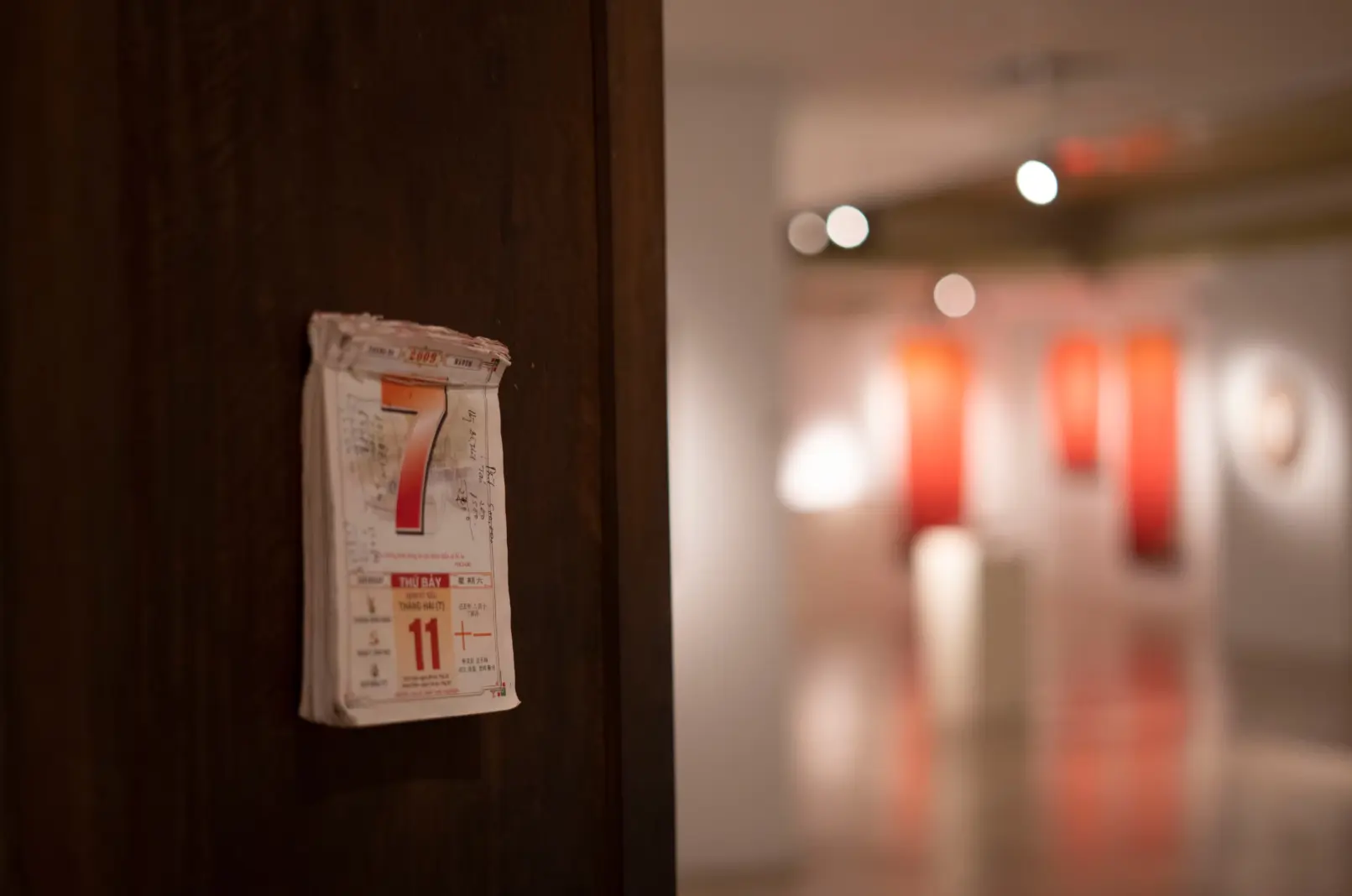
In this way, Xuan Ha’s works emphasise the absence of intrinsic nature – that is, the absence of fixed boundaries – in things. Each object is merely a temporary knot in a web of relationships, in currents of causality that never cease to flow. Perhaps this understanding explains her recurring use of two elements: wooden doors (symbolising the medium as intermediary or means of mediation) and blurred images. Both appeared in The Letter R and reappear in The man who fell asleep, and the door that opened to an unnamed place (2025) – a work that turns towards intimate memory rather than scenes of social life. Onto two old wooden doors, she affixes photographs of her late grandfather with his family, an old calendar found in his suitcase after his death, and four photographs of her parents on the day of his funeral, blurred through four glass spheres. The photographic sequence captures her father letting a newspaper fall from his hands before drifting off to sleep, while her mother puts away a large decorative object in the shape of a red heart. In the downward movement of sleep and death, the news is folded away, consciousness gradually fades, and the loved ones who hold the heart are tucked into the shadowed corners of the frame: time is a string of beads threaded from losses. Yet according to the law of conservation of mass, matter is transformed rather than lost: the world is the corpse of all that has been lost, piled layer upon layer, just as dreams are formed from the accumulated remnants of images from the past. Her grandfather remains there in the black-and-white photographs, and the days gone by remain in the forgotten calendar. To live is to witness loss, but also to practise an art of installation that holds on to time. Only within living bodies and the parts of the world they transform can relationships between material things actively hold one another together, seeking to form memories of the past and dreams in which the future takes shape, through processes of meaning-making at the biochemical, psychological and social levels.
Words: Nguyen Vu Hiep
Translation: Art Nation