Đọc phiên bản tiếng Việt tại đây.
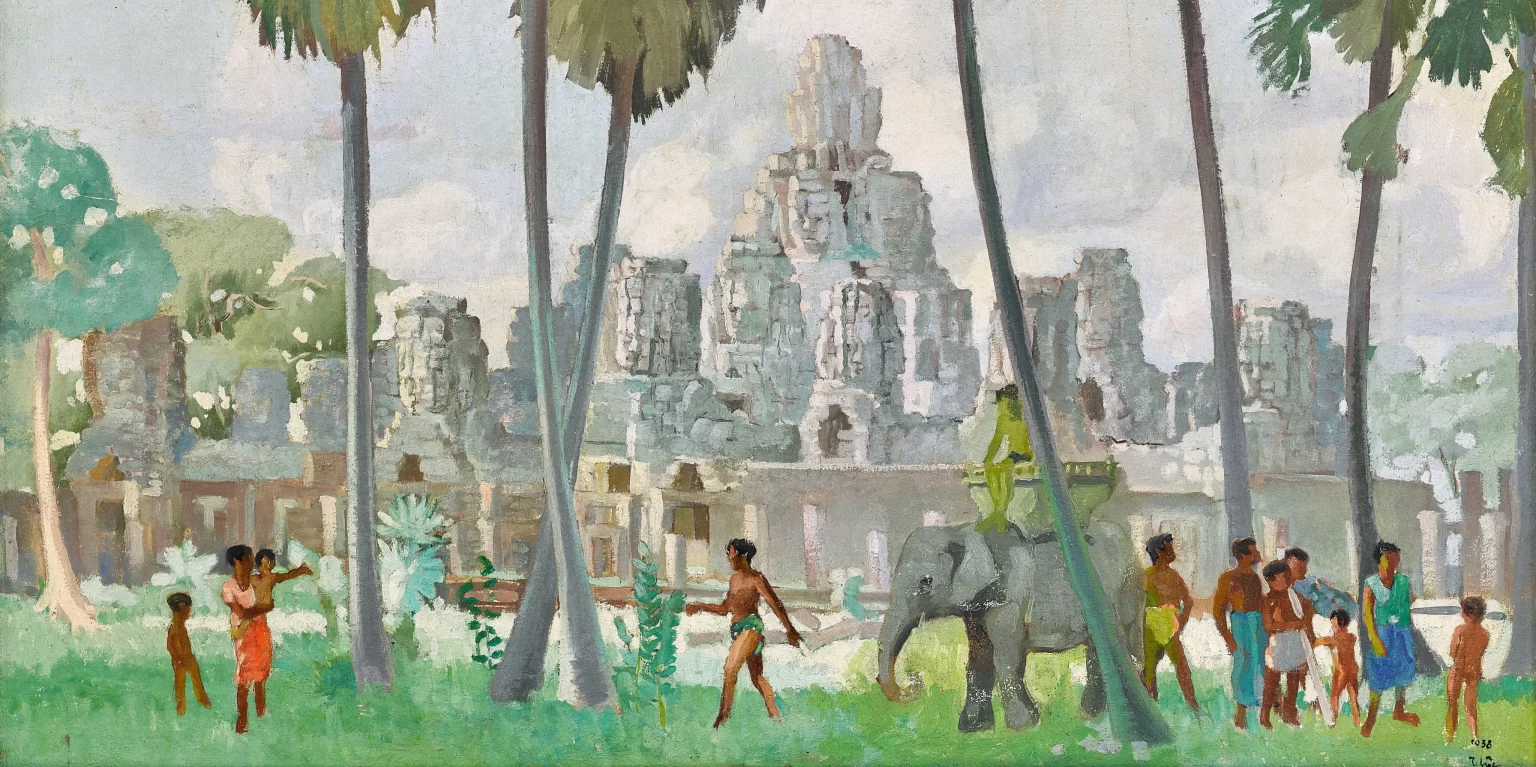
In the history of Indochinese art, Angkor has often occupied an intersection between archaeology, travel, and painting. From the early twentieth century onward, the Khmer ruins became a particular object of spectacle for French artists travelling through the colonies. Yet in the 1930s, a generation of Vietnamese artists trained at the Indochina School of Fine Arts began to approach Angkor through a different visual sensibility, with Tran Binh Loc being a particularly significant case. In Angkor Wat (1938), he does not simply depict a monument; rather, he transforms the temple complex into a living landscape in which architecture, everyday life, flora, fauna, and light participate in a unified visual structure. Viewed through such lens, the painting can be situated within a broader dialectic in Indochinese art: a history of how Angkor was experienced, (re)imagined, and reconstituted from different cultural positions.
A brief yet remarkable career
Tran Binh Loc (1914–1941) graduated as valedictorian of the fifth cohort (1929–1934) of the Indochina School of Fine Arts, alongside such major figures as Pham Hau and Nguyen Do Cung. His exceptional talent quickly earned him the favour of the school’s principal, Victor Tardieu, who submitted his work to the 1931 Paris Colonial Exhibition and retained him as a lecturer at the school in 1935–36, alongside Alix Aymé. Tardieu also introduced Tran Binh Loc to Yves-Charles Châtel, Secretary-General of the Government-General of Indochina, commonly referred to as the “Deputy Governor-General”, and Georges-Alfred Bernard, Director of the Indochinese Department of Education, both of whom began collecting the artist’s works. Châtel additionally commissioned Tran Binh Loc to produce a large-scale painting for the decoration of his residence.
The few surviving works attest to Tran Binh Loc’s outstanding versatility across media, encompassing oil, silk, and paper. He was an eminent part of Hanoi’s artistic landscape through the salons of the Society for the Encouragement of Art and Industry (Société Annamite d’Encouragement à l’Art et à l’Industrie, or SADEAI): Yellow Harmony (Hoa sac vang) and The Thatched Hut (Tup leu tranh) were exhibited at the 1935 and 1936 salons, respectively. Tran Binh Loc also produced illustrations for Mores (Phong Hoa) and These Days (Ngay Nay) magazines, demonstrating how closely his practice was intertwined with the urban cultural life of Tonkin in the 1930s.
This promising career ended abruptly when he died in an accident in 1941, at the age of 27. His health had already been fragile, owing to chronic intestinal inflammation. Nevertheless, he took every opportunity to experience different facets of life. He travelled throughout all three territories of Indochina, teaching and painting landscapes and people: waterways, streets, houses and temples, monks, dancers, and scenes of everyday life. This helps explain why, in his paintings, geography rarely functions merely as a backdrop. Instead, it becomes a visual experience constituted by nature, architecture, and the human presence, mediated through the artist’s own direct encounters. Angkor Wat (1938) is an exemplary expression of this approach.
Angkor through French and Vietnamese eyes
Tran Binh Loc’s Angkor Wat comes into sharper focus when situated against the longer history of the visual imagination of Angkor itself.
For French observers in the twentieth century, Angkor initially appeared as an emblematic monument of the past: colossal and mysterious, almost mythic in character. The school of French travelling painters during the first half of the century played a significant role in constructing this image. In André Delacroix’s Angkor Wat at Dusk (1916), architecture and the effects of twilight produce a highly theatrical space, in which Angkor emerges as a dramatic stage of darkness and light. André Maire, in works such as Cambodia, the Temples of Angkor Thom (1955), frequently employed a simplified visual language to emphasise the mass and geometry of architecture and ruins, sometimes setting them in stark contrast with the organic forms of vegetation. In Roger Baudry’s Bonzes in the Ruins of the Bayon (1940s), monks appear directly within the ruins, producing a visual opposition between the present and the past.
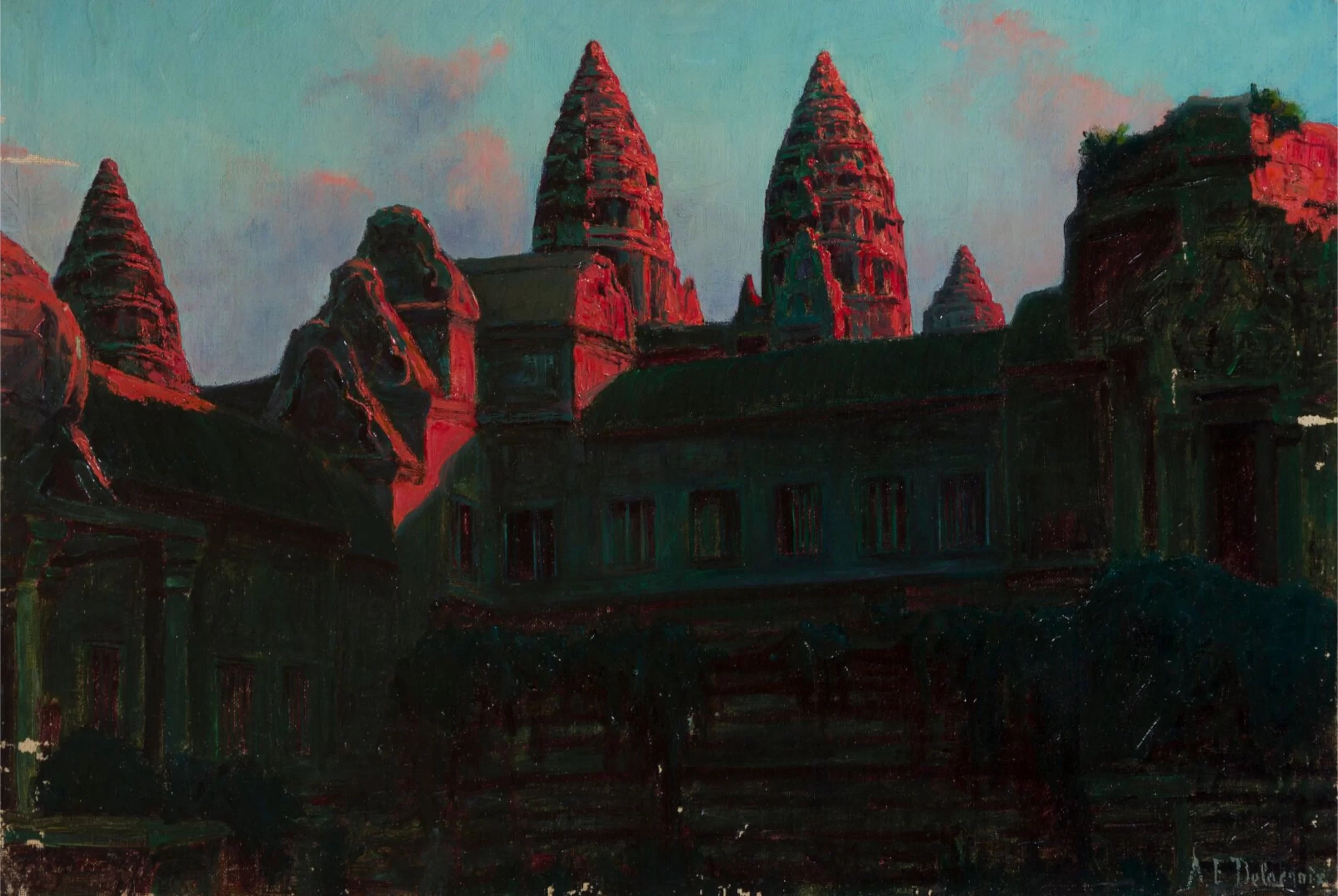
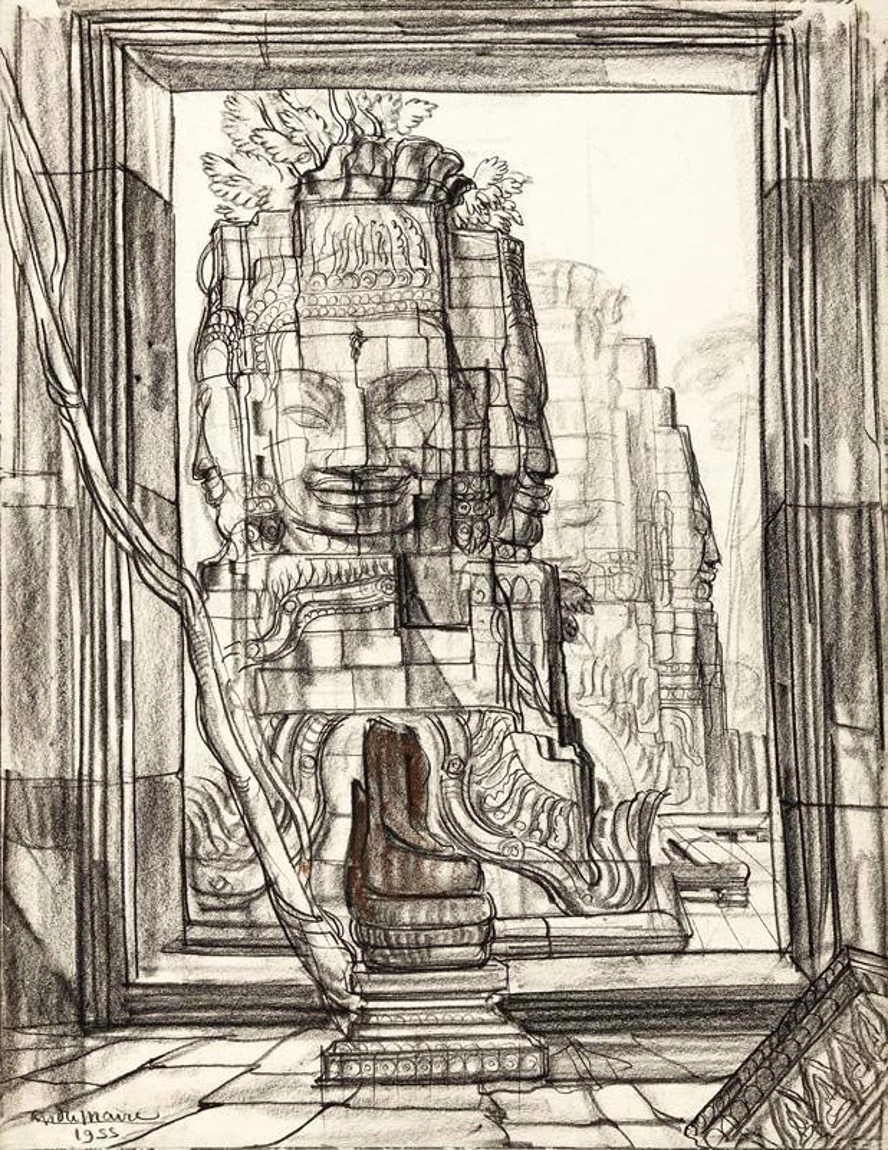
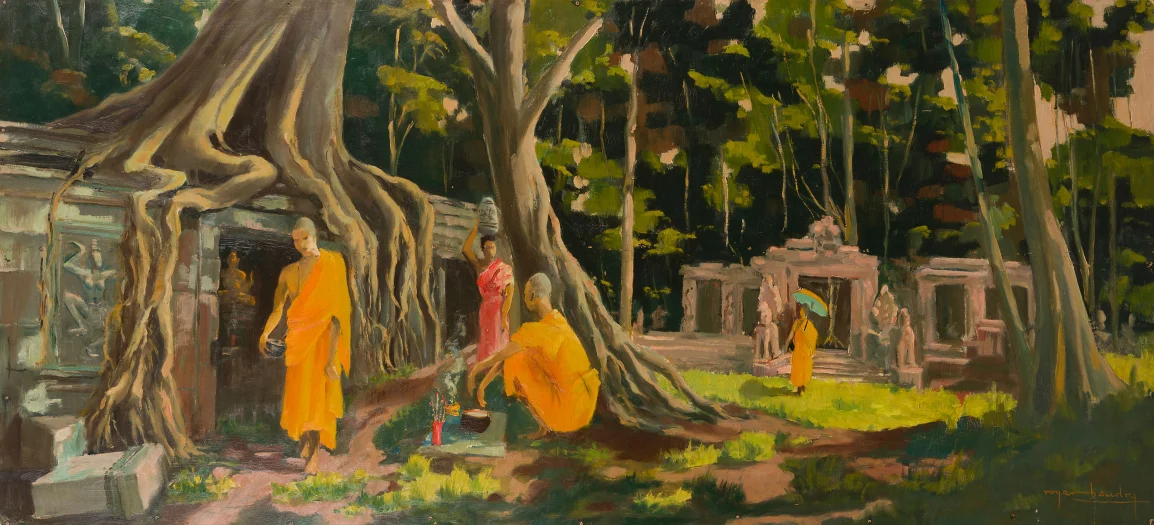
These approaches differ considerably, yet share a fundamental premise: Angkor is established primarily as an object to be observed: as a wonder, a ruin, or the surviving emblem of a lost civilisation.
Recent research by Nelson¹ helps to broaden this trajectory. Examining modern Cambodian art through an “inter-Asia” framework, Nelson demonstrates that Angkor in the 1930s was not imagined solely through the eyes of French outsiders, but was also being reinterpreted by alumni of the Indochina School of Fine Arts. Two works by To Ngoc Van discussed in the article may constitute the earliest representations of Angkor by an Asian artist.
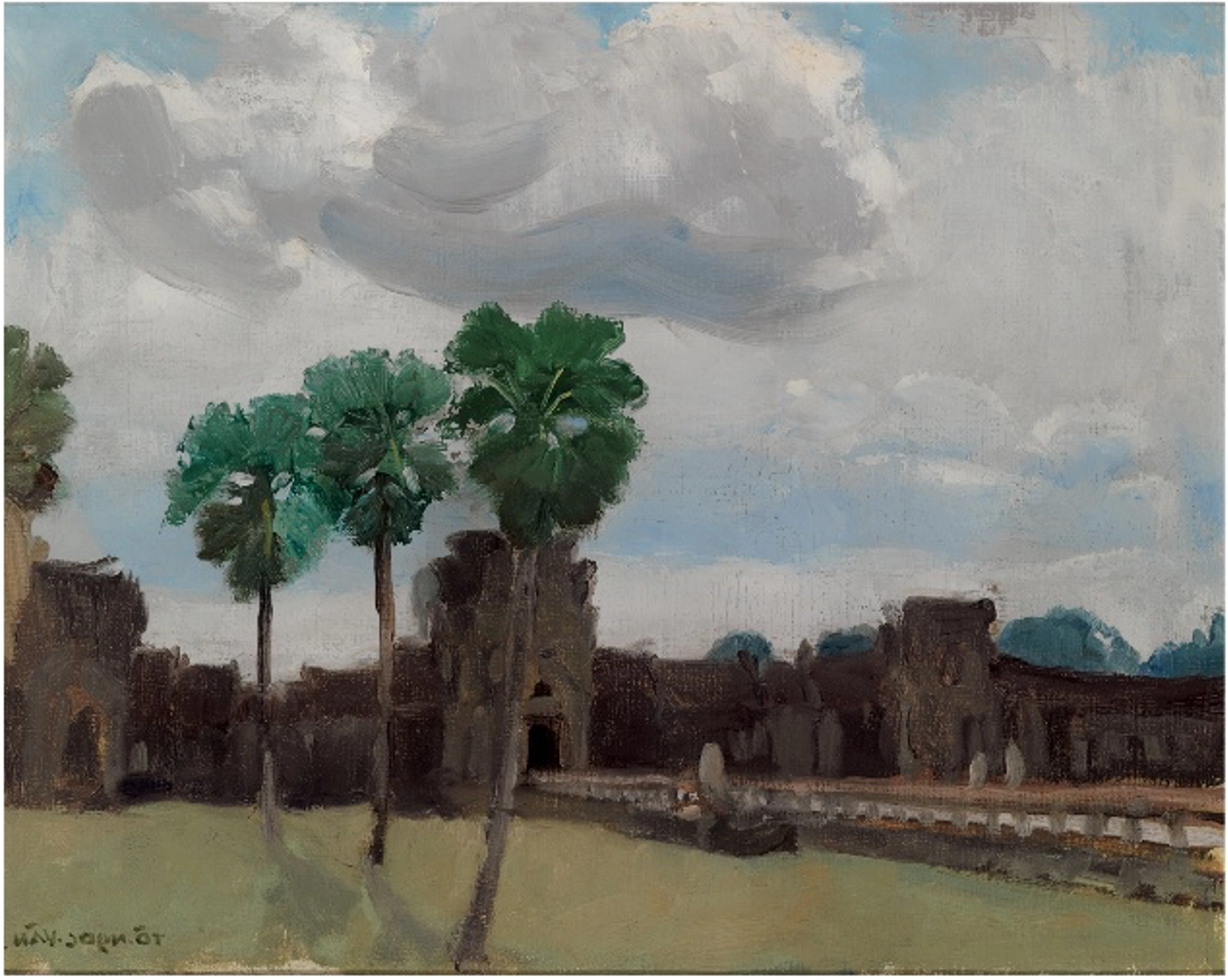
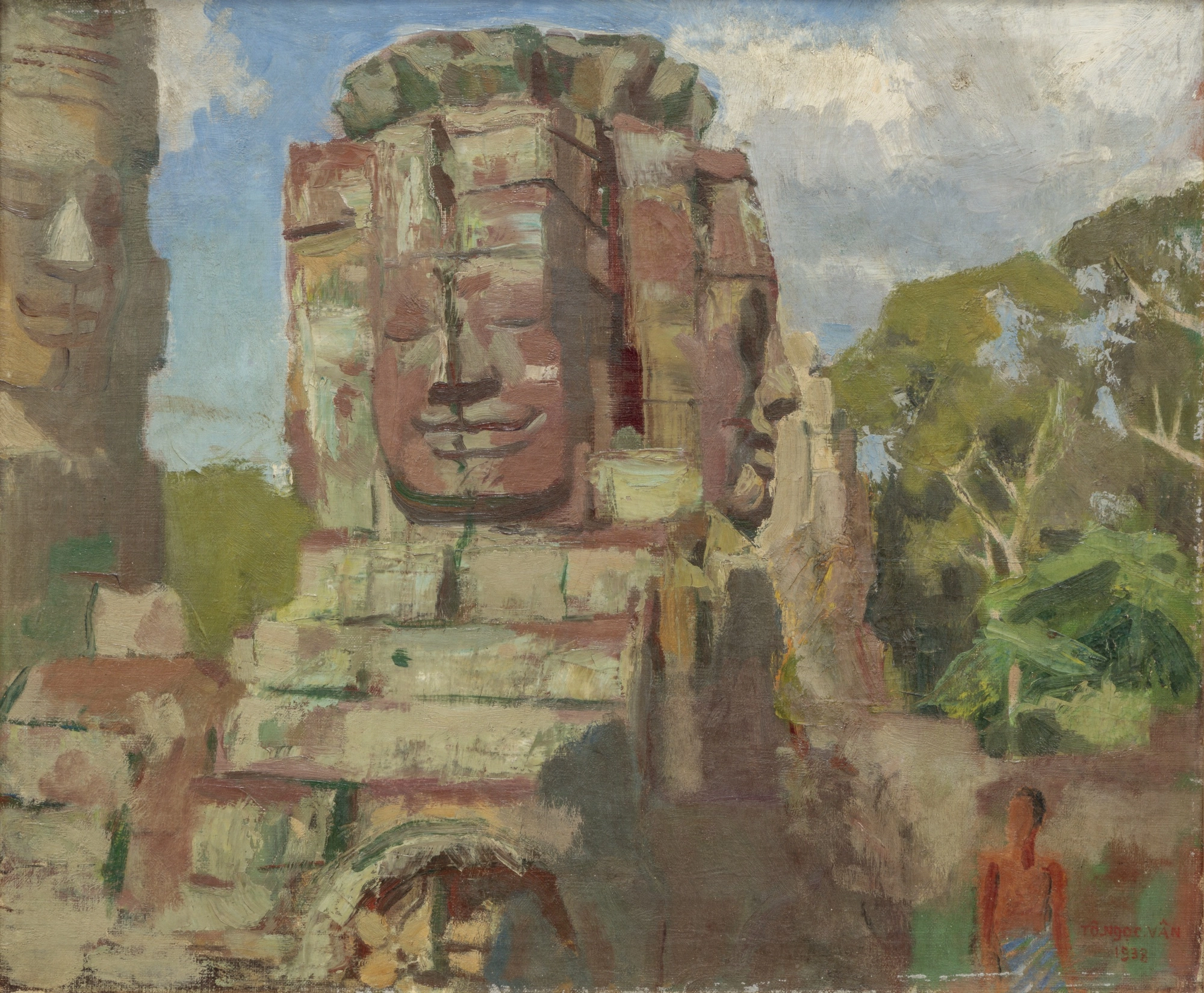
To Ngoc Van’s treatment of the subject differs in important respects from that of the French artists. In Angkor Temple, the temple is not monumentalised; instead, it recedes modestly behind a foreground of tall sugar palms rising into a rain-laden sky. In Angkor, meanwhile, the Bayon face is rendered almost as a living figure – familiar, intimate, and alluring. Architecture is neither isolated nor exoticised; it is situated within the circumstances of a vibrant present. This suggests that Khmer heritage was beginning to enter a broader network of image-making and artistic exchange within Asia, rather than remaining confined to the French colonial discourse surrounding Cambodia.
Although not discussed, Nelson also refers to Tran Binh Loc’s Angkor Temple (1936), a small-size painting (37 × 46 cm) in the collection of the Vietnam National Fine Arts Museum. This mention places Tran Binh Loc within the movement that Nelson identifies. From this perspective, Angkor Wat (1938), one of the rare large-scale (71.5 × 108 cm) works by Tran Binh Loc could be understood as a continuation and expansion of a question emerging in Vietnamese art at the time: how might Angkor be seen by an artist who was simultaneously formed within the colonial art-educational system and positioned as an indigenous artist of Indochina?
Angkor Wat: a lens of local intimacy
French artists arrived at Angkor from a repertoire of positions: as travellers, military officers, or archaeologists. Tran Binh Loc, by contrast, was a Vietnamese artist trained within the colonial system of art education and travelling within the same geographical space of Indochina. Like To Ngoc Van, he approached Angkor from a position of political and cultural proximity, and such affective familiarity is particularly evident in Angkor Wat (1938).
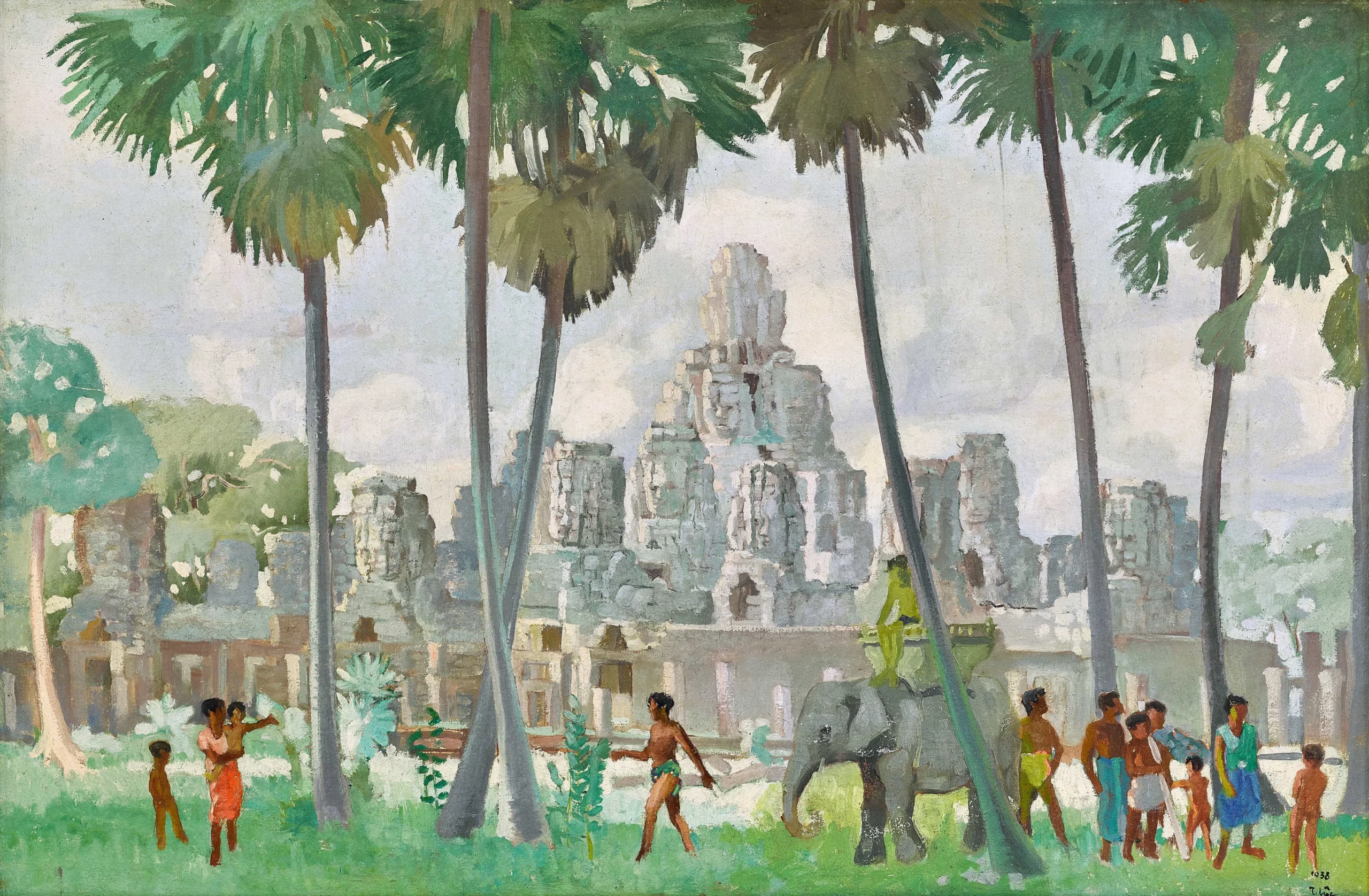
As in To Ngoc Van’s Angkor Temple (1936), the architectural complex is pushed into the background, while the foreground is occupied by the recognisable stand of sugar palms stretching across the full height of the canvas, dividing the pictorial space into rhythmic vertical intervals. Across the vivid green grass, the presence of local inhabitants, their sun-browned bodies rendered with robust naturalism, introduces an immediate sense of lived reality into the ancient setting: a nursemaid carrying a child; a mahout leading an elephant carriage; groups of adults and children gathered together, audibly observing something beyond the picture plane. Nature and everyday life coexist within the same visual field, creating the impression that we are standing there alongside the artist, witnessing the scene ourselves.
These small figures perform more than a merely compositional function. They establish the scale of the architecture while simultaneously drawing the monument out of its symbolic isolation. The temple is not presented as a wonder suspended outside of time, but as a place inhabited by an everyday life that feels immediate and endearing.
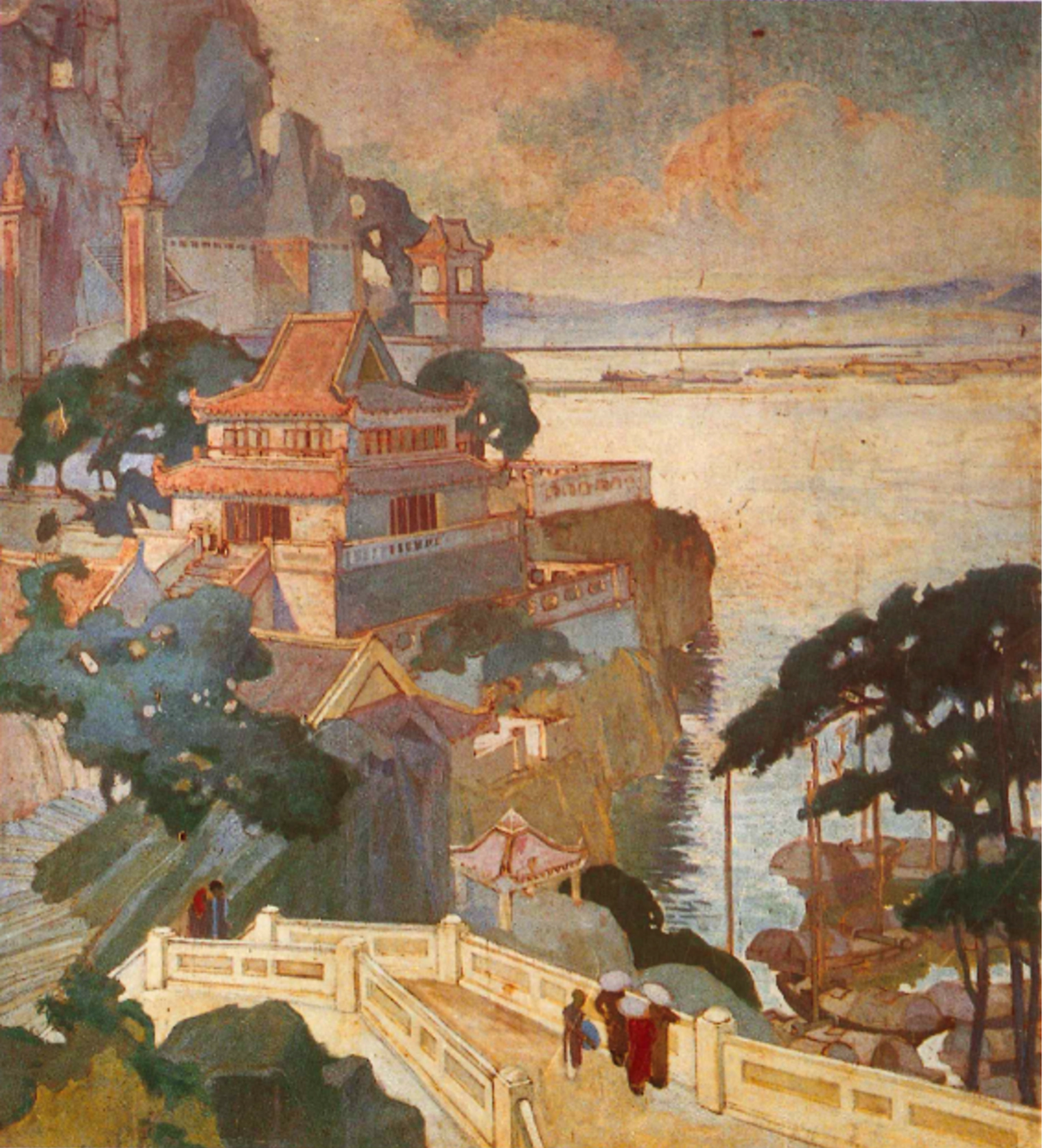
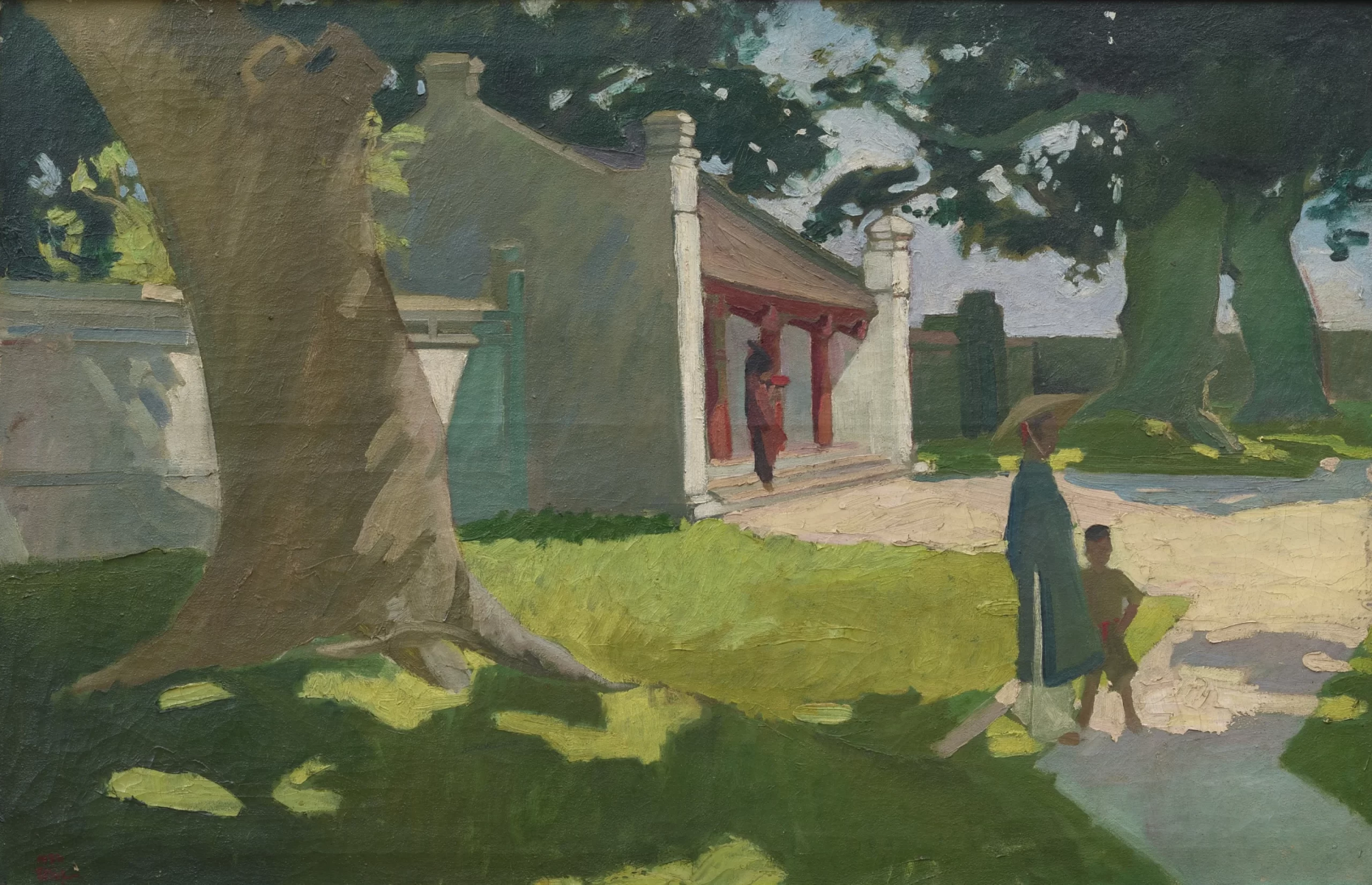
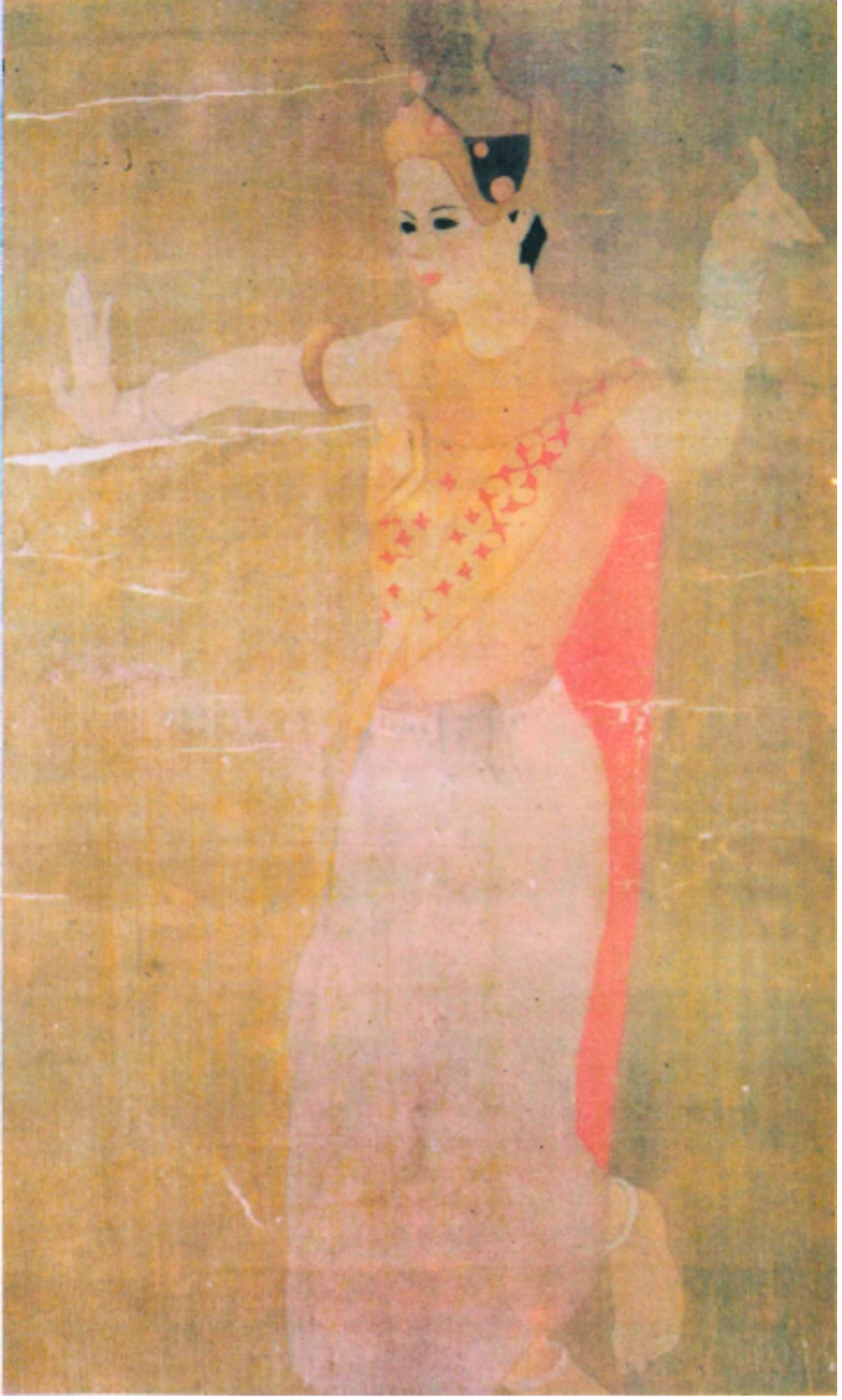
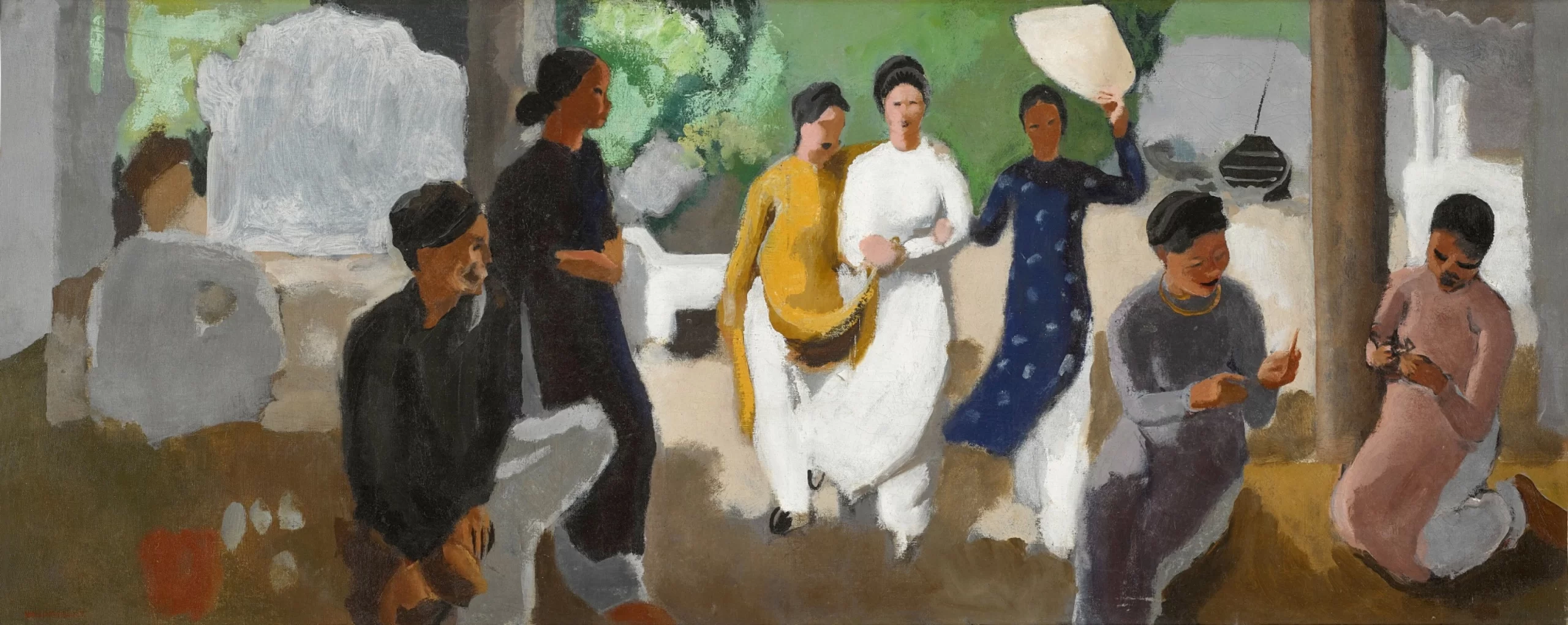
This visual sensibility becomes clearer when the painting is considered alongside other works by Tran Binh Loc himself. In Landscape (1934), a work likely commissioned for the residence of the Deputy Governor-General, the architecture of the temple appears beneath a radiant dawn, yet it does not dominate the composition. Instead, it yields to water, mountains, and sky. Vegetation occupies throughout foreground and background, punctuated by boats moored along the water. Early-morning worshippers appear small, yet possess their own agency. Crossing the connecting bridge, they become an integral part of the architectural ensemble, animating the monument. Similarly, in Lang Pagoda (A Garden Scene of Temple) (1936), religious architecture is not presented as an autonomous object. Urban inhabitants, trees, courtyards, light, and surrounding spatial layers situate the pagoda within the lived landscape of Hanoi. Although the two paintings depict different locations, both demonstrate a consistent tendency to view architecture within its environment rather than detach it from the life that surrounds it. The sense of familiarity in Angkor Wat is therefore not fundamentally different from that found in both. It is an affectionate gaze, not that of the coloniser, but of an Indochinese artist encountering a neighbouring society through forms of life that were proximate. Like To Ngoc Van, Tran Binh Loc travelled from Hanoi to Phnom Penh to paint and teach, immersing himself in local life. Cambodian Dancer (1936) provides a complementary perspective through the representation of the human figure. Against a yellow-and-blue silk ground, the dancer’s carefully observed body is constructed with an immediacy and familiarity comparable to the ordinary gestures and movements of the inhabitants in Angkor Wat.
Considered within the longer history of art, Angkor Wat (1938) thus occupies a distinctive position. If French artists contributed to constructing the image of Angkor within the European imagination, Tran Binh Loc demonstrates a markedly different possibility. He did not need to render Khmer heritage overwhelming or mysterious in order to affirm its significance. By allowing architecture, people, and nature to coexist within a single visual field, he transformed Angkor from a ruin framed by the past into a place endowed with its own lived presence. The painting achieves this precisely because it is seen through a lens of Indochina formed from within Indochina itself. Angkor Wat is therefore both a rare masterpiece by a remarkably gifted artist whose life was cut tragically short, and a compelling trace of an Indochinese art history that has always exceeded the national borders through which it has subsequently been narrated.
The work will appear at the Modern Day Auction of Sotheby’s Hong Kong on 29 September 2026.
Words: Ace Le
[1] Roger Nelson, “Intermedial Inter-Asia and the Beginnings of Modern Art in Cambodia”, TRaNS: Trans-Regional and -National Studies of Southeast Asia (2026), pp. 1–19.
[2] Nguyen Quang Phong, Painters of the Fine Arts College of Indochina, Fine Arts Publishing House (1993).
[3] Duong Vien et al., Les peintures sur soile du Vietnam, Fine Arts Publishing House (1992).