
Currently attributed to painter Chen Jianru (阵鉴如), “The Mahasattva of Truc Lam leaving the mountains” (“The Mahasattva of Truc Lam”) is one of the rare pieces in the history of Chinese painting from the Yuan dynasty to depict a main subject matter from Dai Viet (ancient Vietnam). Behind the depiction of an otherworldly Zen master, the painting allegedly portrays the Dai Viet Emperor Tran Nhan Tong who, following his abdication, became a Buddhist monk and founded the Truc Lam Yen Tu Zen sect, the first Zen sect in Vietnam at the time. This not only makes for a singularly unique occurrence, but also speaks to the complicated relationship between the two cultures after three defeats of the Yuan-Mongol army at the hands of the Tran Dynasty (1258, 1285, 1287–1288). In this context, the fact that a Chinese painter chose to portray a deeply local Vietnamese narrative has sparked a rare phenomenon in the art history of both countries. This article will analyse the piece’s masterful brushwork and distinctive characterisation. A close examination of its artistic features reveals not only vivid reflections of Vietnamese life and customs during the late 13th to early 14th centuries, but also the subtle interweaving of religious thought and political ideology in medieval East Asian history.

“This synthesis of the three principal religious denominations is precisely what separates Truc Lam Zen sect from its Chinese counterparts.”
Genesis and subject
To this day, “The Mahasattva of Truc Lam leaving the mountains” is regarded as one of the most representative works of Chen Jianru. Born in Hangzhou, Chen was renowned for his exceptional skills in portrait painting and heralded as a master of this genre. Created in the 23rd year of the Zhizheng era during the Yuan Dynasty (AD 1363) – 50 years after Emperor Tran Nhan Tong’s passing, the work depicts the Dai Viet Emperor’s monastic life following his abdication. It is believed that the scene in the painting concerns the trip Emperor Tran Nhat Tong made following his enlightenment and ordination with the title “the Mahasattva of Truc Lam,” travelling from Vu Lam cave to the neighboring kingdom of Champa.
To the right of the painting, an inscription in seal script bears the title “The Mahasattva of Truc Lam leaving the mountains,” next to which signed Chen Qi, courtesy name Zhai Tian, senior secretary at the Palace Secretariat (中书舍人石田陈岂篆). To the left is a colophon written in regular script titled “A monograph on the Mahasattva of Truc Lam leaving the mountains”, recounting the story of Emperor Tran Nhan Tong: a benevolent ruler who became a monk and founded the Truc Lam Yen Tu Zen sect, leaving a lasting spiritual legacy and being honored as the First Patriarch of Truc Lam. After its completion, the work had changed hands many times, at one point falling under the possession of the last Qing Emperor Puyi, before ending up in the archives of the Liaoning Provincial Museum in 1949.

Imprints of Dai Viet characters and customs
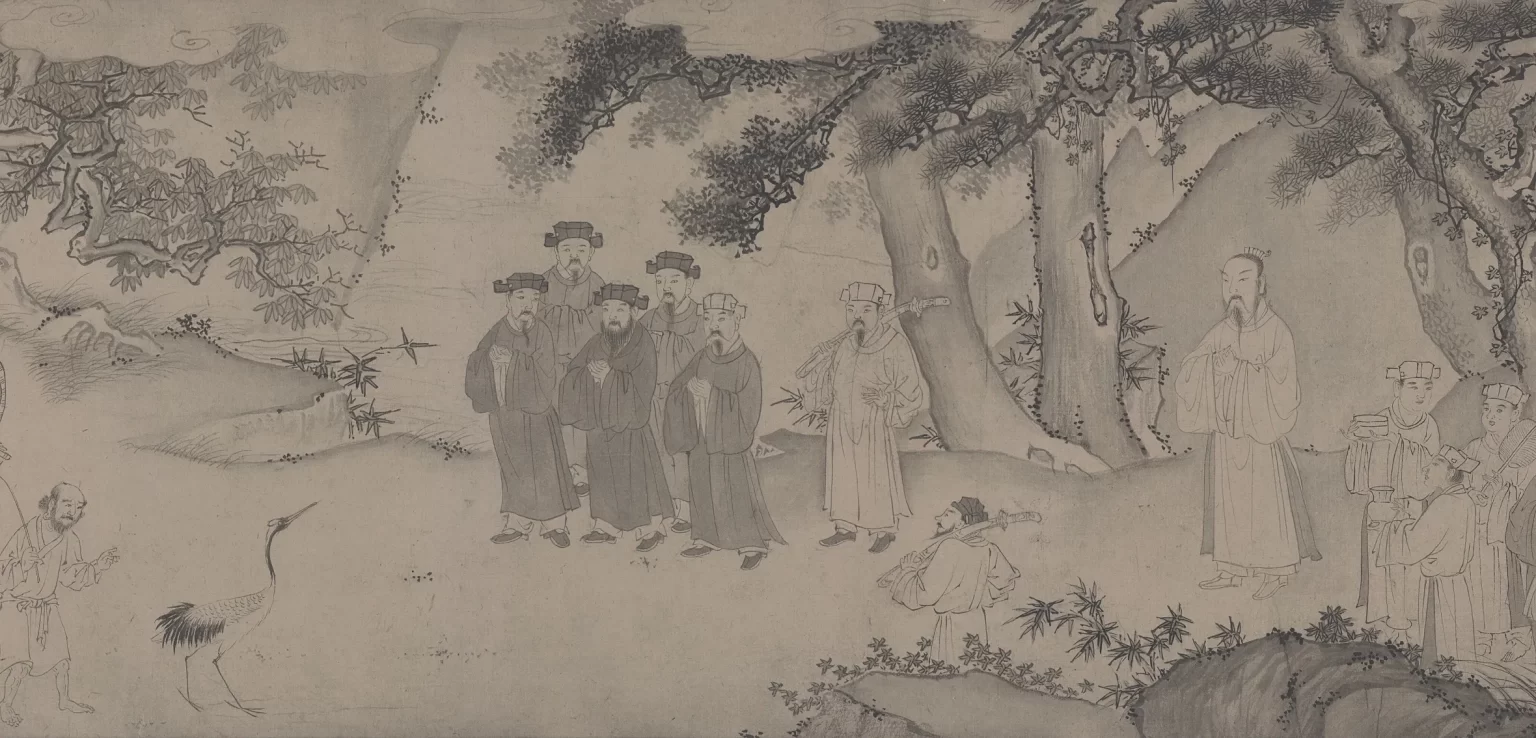
As the scroll unfurls, a series of three scenes appear in the following order: The reigning Emperor Tran Anh Tong and court officials welcoming the Mahassatva; the Buddha King Tran Nhan Tong seated on a palanquin accompanied by common folks, Buddhist monks, and celestial cranes; and the monks of Thien Phuc Temple walking alongside a white elephant bearing sacred scriptures. These images can be seen as a harmonious arrangement of Confucianism, Buddhism, and Daoism within one composition. Three principal religious denominations is precisely what separates Truc Lam Zen sect from its Chinese counterparts, which often prioritise an individual’s connection to nature and the universe in their meditation.
One can easily recognise the imprints of classical Chinese art in “The Mahasattva of Truc Lam.” The composition of the painting is fluid and dynamic, using “scattered perspective” – a spatial conceptualisation method in classical Chinese art – to present a comprehensive picture while simultaneously accentuating the status and identity of each character. In portraying characters and scenery, the artist does not employ colours but achieves tonal variations through ink density to enhance visual resonance – an aesthetic highlight in traditional Chinese painting.
The scroll features a total of 82 figures, all rendered in “iron-wire” lines – one of the 18 fundamental brush techniques in traditional Chinese painting, first emerging during the Wei-Jin-Sui dynasties and flourishing in the Tang and Song periods. This technique is considered to have reached a high level of refinement in the works of Li Gonglin (李公麟), a master painter of the Northern Song. Notably, the figure-painting style in “The Mahasattva of Truc Lam” bears a striking visual affinity to that of the monks in Li’s work “Scroll of five horses.” Through the exquisite application of the “iron-wire” line, each member of the Buddha King’s entourage exudes distinctive characterisations, conveying the artist’s acute sensitivity to individual traits and demeanours.
The Mahasattva’s entry into the earthly realm is envisioned with him seated on a palanquin, a string of prayer beads in hand, his expression gentle and compassionate. Five other monks are also shown holding or wearing similar beads. Such a depiction reflects the tendency to fuse the two different traditions of Zen and Pure Land Buddhism during the Yuan period. It also mirrors the real-life spiritual practice of the Mahassatva of Truc Lam himself as recorded in his poem “Song of Enlightenment upon Joys of Forest and Stream”:
“Worshipping Buddha and Heaven
Offering incense day and night
Chanting sutras and reciting the Buddha’s name
Invoking the sacred in earnest prayers.”


“The Mahasattva’s entry into the earthly realm is envisioned with him seated on a palanquin, a string of prayer beads in hand, his expression gentle and compassionate.”
Other Vietnamese figures are portrayed as gathering around the palanquin carrying the Mahasattva of Truc Lam. According to the book “A thousand years of caps and robes” (The Gioi Publishers, 2013) by Tran Quang Duc, the dress code for court officials in the year 1300 stipulated that all officials at the rank of the Emperor’s entourage wear the blue Toan Hoa hat as per previous regulations, which is described as having “two jeweled ornaments attached on both sides”. In the painting, it can be seen that the mandarins, guards, and eunuchs in attendance to the Buddha King Tran Nhan Tong all wear hats of similar forms: half-hexagon shaped, with two wings short and square, some curled backward, some forward, others extended straight, the majority fastened with jewels at the temples. A number of guards are shown wearing a different kind of hat with a six-notched ornament placed at the centre of its horizontal wings. Traditional Vietnamese clothings such as ao tu than (four-piece shirt) and ao giao linh (robe with a wrap collar on the right side) can also be identified in the painting.

Furthermore, images of figures with shaved heads draw attention to a distinctive feature of the Vietnamese people during the Tran dynasty that set them apart from their northern neighbours, who typically wore their hair long and tied in topknots. During this period, it was common for the Vietnamese to keep their hair short or tied into a bun, tattoo their bodies, dye their teeth black and lips red, and walk barefoot. This practice of head-shaving persisted until around 1470, at which point it started to fade. Chinese scholar Chu Yingzhang (俆英章) writes: “From their caps and robes to their carriages, everything […] captures a glimpse into the life of Annam.”1 As such, the painting offers a detailed portrayal and reconstruction of the unique customs and cultural sensibilities of the Dai Viet people.
In addition to human characters, the animals in “The Mahasattva of Truc Lam” are also rendered with deliberate artistic intent. The significance of the crane, buffalo, and white elephant in the painting have been well established in scholarly discussions of the scroll, but one may also discern the distinct imprint of Song and Yuan–period artistry in the depiction of the spirited steed standing among the entourage welcoming the Buddha king. In traditional Chinese painting, the image of a horse often conveys the artist’s attitude towards the political and social climate of the time, based on various styles of depiction. Unlike the the forlorn horse in the painting “Emaciated horse” by Gong Kai (龔開) from the late Northern Song dynasty or “Tribute horses” by Ren Renfa (任仁发) of the Yuan dynasty, the imagery of this animal in “The Mahasattva of Truc Lam” exudes strength and nobility, embodying the spirit of a creature symbolic of a gentleman’s virtue and integrity. This imagery not only highlights the prestige and poise of the Mahasattva, but also reflects the author’s reverent vision of the flourishing and prosperous life of Dai Viet. All in all, the image of Emperor Tran Nhan Tong embracing spiritual life must have deeply resonated with Yuan scholars during a time of political upheaval and moral degeneration. Within such a context, a sovereign who willingly relinquishes power in pursuit of inner peace embodies not only religious ideals, but also serves as a symbol of transcendence over worldly ambitions, evoking admiration and deep yearning for a return to the truth.

“From their caps and robes to their carriages, everything […] captures a glimpse into the life of Annam.”
An unfinished tableau
Historical records indicate that the influence of the Truc Lam Zen sect gradually declined following the fall of the Tran dynasty; by the time of the Ming invasion, many works related to Buddhism, Zen, and the Truc Lam Zen sect itself were brutally destroyed. This archival gap has given rise to theories challenging Chen Jianru’s authorship, advocating instead for a claim that the painting might have been the work of a Vietnamese artist or the result of an indigenous Vietnamese collaborative effort. If we are to accept the accuracy of this theory, then the painting serves as a precious historical document proving how the artistic techniques of Vietnamese painters from the Tran dynasty were highly influenced by Chinese traditions, especially the “iron-wired” line technique of the Song era, reaching significant heights in technical sophistication. The painting also stands witness to an era of Buddhism’s proliferation and prosperity in Vietnam under the benevolent leaderships of Tran rulers. However, one cannot entirely rule out the possibility that the work was, in fact, produced by an artist of the Yuan court, in which case, it serves as testimony to the vibrant cultural exchanges between the two civilisations during the tumultuous late-Yuan era. Ultimately, the work remains a vital text for historians and art scholars between and beyond Vietnam and China, not least for disputes surrounding its true origin and authorship, but for its artistic significance as a rare testament to Tran Nhan Tong’s transformation into a Zen icon whose legacy transcended the borders of Dai Viet.

Words: Hà My
Translation: Nhật Anh