Đọc bài viết tiếng Việt tại đây.
Artistic change in 1990s Vietnam
The 1990s were a time of artistic exuberance in Hanoi as, following the 1986 Renovation reforms that transformed Vietnam’s centrally planned economy to a market-oriented system, art altered too. This decade saw most painters refreshing modern Vietnamese painting through expressionism and abstraction.¹ However, a few Hanoi non-conformists frayed independent paths. Vu Dan Tan (1946–2009), Truong Tan (b. 1963), Nguyen Van Cuong (b. 1972), Nguyen Minh Thanh (b. 1971), and Nguyen Quang Huy (b. 1971), among others, early in the decade innovated idioms that, unlike Vietnamese modern painting shaped via reception of European academy aesthetics, did not involve foreign-sourced transfer described by Phoebe Scott.² Instead, adopting the momentous social and cultural shifts spurred by Renovation and globalisation as components and drivers of untested visual forms, they initiated contemporary art.³
Non-conformists disregarding disciplinary segregation
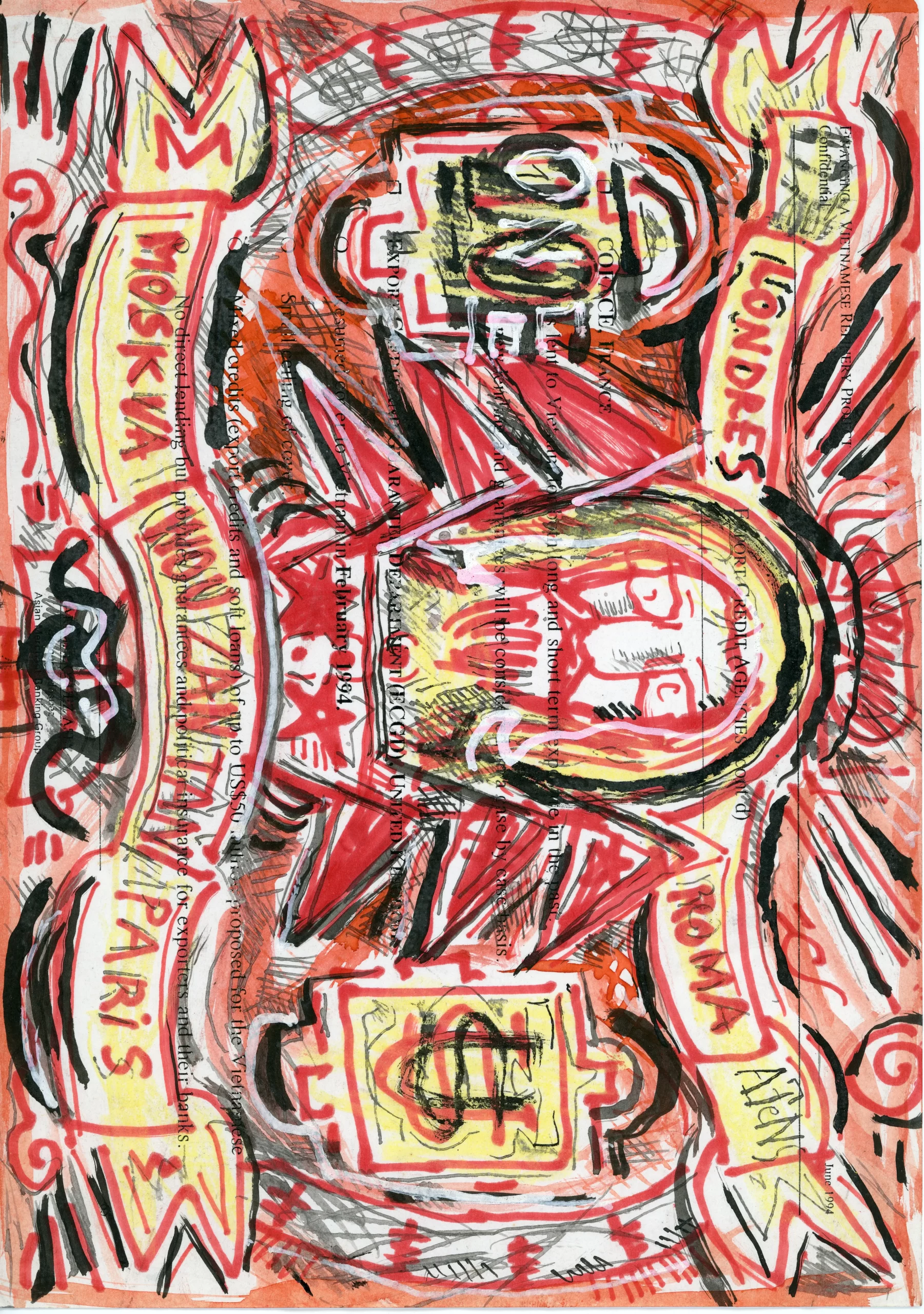
While Southeast Asian artists often abandoned painting when developing contemporary art, Hanoi pioneers conserved painting and aspects of Beaux-Arts aesthetics.⁴ But departing from modern pictorial convention, they expanded their media and disciplinary repertoire, and disregarding academy disciplinary compartmentalisation, merged images and text in the graphic field. In 1993, Truong Tan presented in Hong Kong inks that combined figuration and narrative in cursive Vietnamese. In 1994, answering economic reform, Vu Dan Tan began his paper series Money, variously-sized humour-filled mock currency featuring multilingual captions. Decades before, he was already marrying images and words, and in 1989 started his abstracted pictogram series Festival Banners (1989–1993). In 1994, while a student at Hanoi’s Fine Arts University, Nguyen Van Cuong produced My mother is a farmer, an ink-on-paper diptych giving equal space to language and image.⁵ Cuong’s classmate Nguyen Quang Huy also conflated forms and words, repeated as leitmotifs or short narratives. Their classmate Nguyen Minh Thanh text-captioned his whimsical figurative inks. Thanh and Huy’s interest in text-image composites dwindled later in the decade, although Huy morphed his earlier narratives into undecipherable script masking figures and portraits.⁶ Since Vu Dan Tan, Nguyen Van Cuong, and Truong Tan explored image-text juxtapositions persistently over years, they are the focus here.
How and why did artists incorporate language into art, providing it with conceptual titles, when most were painting descriptively titled, text-free landscapes or interiors? What were the sources of their disciplinary expansion and blurring? As Nora Taylor has written, the early-1990s Hanoi art world was still relatively closed to outside aesthetic trends, and artists had limited access to then-current New York conceptual art⁷ – Tran Luong, visiting New York in the early-1990s, was among the few exceptions.⁸ Vu Dan Tan had been in the USSR (1987–1990), and Russia and France (1993-1994), and Truong Tan in Paris in 1994. However, both, along with younger artists discussed here who had never left Vietnam, confirmed that until 1996, when they began travelling for exhibitions, they were unaware of New York conceptual practices – Jeff Koons, Barbara Kruger, and Jenny Holzer were unknown.⁹ When, in 2001, I asked Vu Dan Tan about art in 1993 Paris, he cited Yves Tinguely’s mobile pieces; Truong Tan in 2010 remembered the aesthetics of Paris streets and metro signage, claiming these as influential. While a few foreign artists – Erix Leroux; Veronika Radulovic – circulated in Hanoi after 1993, – their influence on aesthetics is debatable. Vu Dan Tan and Truong Tan had practiced disciplinary crossover before knowing these foreigners’ works. Of the foreigners, Radulovic made word-images, but the Hanoians’ pieces didn’t resemble hers. Plausibly, her text usage, like that of Truong Tan – their university drawing instructor and friend, who mentored them as an independent – encouraged Cuong, Thanh, and Huy’s initiatives.¹⁰ But beyond this, as in wider Southeast Asia where contemporary art broke from modern pictorialism because innovating aesthetic-conceptual methods were needed for answering complex Cold-War and millennium reality,¹¹ Hanoi artists mined local sources and conditions for materials and ideas. They originated new art not as imitation or transfer, but in response to the times. Southeast Asian artists used their surroundings – its images, materials, and paradigms – as building-blocks and driving forces; 1990s Hanoi trailblazers were no different: they seized local culture and the fast-changing city to forge contemporary art that resembled nothing else.¹²
This article, drawing on my research since 2001, revisits examples and contextual reasons illuminating how and why Vu Dan Tan and the others fostered image-word combinations, a marker of Vietnamese and Southeast Asian contemporary art.¹³ Their environment and its frictions provided physical and intangible sources, while the urge to critically solicit viewers in ways impossible with standard painting explained artists’ attraction to textual components. Typological examples of works by Vu Dan Tan, Truong Tan, and Nguyen Van Cuong demonstrate the text-image methodologies and aims of novel expressions contending with urgent home realities – imitation was useless, as there were no models for art capturing a “New Vietnam” in the globalising 1990s.
New Art from components of culture and urban life
The Vietnamese’ penchant for poetry, folklore, and literature is well established. Jamieson observed that Vietnamese of all social strata reference literary allusions and classical language in everyday life.¹⁴ Even before mass literacy, the great epics recounting Vietnamese history in mythologised form were universally engrained, and Dong Ho festival prints, captioned in Chu Nom or Quoc ngu, remained relevant into this century. Thus, language-based vernacular forms could inform contemporary art. Late-20ᵗʰ century Hanoi also yielded visual source material via signage. Posters publicising government campaigns, pervasive around Vietnam, were suited to artistic appropriation, as was international brand advertising infiltrating the Hanoi skyline. Works by Vu Dan Tan and Nguyen Van Cuong suggest the artists not only plundered these text-rich icons, but also drew on the tensions represented by their semantic opposition on Hanoi streets. Nguyen Van Cuong’s 1997 Couleur du Dollar (The Colour of Money), part of his Franklin series included in the 1998 exhibition Paris, Hanoï, Saigon-l’aventure de l’art moderne du Viêt Nam (Paris, Hanoi, Saigon: The Adventure of Modern Art in Vietnam) at the Pavillon des Arts (France), through its image-text juxtaposition and French title, dialogued with tensions between systems as Vietnam and the world embarked on globalisation. The image’s French title meaning “the colour of money”, and Vietnamese wordplay on colour – “màu đỏ” (red) and “màu đen” (black) – allude to debtors’ solvency/insolvency, or being in-the-black or in-the-red, so can be read as fingering capitalism’s social ramifications and creation of haves and have-nots. The work takes no position, but via word-image juxtapositions prompts the viewer to think about the world around them. And while rooted in 1990s Hanoi, it conversed with global audiences on capitalism and its impacts which found relevance everywhere.
As 1990s Northern Vietnam emerged from decades of austerity, including food shortages, and then climbed from poor to lower-middle income nearly overnight, inventive artists, seeking new expressive idioms for answering the era and its stresses, claimed whatever was available, including language – a conceptual-visual component or “material”. Observing widening material sourcing (although not discussing textuality), Ian Howard’s essay for the 1996 Second Asia-Pacific Triennial of Contemporary Art focused on Vietnamese “making do”.¹⁵ Words, abstract and requiring interpretation, with images served the critical, conceptual purpose of contemporary art.
Thus, the disciplinary expansion of text-image alliances, sourced locally in vernacular culture and the city, and in social frictions of globalising Vietnam, was attractively cost-free and versatile. It was also appealing for its ease of audience access and capacity to convey artworks’ questions on economic shifts; changing gender relations; altering views of tradition; rural/urban dichotomies that were impacting Vietnam’s social contract. Finally, as observed in wider Southeast Asian contemporary art, by enlisting text-rich visual idioms, Vu Dan Tan, Truong Tan, Nguyen Van Cuong, and their friends ensured active viewer involvement with the artwork’s subject matter through reading: textuality compelled audiences to work – thereby buttressing the collectivist, outward-looking perspectives of the pieces.
Typology of textual methods
Research on 1990s Hanoi’s breakaway art, which I began in 2001, reveals textual components as a marker of early Vietnamese contemporary art that I systematised typologically, as summarised below.¹⁶ Artist biographies reveal shared interest in language irrespective of differing backgrounds and generations.¹⁷ Vu Dan Tan, born into a Hanoi literary family, wrote stories and played piano in addition to artmaking. Not trained at the Hanoi art school, and drawing cartoons for Vietnam’s national cartoon studios, he saw no justification for disciplinary separation and thus from the 1970s, combined multilingual text and image to extend and complicate iconographic meaning.¹⁸ As a child, Truong Tan was enchanted by the aesthetics of writing and his teachers’ elegant cursive notes. He took refuge in stories, and in the school library, unlike his classmates who played outdoors. Nguyen Van Cuong recounted his fascination watching his grandfather practicing calligraphy in the family courtyard. Beyond aesthetics, he revelled in the sound of words, and in playing with their meaning. Nguyen Quang Huy was interested in the form and semantics of words, while Nguyen Minh Thanh, drawn to books, studied French when Alliance Francaise began Hanoi classes in 1992. Whatever their personal relationship with language, all agreed that standard mimetic painting could not contend with 1990s Vietnam. Expanding images with sound, space, time, movement, and text was mandatory, hence their development of installation, audio pieces, performance, and novel pictorial-textual aesthetics. Speaking about his and his classmates’ mid-1990s innovations, Nguyen Van Cuong stated: “We were confronting unprecedented times, so we made other kinds of art to address that, and language was obvious and easy. It took pictures to new places”.¹⁹
Titling, series, wordplay, interrogation
Whereas Vietnamese modern painting was usually titled descriptively or poetically – Girl with Cat, Autumn Memory – Vu Dan Tan and Nguyen Van Cuong created 1990s series about intangible notions necessitating titling that could articulate difficult to illustrate ideas, and sometimes solicit viewer effort through decoding and interrogation, which spurred critical reflection and exchange on societal topics, a marker of contemporary art.
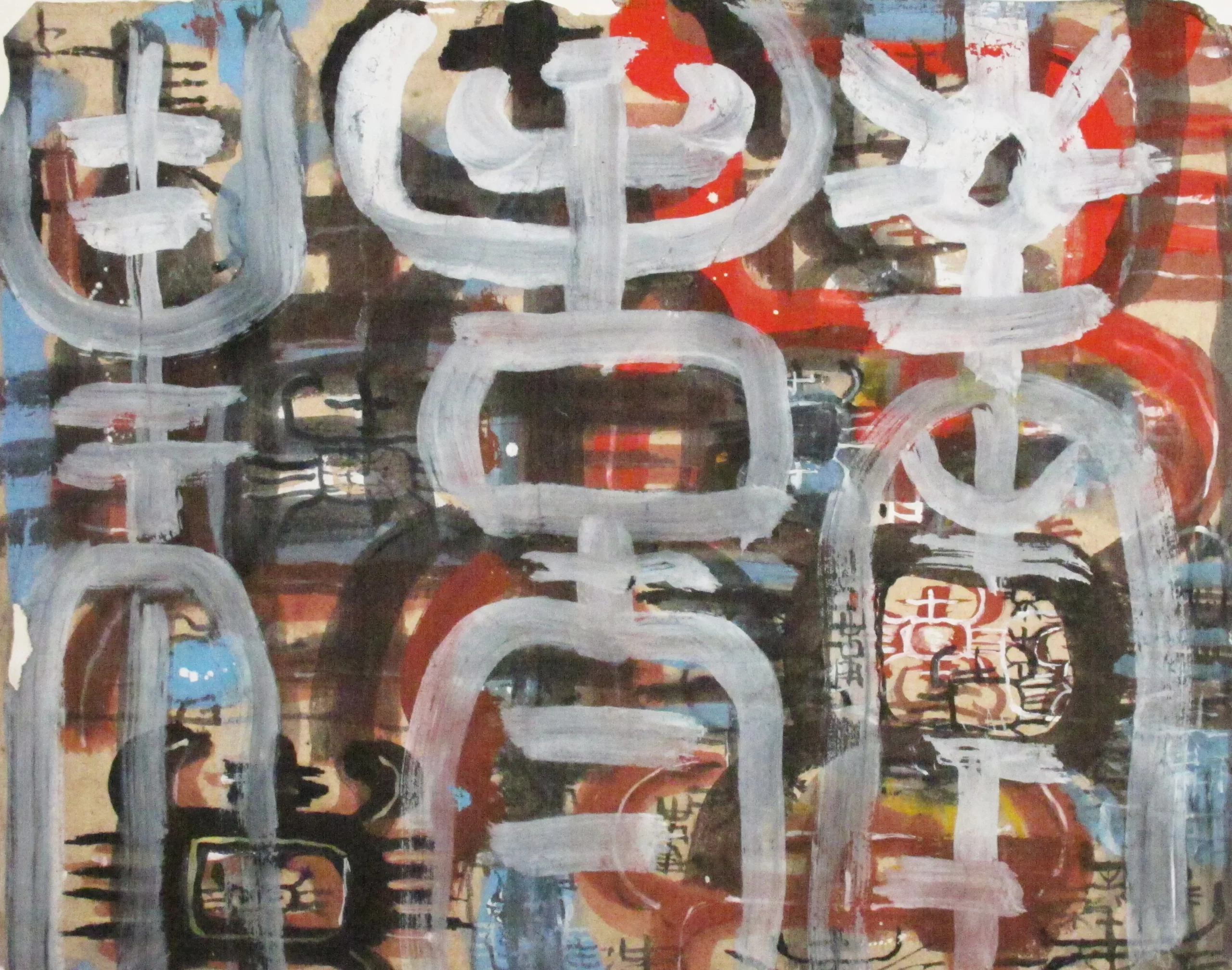
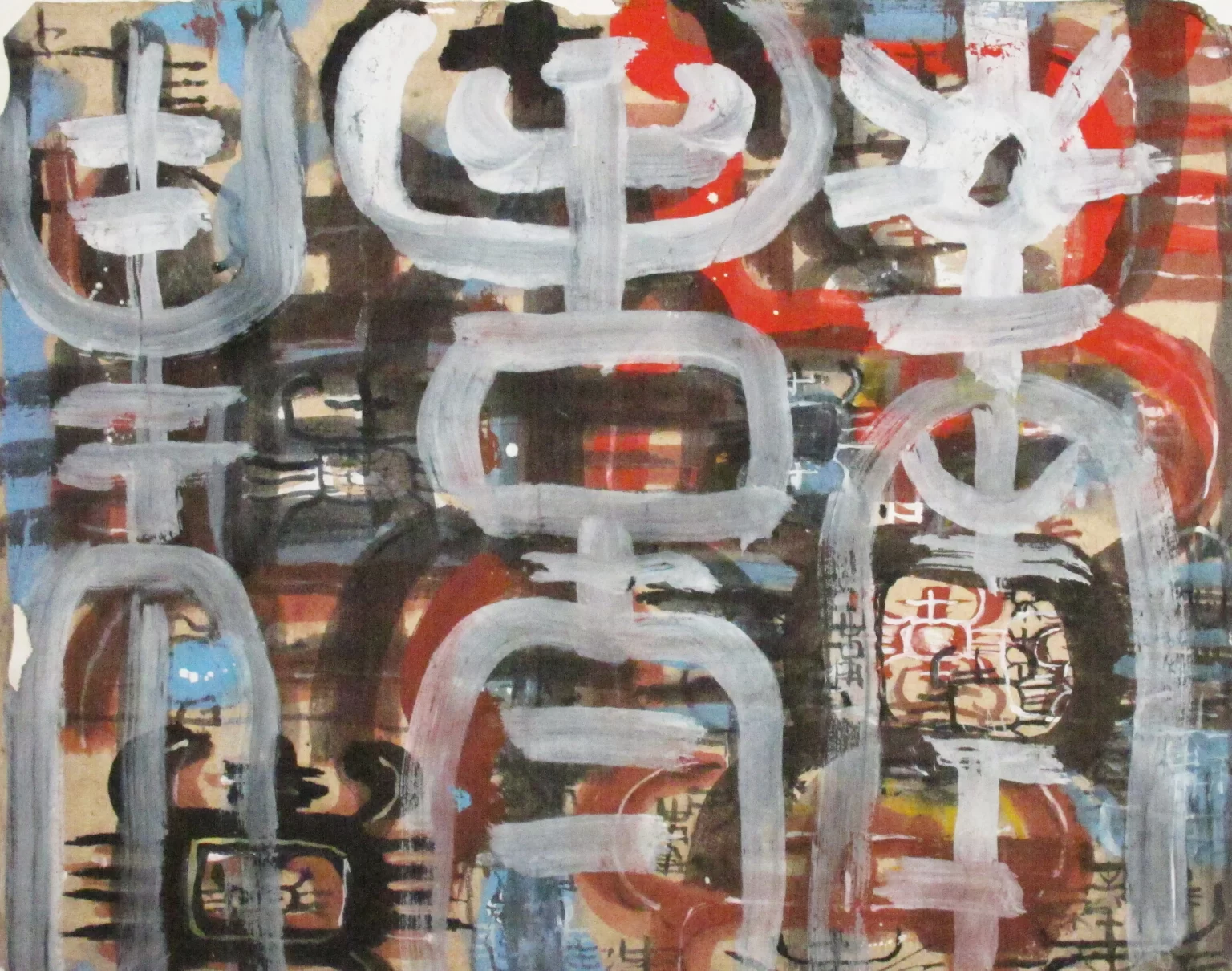
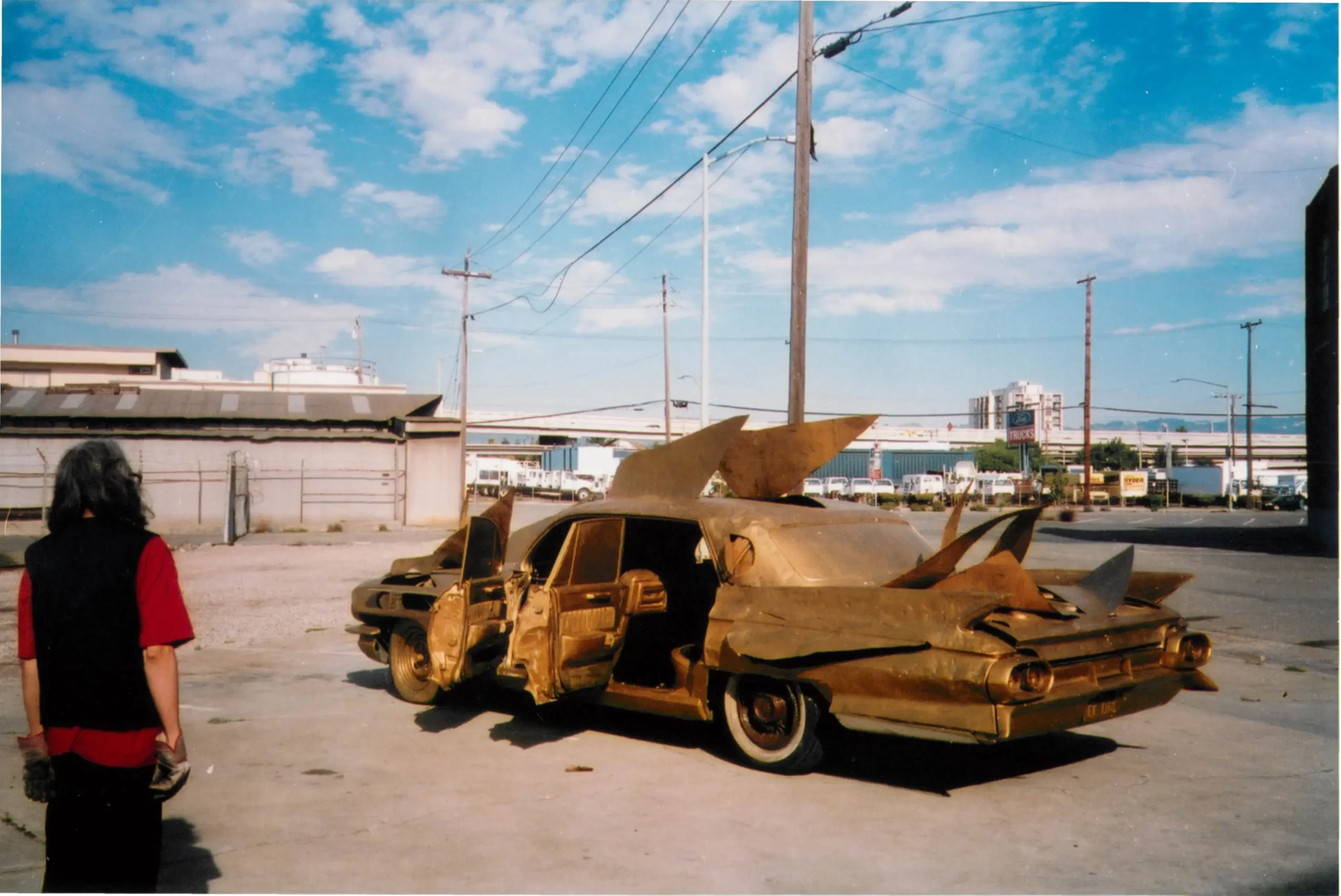
Vu Dan Tan’s Festival Banners, straddling figuration and overscale pictograms, was an early example of the enigmatic language-picture mixing that invited viewers to decipher. The series’ title contributed by cryptically suggesting festivals long discouraged, were re-emerging, so flagging evolving 1990s Vietnamese cultural-social rules and grass-roots voice.²⁰ Pilgrims don’t appear in Suitcases of a Pilgrim, but the series title connotes geographic and intellectual frontier transcendence and opening Vietnam. Titles of other Vu Dan Tan works Fashion, Amazon, and RienCarNation suggest concepts not pictured in the physical pieces. RienCarNation, a Pacific Bridge, California (US) exhibition based on a repurposed 1961 Cadillac, was enriched by its French-English title’s homophonic wordplay yielding meaning: Rien, “nothing” in French; Car; Nation, a teasing meditation on nationhood in the globalising 1990s. Nguyen Van Cuong also used titling conceptually to impart allusive significance and extend critical reach. His Karaoke (1996-1997), Franklin (1997-1998), Cultural Pollution 1999-2000, and Porcelain Diary (1999-2001) series contended with difficult-to-picture stresses: sexual liberalisation, rural-urban divides, classism, capitalism, individualism, and effects of encroaching global mass culture. Titling plays on figurative-literal meaning and contra-meaning to amplify artworks’ reading, and thus audience involvement through metaphor, association, contradiction, constructing tension and sometimes interrogation. Franklin is literal and metaphoric, picturing historic Ben Franklin, and flagging the concept of money via his portrait on 100 USD notes. Porcelain Diary, a title conjoining unrelated culturally-loaded terms, denoted Hanoi social disconnections.²¹ Cuong’s 1998 mural installation Give it Title summoned viewers to confront the discomforts of New Vietnam, pictured as jostling business-men, motorbikes, farmers, and more.
Image-text mixing: citation, provocation, activation
Typological variations of image-text mixing appeared early-on. As above, Truong Tan’s 1993 inks paired stylised figures with cursive Vietnamese narrative. His 1995 Here Very Dark was yet more text-rich. Comprising some 25 monochrome profiles of one protagonist, each was presented as a story episode, the tale advancing via words, not pictures.²²
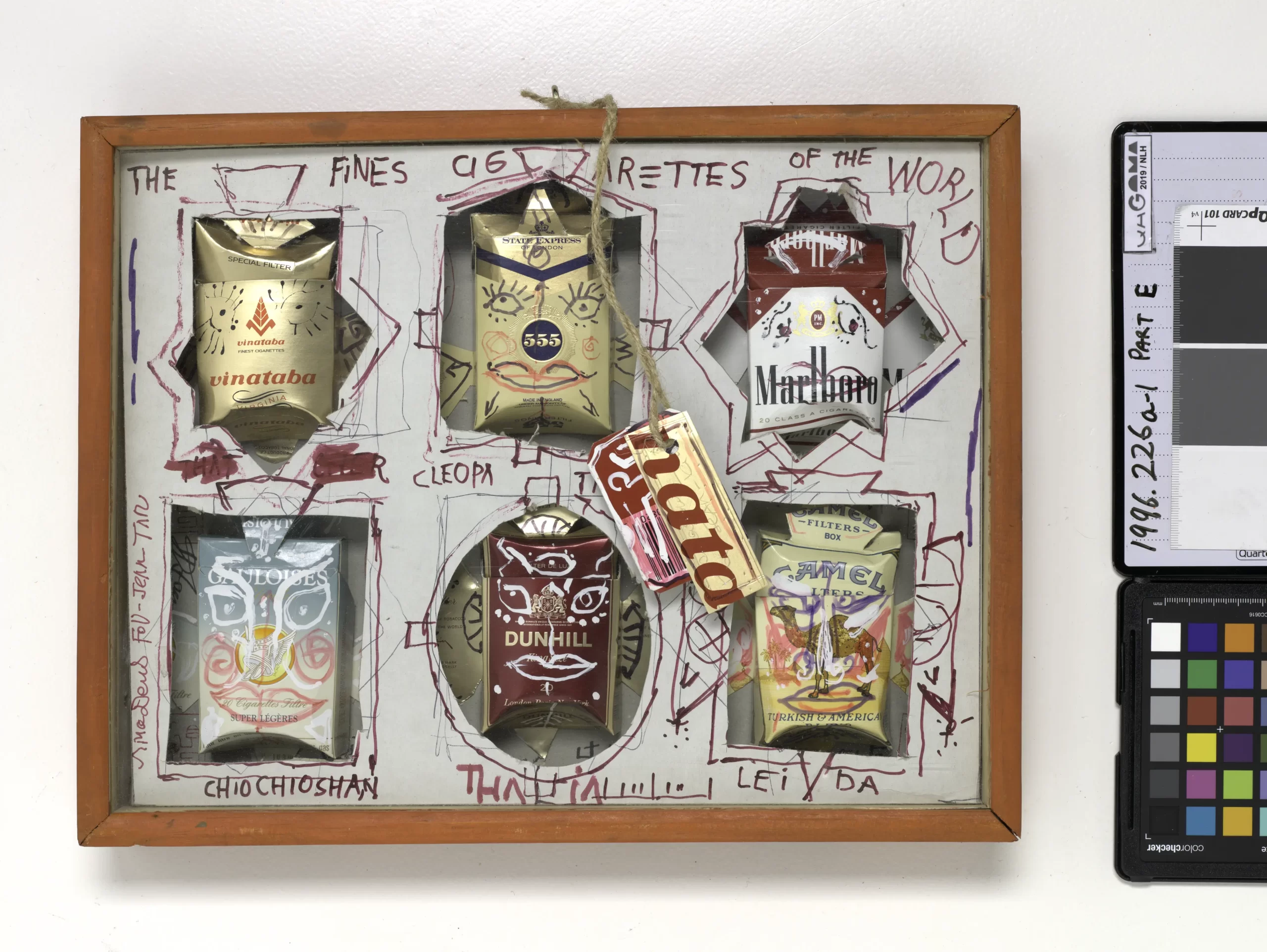
Vu Dan Tan’s image-text fusing altered over time, and unlike Truong Tan, he did not favour grand stories. In the 1980s, painting on maps, posters, and newspapers, he incorporated existing printed words into his images. His picture-text straddling Festival Banners encouraged reading, marshalling audiences into dialogue as they “worked” to find meaning – unlike self-contained imagery absorbing the viewer’s gaze. In the 1990s, Vu Dan Tan painted on word-rich packaging, creating miniature cardboard sculptures pinned or pasted into glass-lidded hawker boxes, surrounded with citations, slogans, and dangling address labels, forming Suitcases of Pilgrim. Included in the 1996 Second Asia-Pacific Triennial of Contemporary Art, the work resonated with Australian audiences. Captions such as “the finest mask of the world” and “the fines (sic) cigarettes of the world”, read alongside the work’s iconography, fostered visual-conceptual dialogue on the optimism and downsides of globalisation. Vu Dan Tan’s Money series was especially text-reliant, its mascots from world culture and history (Charlie Chaplin, Napoleon, etc.) intersecting with captions that mobilised viewers critically on capitalism and money as engendering exchange, and as a representation of erased borders and mobility.
Nguyen Van Cuong’s use of text differed from that of his friends. From the declarative My mother is a farmer, he shifted to irony-tinged idioms, his Karaoke series bearing English and Vietnamese text driving audience assessment of mass culture’s incursion into Hanoi using Karaoke as a trope: “khong muong karaoke” (no karaoke); “karaoke go home!”; “day la gi coc tay” (what is this cocktail) – “cocktails” as cultural mixing. Some captions, reverse-scripted, commanded extra viewer effort to grasp. Nguyen Quang Huy’s experimentation with text was brief, his 1994-1995 inks interweaving one or two words in English and Vietnamese – “blood” and, “máu” – with diaphanous ink forms. The incongruous juxtaposition of semantic rawness and visual softness was novel, jolting audience response to conditions around them. Later, Huy invented a pseudo-script overlaying women’s portraits, its illegibility conveying the ambiguities of the era.
All were multilingual in their textual usage. Vu Dan Tan, as a global citizen, opted for English, French, Spanish, mock Chinese, and mock Cyrillic. Truong Tan adopted French after his Paris trip, and Nguyen Van Cuong favoured English titling for its precision and concision, noting that in English, a complex idea could be expressed in a word or two, while Vietnamese required a sentence.
Text-image mixing: trait of contemporary art in Vietnam and beyond
Vietnamese contemporary artists’ utilisation of language has continued into this century: Nguyen Minh Phuoc‘s Sleep Walking (2003); Bui Cong Khanh’s Stamp on Me (2003); Hymne National (2010); and Commitment Culture (2012); Tuan Andrew Nguyen’s UFOs Sighted Over Ho Chi Minh City, Viet Nam, 2009; Thao Nguyen Phan’s 2013 Silicchalcedon, among many. Outside Vietnam, Southeast Asian artists manifested conceptually-underpinned aesthetics contending with social challenges of the nation-building and globalising eras. They borrowed from life, its iconography, techniques, and materials, including language, mostly indigenous. After 1970, FX Harsono, Imelda Cajipe-Endaya, Redza Piyadasa, Nirmala Dutt, Zulkifli Yusoff, Brenda Fajardo, Vasan Sitthiket, Tang Da Wu, Amanda Heng and others bypassed academy disciplinary segregation to combine image and text in contemporary artworks corralling audiences on shared social conditions. Harsono and Cajipe-Endaya’s 1970s image-text conjoining installation Paling Top ’75 and prints dialogued with viewers, constituting contemporary art. As in 1990s Hanoi, their such picture-word associations were artistically new, yet familiar, so drew audiences into conceptual art.²³
Text-image integration: a locally sourced marker of early contemporary Vietnamese art
Textuality and language appeared in early-20ᵗʰ century modern art – Dada, Surrealism, and mid-century Conceptual Art. But groundbreakers fraying new expressive paths in 1990s Hanoi did not need foreign models to enlist words, and as scholars have noted, conceptual methods in art, never monolithic, evolved in multiple centres, according to contextual requisites.²⁴ Vu Dan Tan, who was already advancing image-text conflations in the 1970s, along with Truong Tan, Nguyen Van Cuong, Nguyen Quang Huy, and Nguyen Minh Thanh, took Vietnamese art onto uncharted terrain, and ignoring modern stylistic revivals, initiated contemporary art characterised by conceptually-underpinned, contextually-informed aesthetics. Steeped in story-telling tradition, surrounded by vernacular prints and wordy advertising, Hanoi pioneers devised text-picture modes enlisting audiences on home conditions. In opening 1990s-Hanoi, brimming with fresh images and ideas, vanguard artists seized what they could as content and driver of new expressions. With titling, narratives, literary references, and captions woven into pictures, they expanded art beyond description, creating active, audience-reading works that tackle difficult-to-depict risks and promises of Renovation Vietnam.²⁵ Among disciplinary borrowings, language-image conjunction is a distinctive and persistent feature of Vietnamese contemporary art. It also anchors Vietnamese contemporary in wider Southeast Asian contemporary art where image-text marriage appeared from its earliest development.
*This article draws on research originally presented in the author’s doctoral dissertation: Lenzi, I.G.L. (2020). The contemporary turn in Hanoi, Vietnam, 1989-2002: Vu Dan Tan, Nguyen Van Cuong, Salon Natasha, and doi moi-in-art (PhD thesis, Nanyang Technological University, Singapore.)
Words: Iola Lenzi
Translation: Art Nation
[1] Boitran Huynh-Beattie, “Post doi moi International Reception of Vietnamese Contemporary Art”, Eye of the Beholdler: Reception, Audience, and Practice of Modern Asian Art, eds. John Clark et al, University of Hawaii Press (2006), pp. 271–287.
[2] Phoebe Scott, “Forming and Reforming the Artist: Modernity, Agency and the Discourse of Art in North Vietnam, 1925–1954”, PhD diss., University of Sydney (2012), pp. 46–56.
[3] Iola Lenzi, “Seductive Amazons and Liberated Icons”, Vu Dan Tan + Nguyen Quang Huy, Atelier Frank & Lee (2001), pp. 1–13, makes a case for emergent contemporary art in 1990s Hanoi; Iola Lenzi, “Conceptual Strategies in Southeast Asian Art: a local narrative”, Concept Context Contestation: art and the collective in Southeast Asia, ed. Iola Lenzi, Bangkok Art and Culture Centre (2014), pp. 10–25; Iola Lenzi, Power, Politics and the Street: contemporary art in Southeast Asia after 1970, Lund Humphries (2004).
[4] Iola Lenzi, “L’art contemporain vietnamien dans le contexte du Sud-Est asiatique: l’oeuvre pionnière des années 1990 crée sur les bases des Beaux-Arts de Hanoi” (Vietnamese Contemporary Art in the Southeast Asian Context: pioneering works of the 1990s built on the foundations of Hanoi’s University of Fine Arts), FAP 7 (2021), pp. 113–141.
[5] Iola Lenzi,“Word-Power: How Vietnamese Contemporary Art integrates Language in a Visual Practice of Contestation”, paper presented at International Institute for Asian Studies (IIAS) conference Language, Power and Identity in Asia: Creating and Crossing Language Boundaries (14–16.03.2016).
[6] Lenzi, “Seductive Amazons and Liberated Icons”, pp. 7–11.
[7] Nora Taylor, “What is Đổi Mới in Art?”, Southeast Asia Digital Library, Northern Illinois University (2011).
[8] Personal communication with Tran Luong, 07.05.2024.
[9] Personal communications with Vu Dan Tan, Hanoi, 03.2001; 02.2003; with Truong Tan, Hanoi, 11.2010; Paris, 12.2015.
[10] Personal communications with Cuong, Huy, and Thanh from 2010 to 2015 affirm this influence.
[11] Iola Lenzi, “Conceptual Strategies”, pp. 10–14.
[12] Lenzi, Contemporary Art in Southeast Asia after 1970 (2024); Iola Lenzi, “The contemporary turn in Hanoi, Vietnam, 1989-2002: Vu Dan Tan, Nguyen Van Cuong, Salon Natasha, and doi moi-in-art”, PhD diss., Nanyang Technological University (2020), DR-NTU Research Repository; Iola Lenzi, “Early Contemporary Art in Vietnam: Đổi Mới Shift as Spur of Innovation in Globalizing 1990s-Hanoi,” The Russian Journal of Vietnamese Studies vol. 6, no. 1 (2022), pp. 73–85.
[13] Iola Lenzi, “Seductive Amazons” (2001); Iola Lenzi, “Urbane Subversion: empowerment, defiance and sexuality in the art of Vu Dan Tan”, 12 Contemporary Artists of Vietnam, ed. Dao Mai Trang, The Gioi Publishers (2010), pp. 13–33; Iola Lenzi,“The Art of the Court Jester: Vu Dan Tan’s Money Series”, Money For All Times, Salon Natasha (2010), pp. 10–12; Lenzi, “Word-Power”, IIAS (2016).
[14] Neil Jamieson, Understanding Vietnam, University of California Press (1993), preface XI, p. 108.
[15] Ian Howard, “Vietnamese Artists: Making do, digging in, breaking out,” in publication of 2nd Asia-Pacific Triennial of Contemporary Art, Queensland Art Gallery (1996), pp. 49–50.
[16] Iola Lenzi, “Seductive Amazons” (2001); Iola Lenzi, “The Art of the Court Jester” (2010); Iola Lenzi, “Word-Power”, IIAS (2016).
[17] Personal communication with Vu Dan Tan, Hanoi, 03.2001; 02.2003; Nguyen Minh Thanh, Dalat, 1/2014; Nguyen Van Cuong, Gia Lam, 12.2014; Nguyen Quang Huy, Hanoi, 03.2001; Truong Tan, Paris, 12.2015.
[18] Personal communication with Nguyen Van Cuong, Gia Lam, 11.2010; 12.2014.
[19] Iola Lenzi, “Early contemporary art in Vietnam”, pp. 73–85.
[20] Kirsten Endres, “Beautiful Customs, Worthy Traditions: Changing State Discourse on the Role of Vietnamese Culture”, Internationales Asienforum (International Asian Forum) vol. 33, no. 3–4 (2002), pp. 303–304.
[21] Iola Lenzi, “Lost and Found: Tracing Pre-Modern Cultural Heritages in Southeast Asian Contemporary Art”, Connecting Art and Heritage, ed. Bui Thi Thanh Mai, Vietnam University of Fine Arts / The Gioi Publishers (2013), pp. 132.
[22] Negotiating Home, History and Nation: Two Decades of Contemporary Art in Southeast Asia 1991–2011, Singapore Art Museum (2011), pp. 195–196, 243–244; Iola Lenzi, “Looking Out: How Queer Translates in Southeast Asian Contemporary Art”, Intersections: Gender and Sexuality in Asia and the Pacific 38, Australian National University (2015).
[23] Iola Lenzi, “Conceptual Strategies”, pp. 22–25.
[24] As shown by the exhibition publication Global Conceptualism: Points of origin, 1950s–1980s, Queens Museum of Art (1999).
[25] Iola Lenzi, “Word-Power” (2016).