Đọc phiên bản tiếng Việt tại đây.
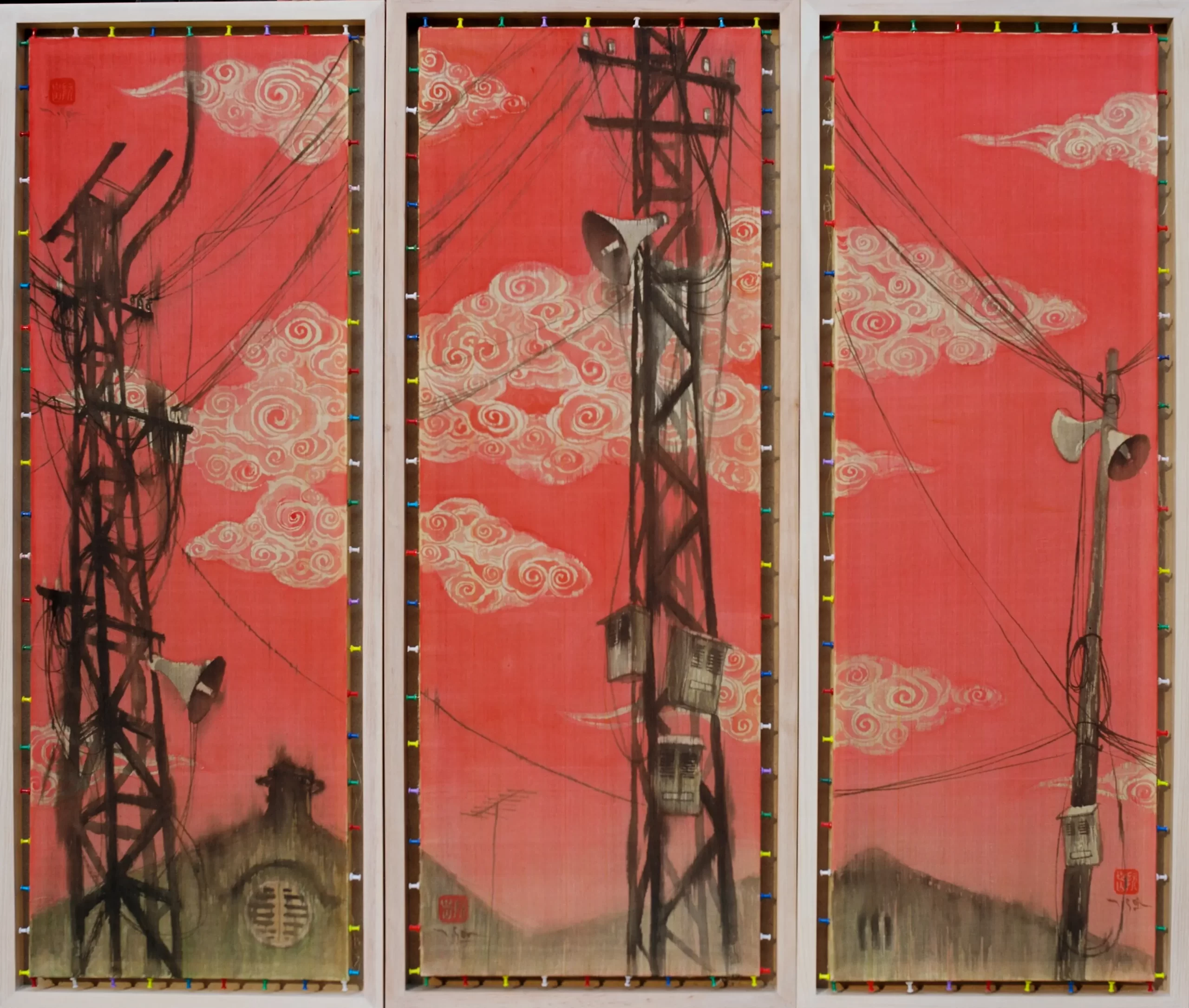
After graduating from the Painting department of Hanoi University of Fine Arts in the early 2000s, I spent a long period focussing on silk painting, from mastering traditional techniques to expanding its experimental possibilities in both material and subject matter. From very early on, I wanted to challenge entrenched assumptions and explore new possibilities within the medium. Through series such as “Super Conductor” and “New Higher Level”, I sought to reflect urban transformation through symbolic images: electricity poles, community loudspeakers, banners, tube houses wrapped in construction tarpaulins, and streams of weary motorbike riders moving below. These silk paintings were not mounted and framed behind glass in the conventional way. Instead, they appeared rough, raw and unfinished, bordered by brightly coloured plastic push pins. Like the urban tube house itself, they never ceased their ongoing process of construction and upward expansion.
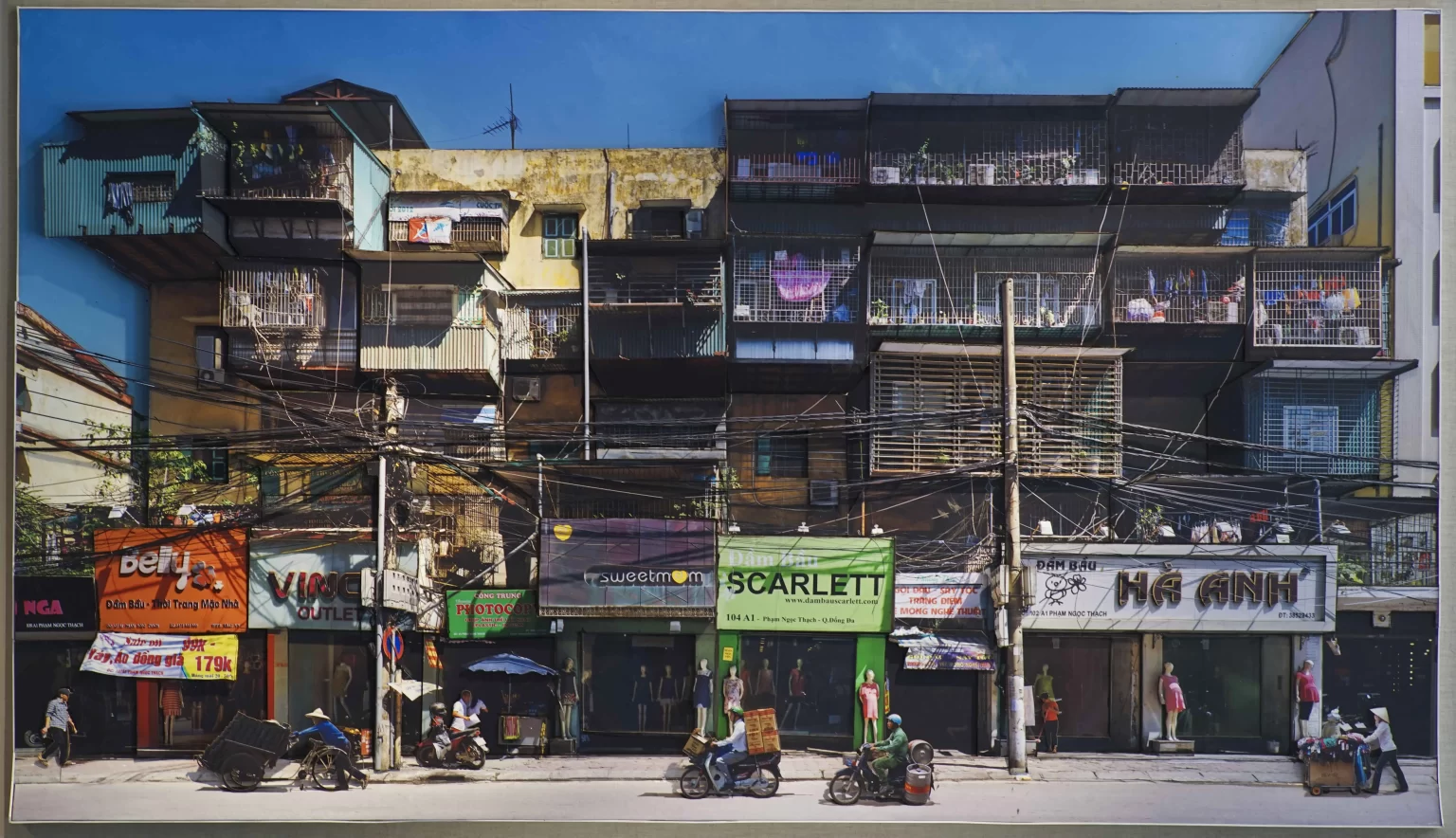
Alongside these experiments in painting, I also turned to photography and installation as means of documenting the creative process and gathering research material for my personal projects. Continuing my exploration of the city through projects centred on water and trees in urban space, my photographic practice underwent a significant shift during my Master’s studies in photography at the Central Academy of Fine Arts in Beijing. The geographical distance – and the constant movement between Beijing and Hanoi – granted me sufficient critical distance to see more clearly the face of a city that had seemed overly familiar since childhood. This idea took shape in my graduation project “House facing the street – Artificial landscapes of Vietnamese cities during the transition period”, which hybridised photography, architecture and sculpture to create the language of “photo-relief”. For me, this method became a way of excavating the layered stratigraphy of the urban tube house across different historical periods, while simultaneously examining shifts in social value systems tied to changes in institutions and economic models. By moving beyond the conventional boundaries of both silk painting and photography, I attempted to reconstruct a personal urban reality through interdisciplinary thinking, where sociological research intersects with visual art.
This project also became a turning point for my subsequent research into urban themes and memory, such as “Searching for the Common House” – a study of the changing forms and functions of communal shrines dedicated to craft ancestors in Hanoi’s Old Quarter – and “Nha Tay Transforms”, a collaboration with artist and researcher Tran Hau Yen The that sought to peel back and decode the façades of the few remaining French colonial villas that have survived two decades of aggressive urbanisation. Here, the language of “photo-relief” re-emerged through a combination of measured architectural drawing and fine-art publication formats, creating an open dialogue within the beautiful Western architectural setting of Manzi.
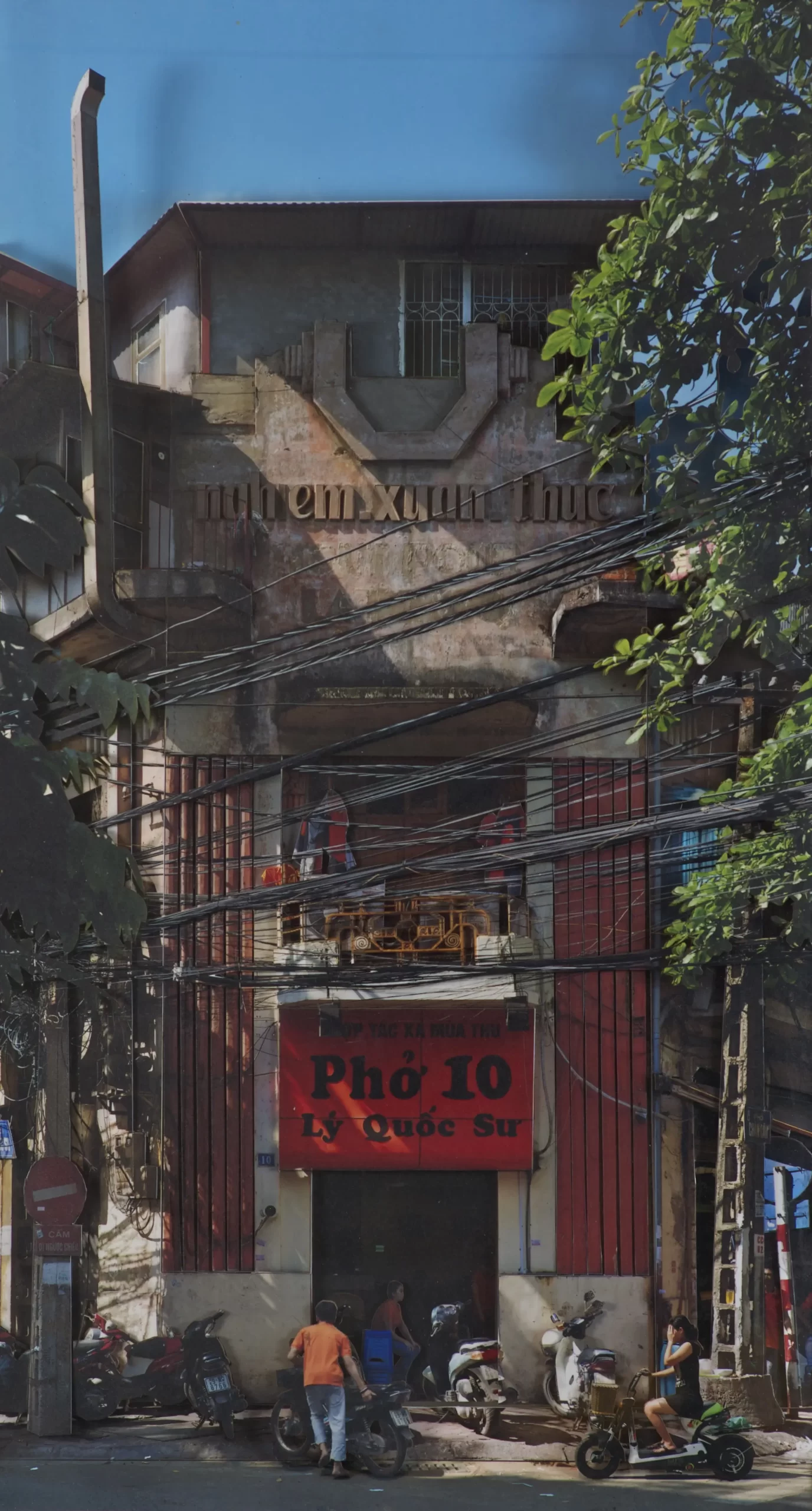
Extending this line of inquiry, “Devant derrière (Change Face)” became the next chapter in my collaboration with Tran Hau Yen The. In this project, photography was employed to uncover the stories and historical layers embedded within the system of improvised “tiger-cage” balcony extensions – where the backs of socialist-era apartment blocks suddenly transformed into street façade, accompanied by the proliferating layers of signage that emerged in the post-Renovation era.
My ongoing preoccupation with the boundary between personal and collective space intensified in “8m²”, a large-scale photo and sound installation exhibited at the museum of Hanoi University of Fine Arts and the Goethe-Institut Hanoi. The work emerged from fieldwork conducted in workers’ rented rooms within industrial zones on the outskirts of Saigon.
At times, my urban investigations in photography have looped back into silk painting, as in “Red Days” and “Colour of the Sound”. Here, a surreal dimension emerges through the intersection of silk and music: the community loudspeakers depicted in the paintings broadcast the sounds of “yellow music” (nhac vang) recorded on vinyl in Saigon before 1975, inviting viewers into a contemplative space of urban history and collective memory.
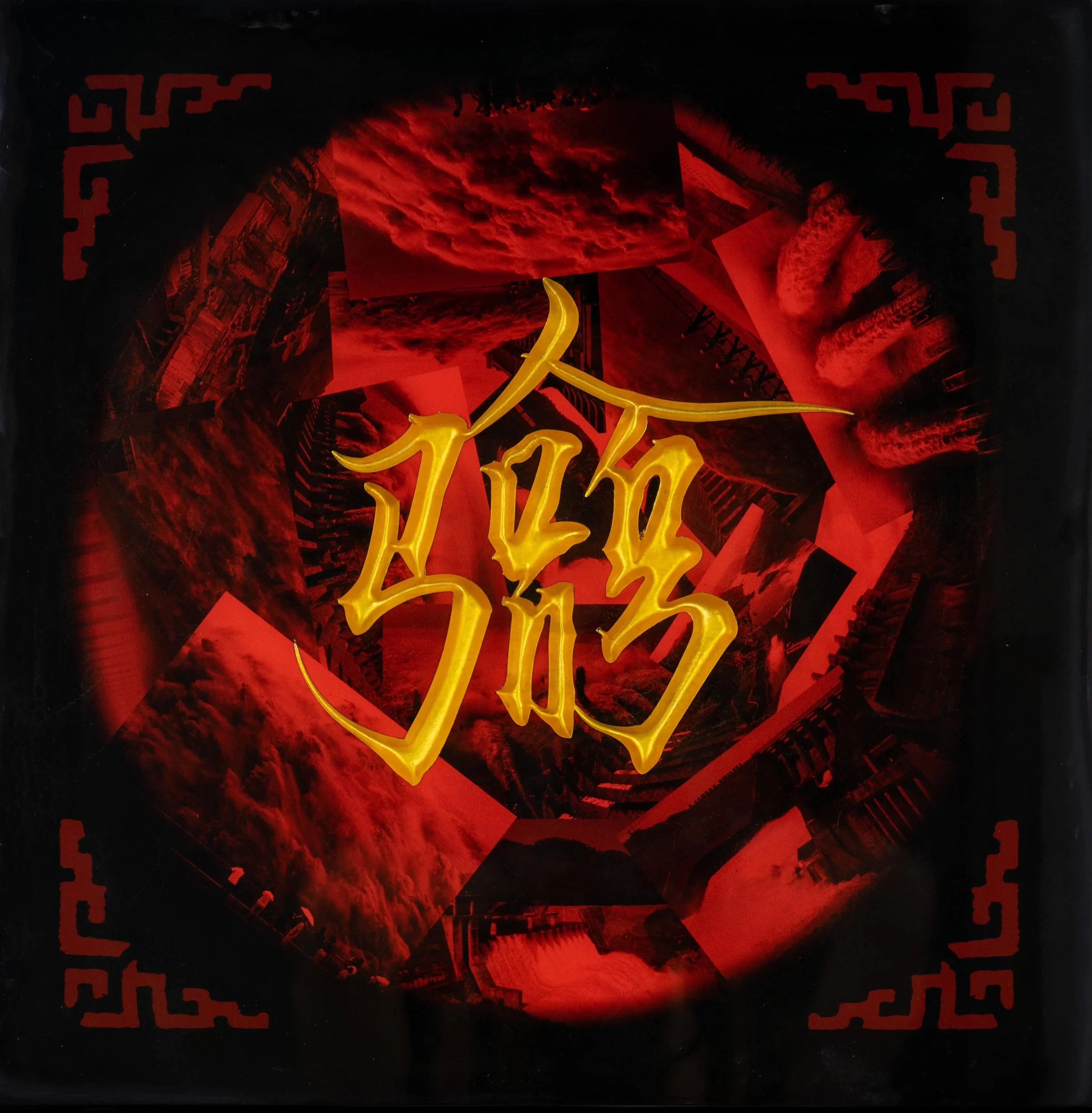
Continuing this trajectory of experimentation, traditional Vietnamese lacquer also became fertile ground when combined with documentary photography. “Mountain to Mountain, River to River,” exhibited at the Lumenvisum Art Centre (Hong Kong), and “Story of 16 Coffee Tables”, exhibited at Bildmuseet (Sweden), sought to extend conceptual photography through the combination of traditional lacquer, quoc ngu calligraphy and contemporary documentary photography. Here, photographic data functions as a catalyst, interacting with materials that might initially appear incompatible – such as quoc ngu calligraphy and lacquer – and opening up reflective questions about history in relation to the present and the future.
For many years, my personal artistic projects and community projects have continued to coexist and intersect within my practice as a reciprocal relationship. In that space, the boundary between fine art and photography has become increasingly difficult to define. Materials meet and overlap naturally, like necessary voices shaping the very conception of the work.
Words: Nguyễn Thế Sơn
Translation: Art Nation