Đọc phiên bản tiếng Việt tại đây.
Within the Nguyen court attire system, the thuong (裳) worn by imperial consorts is one of those categories of artefacts that, for a long time, existed almost exclusively in written records. Knowledge of the garment has largely depended on codified prescriptions preserved in historical sources, while the artefacts themselves had been for the most part dispersed or lost to deterioration. The repatriation in recent years of surviving thuong fragments from Europe has therefore done more than fill an archival lacuna – it has enabled direct comparison between prescriptive texts and extant artefacts, marking a methodological advance of considerable significance for art-historical research and the study of court history.
A signifier of power in the inner court
The “thuong”, also known as nghe thuong or xiem, was a type of garment worn outside to cover the two-legged trousers beneath. Its form ultimately derived from vernacular wrap skirts, particularly the vay dup (tubular wrap skirt) worn by women in the north. Even after Emperor Minh Mang’s ban on “bottomless trousers”¹ as part of broader sartorial reforms intended to standardise dress, the memory of this garment has survived in folk culture to the present day, associated with the image of the ao tu than (traditional four-panel northern Vietnamese tunic) and the vay dup:
“In the eighth month came the royal decree:
the ban on bottomless trousers struck fear into the people.”
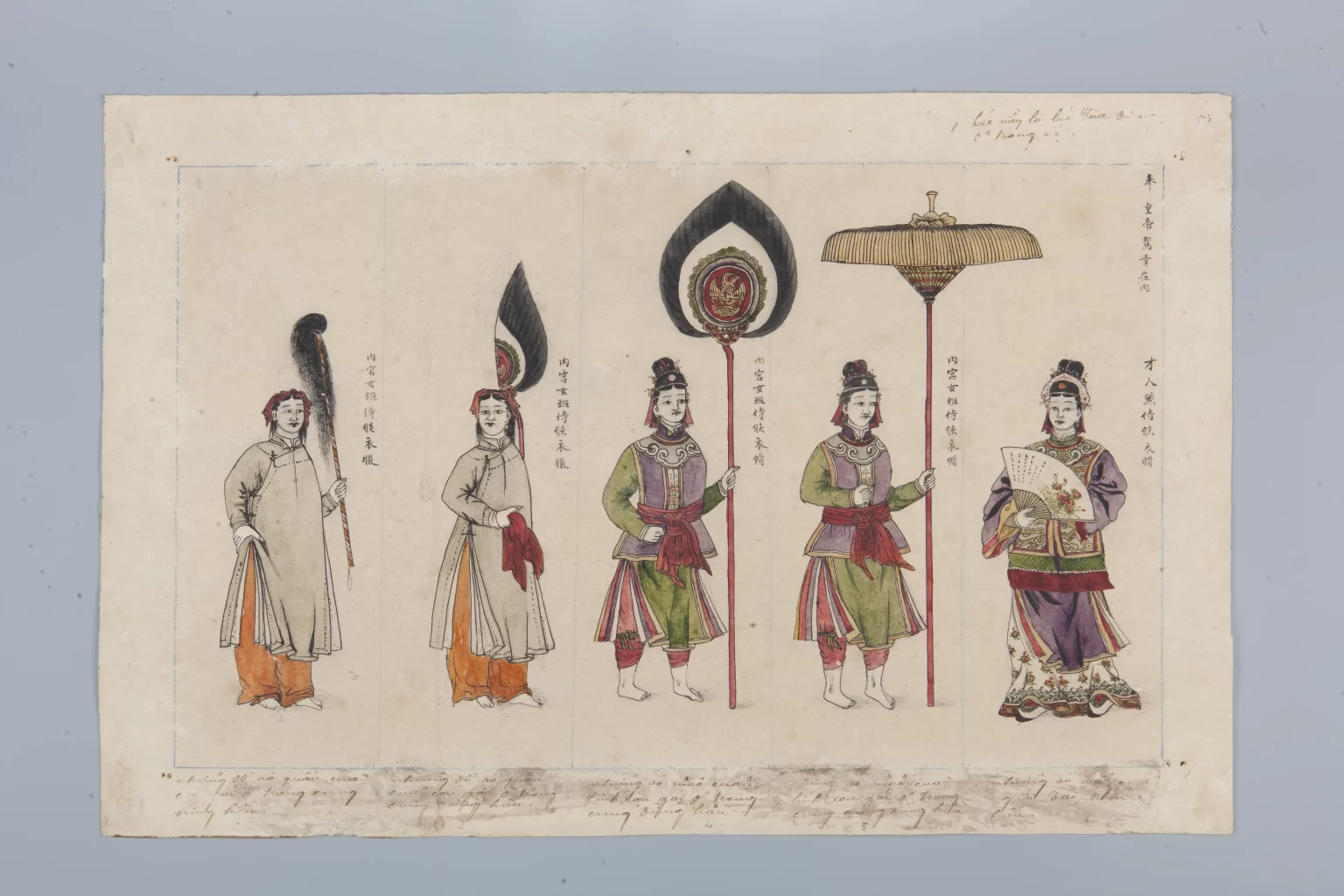
Within the courtly sphere, however, the thuong was transformed into a highly regulated ceremonial garment. Court regulations regarded the visible display of bifurcated trousers during ritual observances as improper, and the thuong consequently became obligatory on formal occasions. The garment was therefore not reserved exclusively for imperial consorts, but also more broadly formed part of the ceremonial attire of members of the imperial clan and court officials.
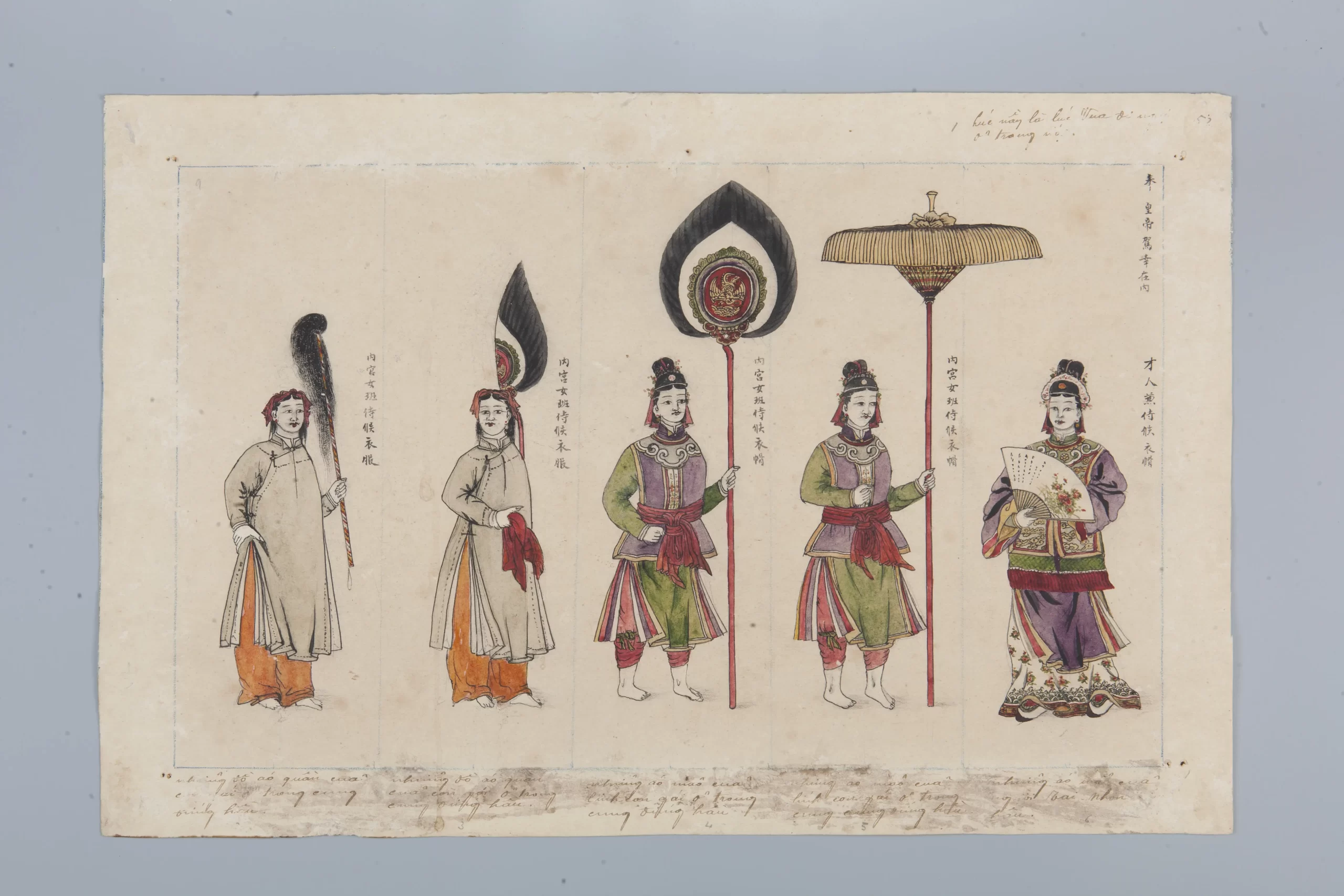
Bound to court ritual, the thuong became a symbolic surface upon which regulation, craftsmanship and authority were articulated through silk and embroidery. Volume 78 of the “The Collected Statutes of Dai Nam (Kham dinh Dai Nam hoi dien su le 欽定大南會典事例)” compiled by the Grand Secretariat of the Nguyen court, records the rules for thuong worn within the inner court as follows:
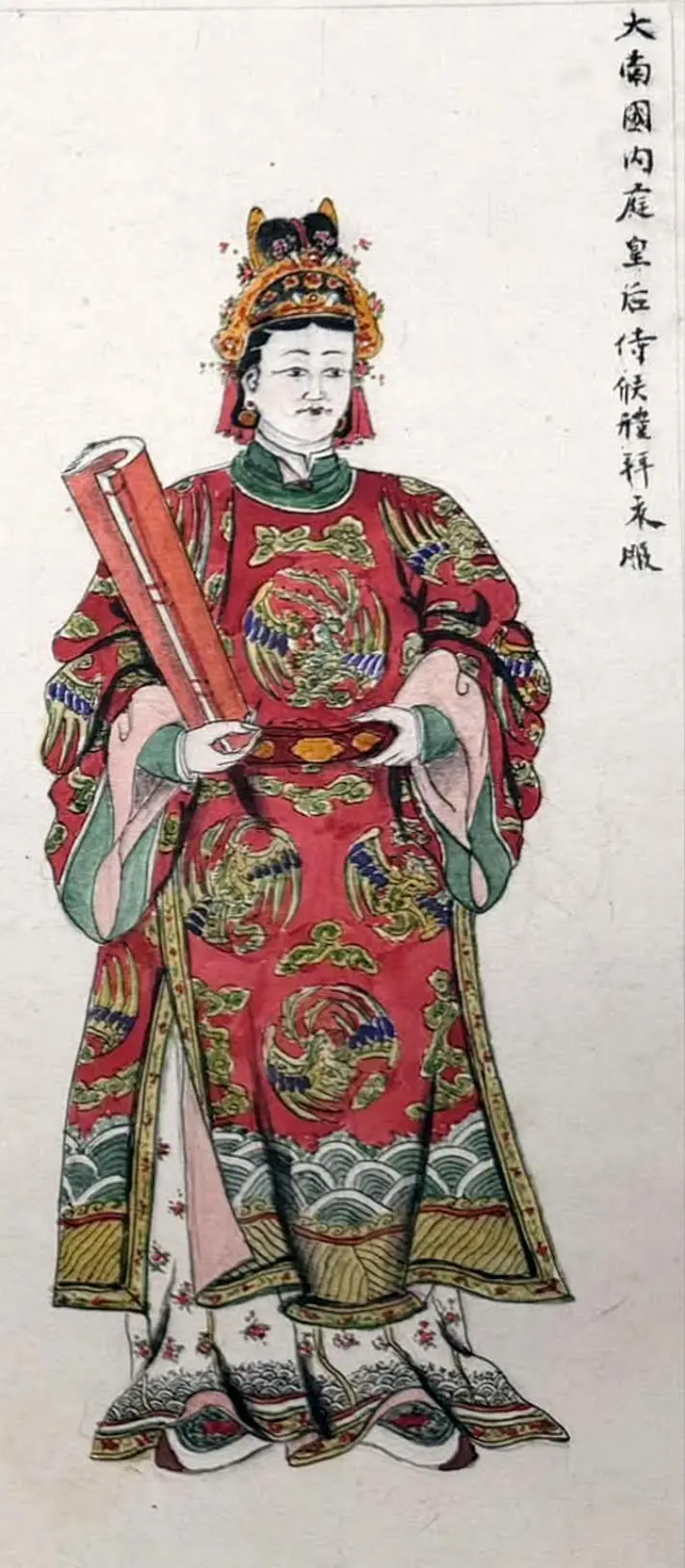
The Empress’s thuong was made of snow-white bat ty silk,² woven with round phoenix motifs in gold; the lining and waistband used snow-white cao bo cloth (fine textile used for linings and waistbands) with gold appliqué.
The Empress Dowager’s thuong used crimson bat ty silk,² embroidered with round phoenixes, divine flowers and waves, interspersed with Western mirrorwork; the border was of gold-ground brocade with lotus-vine scrolls; the lining consisted of cinnamon-yellow gauze and white lụa quyen silk (fine silk textile).
In the sixth year of Gia Long, consorts from the second to fourth ranks were rewarded with white bat ty satin, embroidered with paired loan bird medallions or single loan birds.
Snow white was thus the principal base colour, while the phoenix and loan bird motifs served as markers of rank distinction.
Structurally, the Nguyen thuong consisted of two large fabric panels pleated and joined at the waistband. The essential difference between the garments worn by imperial consorts and those belonging to titled noblewomen outside the inner court lay not only in material quality, but also in the technical treatment of the pleats. Whereas garments belonging to titled noblewomen were often stitched down in order to economise fabric and maximise practicality, those of imperial consorts employed densely layered pleats requiring an extraordinary quantity of cloth while still maintaining a compact silhouette. In movement, these pleats opened and closed rhythmically, producing a visual effect that was at once fluid and solemn. Pleating therefore functioned not merely to create density, but also as a conspicuous display of courtly luxury, in which the deliberate excess of fabric became a visible index of royal status.
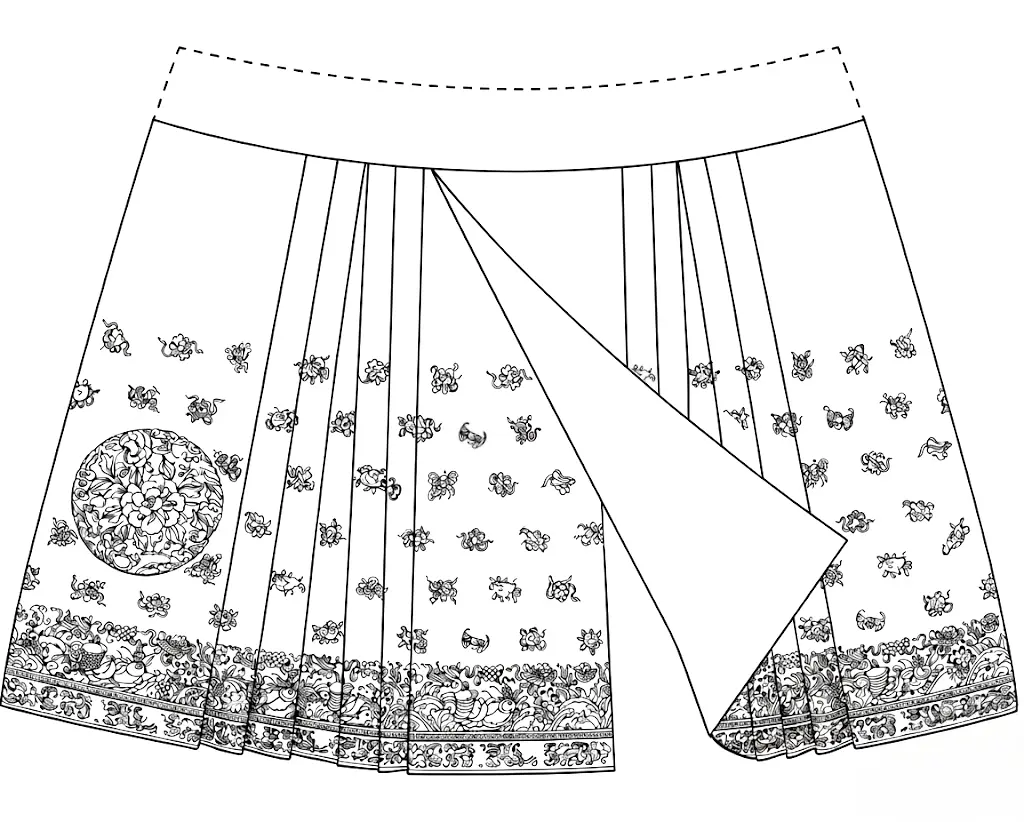
A view once held that the Nguyen thuong had no pleated structure and differed completely from the Chinese Mamianqun (马面裙)³ of the Ming-Qing period. This assessment requires reconsideration. In constructing its sartorial regulations, the Nguyen court referred to Ming systems, particularly through texts such as the “Sancai Tuhui (三才圖會).”⁴ Structural similarities, especially in pleating techniques, were therefore inevitable. Just as the Chinese Mamianqun had multiple variants, the surviving artefacts show that the Nguyen thuong likewise existed in corresponding types. The latter differs from the former less in overall structure than in the dense organisation of decorative surfaces according to the Four Emblems and Five Phases, a visual system characteristic of Hue court aesthetics at the time.
The most distinctive local adaptation of the Nguyen consort’s thuong lay in its use of embroidered bo tu⁵ as indicators of status. These insignias were not merely ornamental devices, but signs of rank analogous to the regulated colours and motifs found on imperial robes. Comparison among surviving examples reveals significant changes in the placement of these badges over time. During the early Nguyen period, they were positioned on the front and back panels of the skirt, following the convention in which the right panel overlapped the left. By the late period under Emperor Bao Dai, however, the badges had shifted to the outer sides of the lower legs, aligned with the pleated sections, while the construction itself was reversed so that the left panel overlapped the right. Such changes suggest an ongoing process of aesthetic and functional adjustment within court dress across successive reigns.
Garment and its courtly shadow
In the course of direct examination of surviving artefacts, we have identified two examples, provisionally designated thuong A and thuong B. Both survive in fragmentary condition and have entirely lost their waistbands – the component most crucial for full reconstruction of their original form.
Thuong A may be dated to the late 19ᵗʰ century, from the later years of Emperor Tu Duc’s reign through that of Emperor Dong Khanh. Measuring 138 × 80 cm, only a single panel survives, though it nevertheless preserves important technical and aesthetic features. Its embroidered rank badge combines phoenix roundels and peony motifs, creating a composition associated with auspiciousness and noble status. Beneath the hem runs a rising wave border from which motifs such as flaming pearls, coral and stylised sacred mountains emerge upward, producing a dynamic and symbolically charged decorative register. Above the badge appears a dense ornamental field composed of more than two hundred small motifs depicting precious objects familiar in Hue court art, including the Eight Treasures, ritual chimes, coral and bodhi leaves.
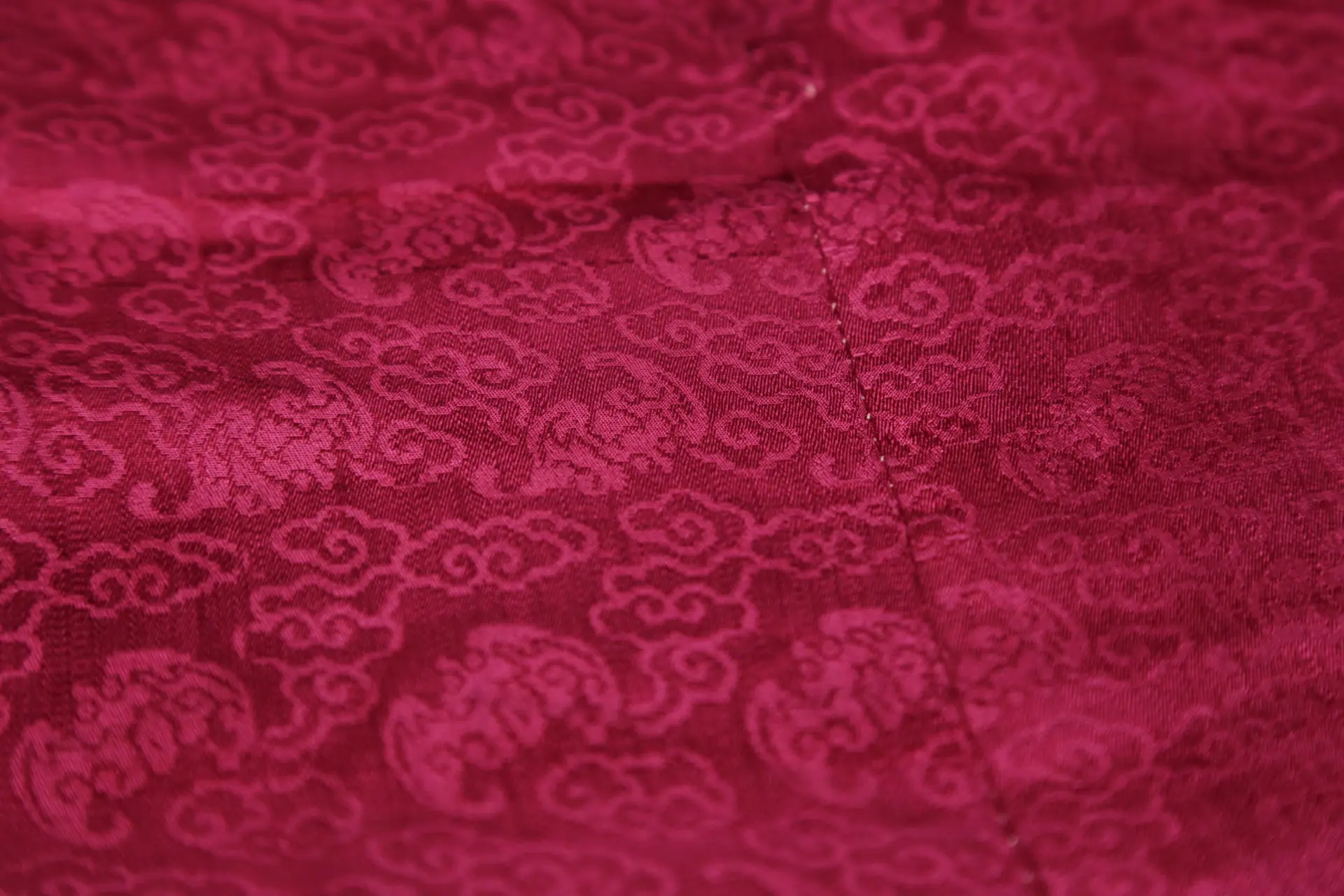
Particularly notable is the use of metallic sequins scattered between the motifs in order to heighten light-reflective effects. This technique, however, has also created conservation problems, as many sequins have detached and torn the surrounding textile ground. Although only a small number survive, they nevertheless constitute important evidence for a rare decorative material among currently known Nguyen embroidered artefacts, underscoring both the extraordinary luxury of Nguyen court costume and its distinction from the dress traditions of neighbouring Sinitic courts. Traces also remain of a woven brocade border with lotus-vine motifs, now almost entirely deteriorated, while the purple-pink linh silk lining decorated with bats and clouds remains comparatively well preserved. On the basis of surviving regulations, the garment may tentatively be attributed to a consort of at least the rank of Tan.
Artefact thuong B is dated between the reigns of Emperor Dong Khanh and Emperor Duy Tan. Measuring 134 x 85 cm, it surpasses artefact A in the refinement of its embroidery and ornament. Its pattern system resembles the court thuong used by officials and titled noblewomen of the same period, specially ordered by the court from China. The use of silk-outline embroidery around the motifs – a technique characteristic of Viet tu embroidery⁶ – suggests that this was a commissioned-to-order object embroidered in renowned Chinese workshops. In the aftermath of the 1885 Fall of Hue, when the embroidery industry in Hue had stalled, overseas commissions were not only a way to meet demand in quantity, but also a means of reconstructing the authoritative image of the royal family.
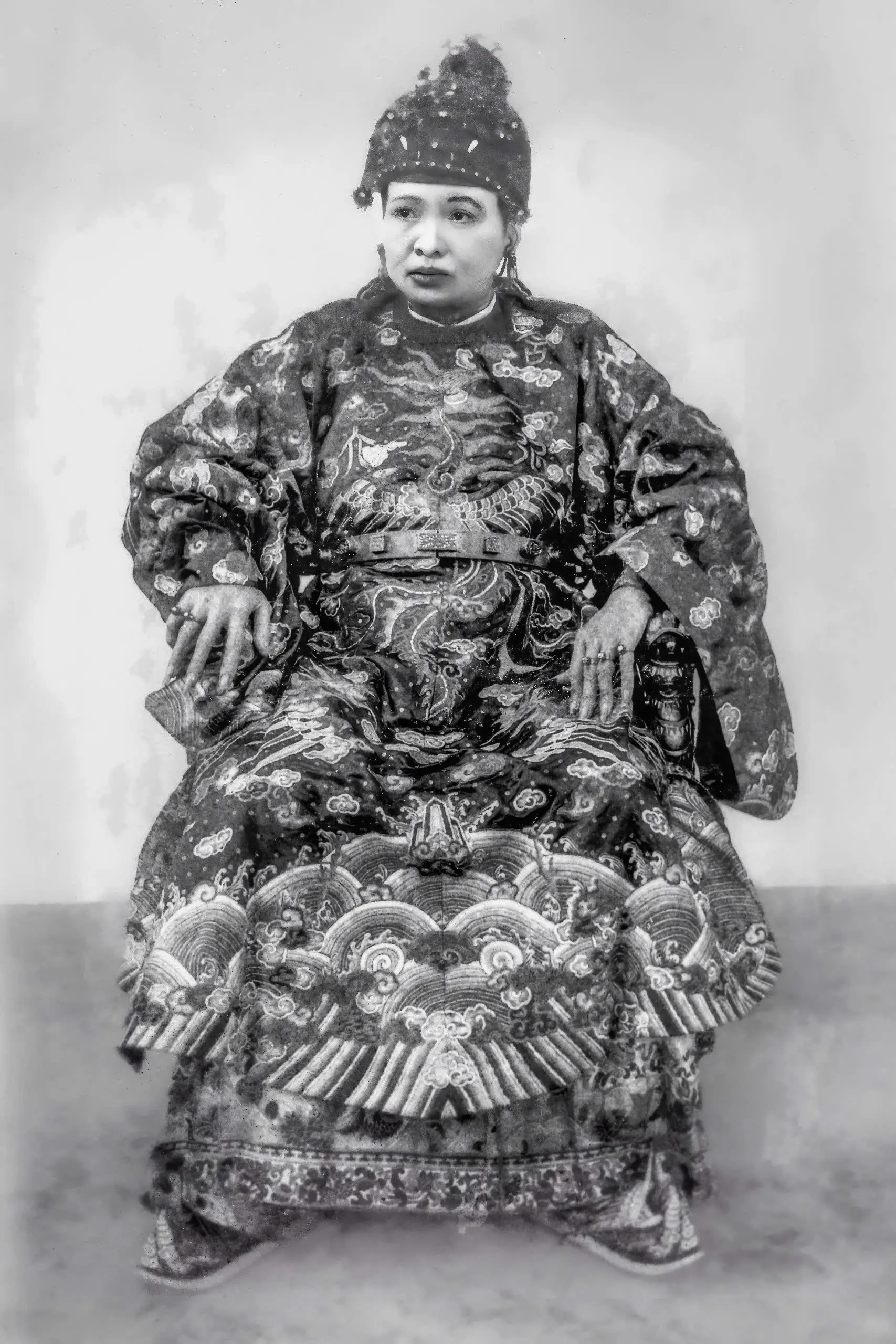
The dense arrangement of wave motifs, combined with Buddhist and Daoist Eight Treasures and interwoven with auspicious imagery such as bats, butterflies, Buddha’s hand citrons and peonies, produces a richly symbolic visual programme associated with wishes for longevity. Particularly striking is the circular rank badge embroidered not with phoenix or loan bird, but with peony. According to court regulations, phoenix imagery was reserved for the Empress and Empress Dowager, while loan birds for consorts. Yet comparison with photographs of Empress Dowager Thanh Cung and other imperial women reveals that this garment possesses a level of ornamental refinement comparable to garments associated with the Empress Dowager, despite employing peony imagery instead.
The choice of the peony – celebrated in East Asian tradition as the “King among Flowers” – constituted a subtle and highly flexible symbolic strategy. During the turbulent succession crises remembered as the “Three Kings in Four Months” and the reigns that followed, the position of an emperor’s birth mother or adoptive mother often occupied an ambiguous ceremonial status, particularly in light of Emperor Tu Duc’s lack of direct heirs and the subsequent deposition of Emperors Duc Duc, Hiep Hoa, Ham Nghi and Thanh Thai. The use of the peony allowed the garment’s wearer to articulate a position of exalted authority comparable to, yet distinct from, that of the legitimate imperial mother holding the title of Empress Dowager. As the foremost among flowers, the peony effectively substituted for the phoenix as a marker of royal prestige while avoiding the appropriation of symbols reserved exclusively for the principle Empress.
In this sense, thuong B demonstrates that Nguyen court ritual was not always a rigid and immutable system, but one capable of considerable flexibility in response to political and dynastic circumstances. Through the symbolic language of floral ornament, embroiderers were able to articulate the status of imperial maternal figures within the tightly regulated visual order of the court.
These two surviving thuong fragments are valuable not merely as material evidence of the attire worn by Nguyen imperial consorts, but also as integral components of the ceremonial order, tied to ritual spaces and occasions marked by imperial solemnity. As Vietnam’s final monarchy, the Nguyen dynasty synthesised, adapted and reworked earlier sartorial traditions into a highly codified system, grounded in both continuity and regulation. As the old saying held, “Dress should befit one’s virtue.” The thuong was more than an article of clothing: it was a visible expression of dynastic aesthetics, ritual order and the authority of the inner court.
Words: Nguyễn Huy
Translation: Art Nation
[1] “Bottomless trousers” was an older colloquial term for the wrap skirt (vay quay)
[2] Bat ty silk (八絲) was a luxury silk woven from highly refined silkworm filaments. Fine strands of silk – typically eight individual threads – were twisted together to produce a fibre of exceptional strength, density and lustre.
[3] The Mamianqun (馬面裙) was a traditional form of women’s dress in China, originating in the Song dynasty, flourishing during the Ming dynasty and remaining widely worn into the Qing dynasty.
[4] The Sancai Tuhui (三才圖會), compiled during the Ming dynasty by the father-and-son scholars Wang Qi (王圻) and Wang Siyi (王思義) and first published in 1609, is regarded as one of the most extensive and important illustrated encyclopaedias in East Asian cultural history.
[5] Bo tu (補子) were embroidered insignias, square or circular in form, attached to the chest and back of the garments worn by emperors, officials and imperial consorts in the courts of East Asia, including China, Vietnam and Korea.