Among the many themes of modern Vietnamese painting – from landscapes and portraits to still lifes – the iconography of women embroidering and sewing evolves along a luminous narrative thread of its own, one that is both ordinary and evocative. More than a familiar scene of daily life, it touches the innermost emotions of the viewer by the power that lies in the harmony between movement and stillness, between labouring hands and contemplative faces, and between the tender light of the domestic space and the quiet silhouette of a woman.
For many generations, one would often see in old Northern Vietnamese houses a grandmother, a mother, or an elder sister mending clothes, knitting, or embroidering scarves. It was a private world where women gathered together, working with their hands while chatting away or confiding in each other. Thus, upon entering into this space to observe and record, a painter, often male, tends to leave a special presence. They become both witness and keeper of an intimate, feminine moment. Perhaps this is why depictions of sewing and embroidery in modern Vietnamese painting so often radiate a sense of closeness and familiarity, as if opening a small door unveiling moments of calm and gentle admiration for women’s patience and quiet perseverance.
When art meets embroidery
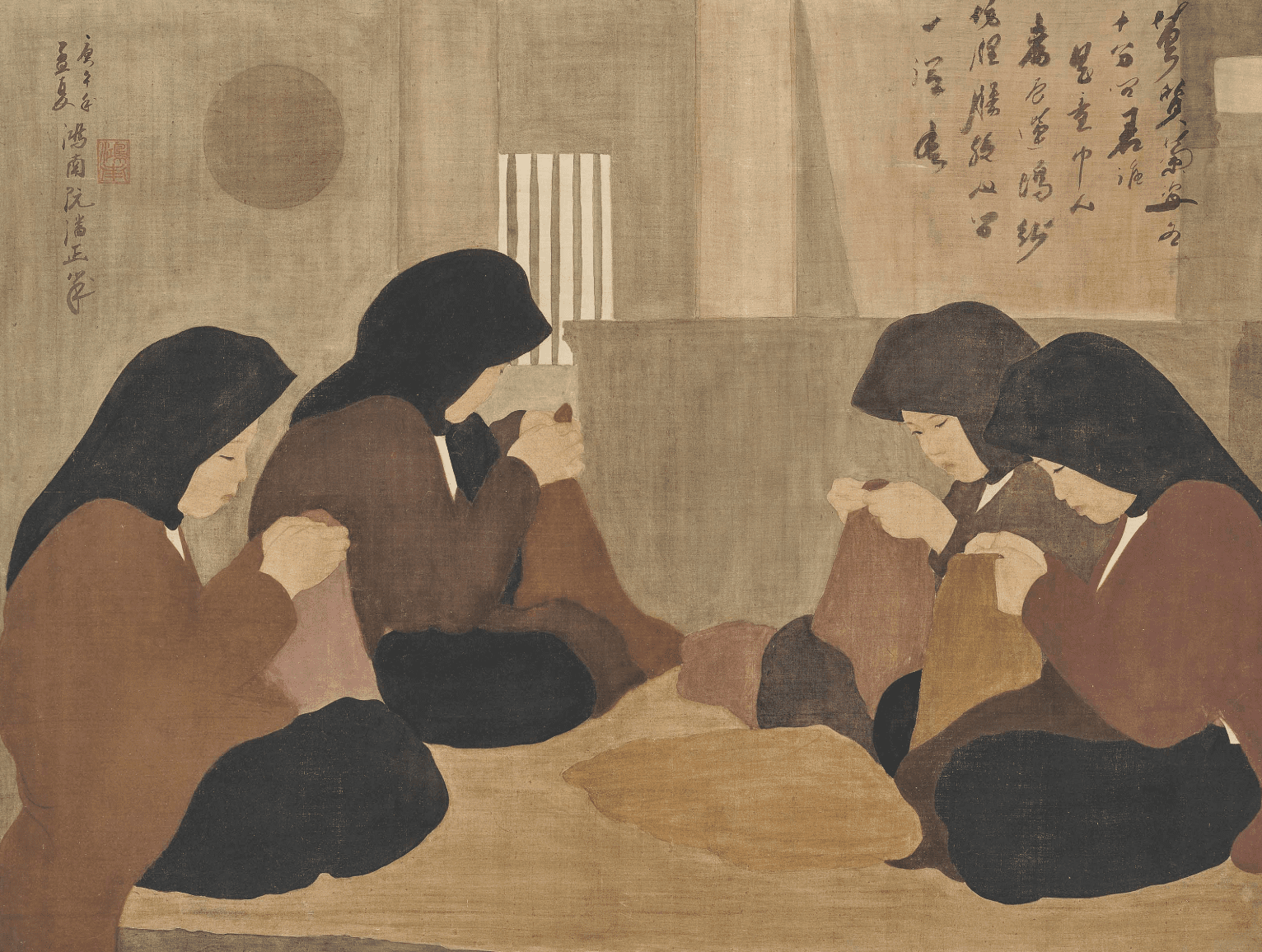
In “The Seamstresses” (1930) by Nguyen Phan Chanh, four women sit closely together in a wooden house, their posture quiet yet steadfast. Each of their heads is bent down, and each pair of hands is steadily sewing, forming a closed, rhythmic cadence of a song of labour. The simple composition, rendered with precision in muted browns and greys, evokes the authenticity of rural life while highlighting the beauty of persistence and devotion.
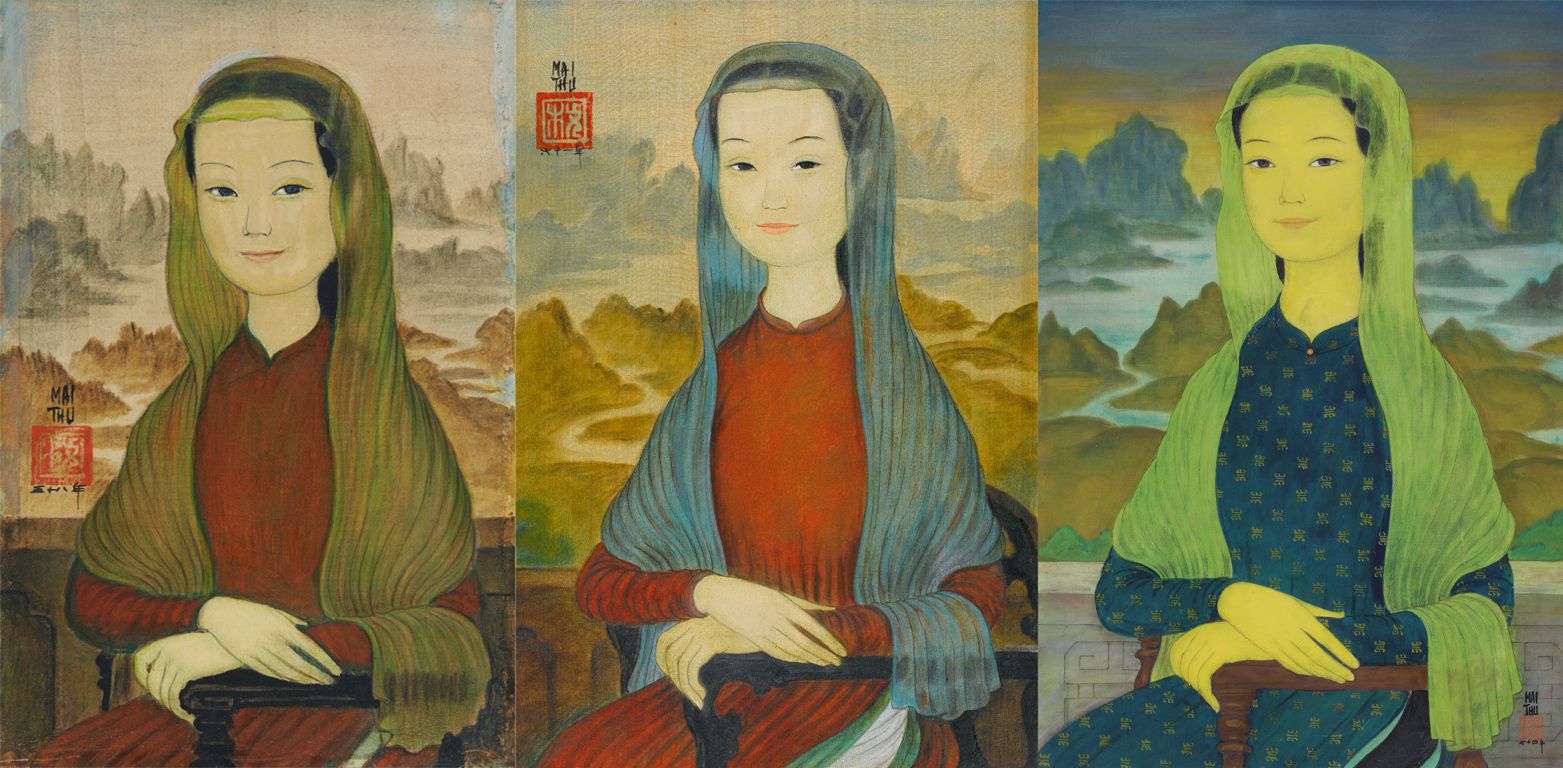
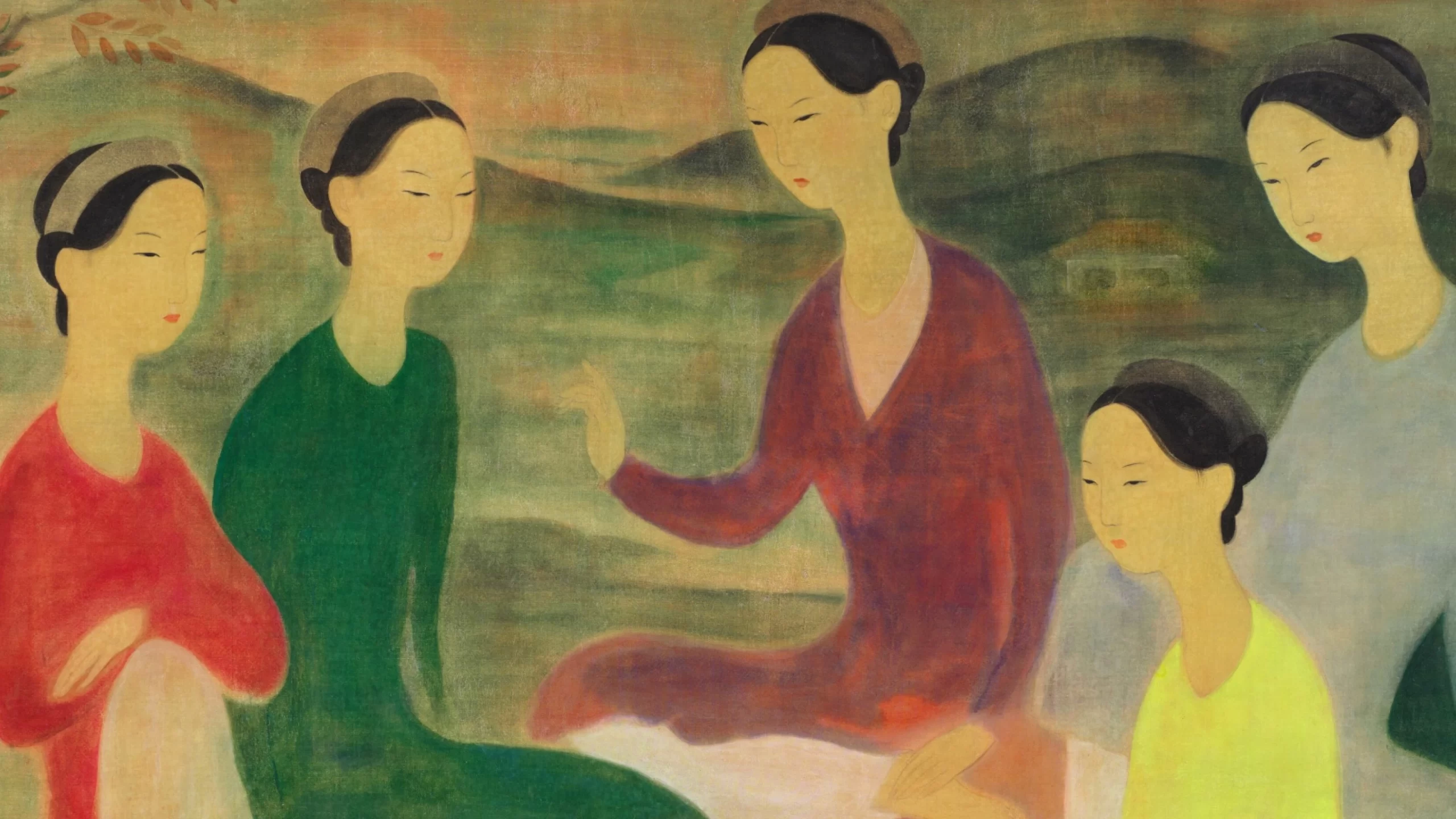
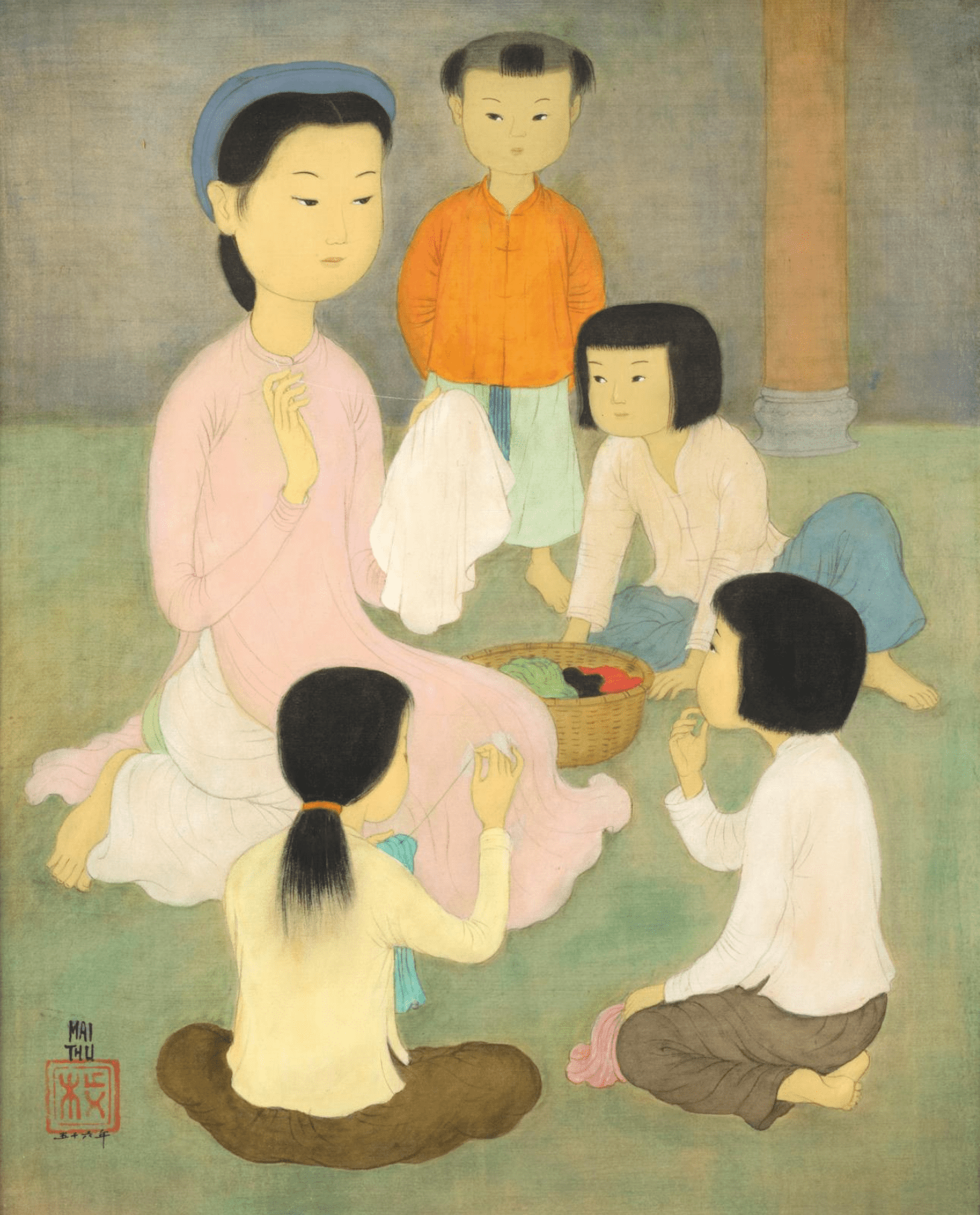
Mai Trung Thu, in several silk paintings from the 1940s, often portrayed young women in ao dai sitting beside sewing baskets, their posture and gestures refined, associated with the purity of the soul. In “The sewing lesson” (1944), in which an elder sister teaches her younger sibling to sew, the familiar poetry of his art is illuminated by the cheerful eagerness of children gathering against the backdrop of childhood innocence. This ordinary scene becomes a subtle metaphor for the continuity of life, evoking echoes of a pure melody from childhood memories.
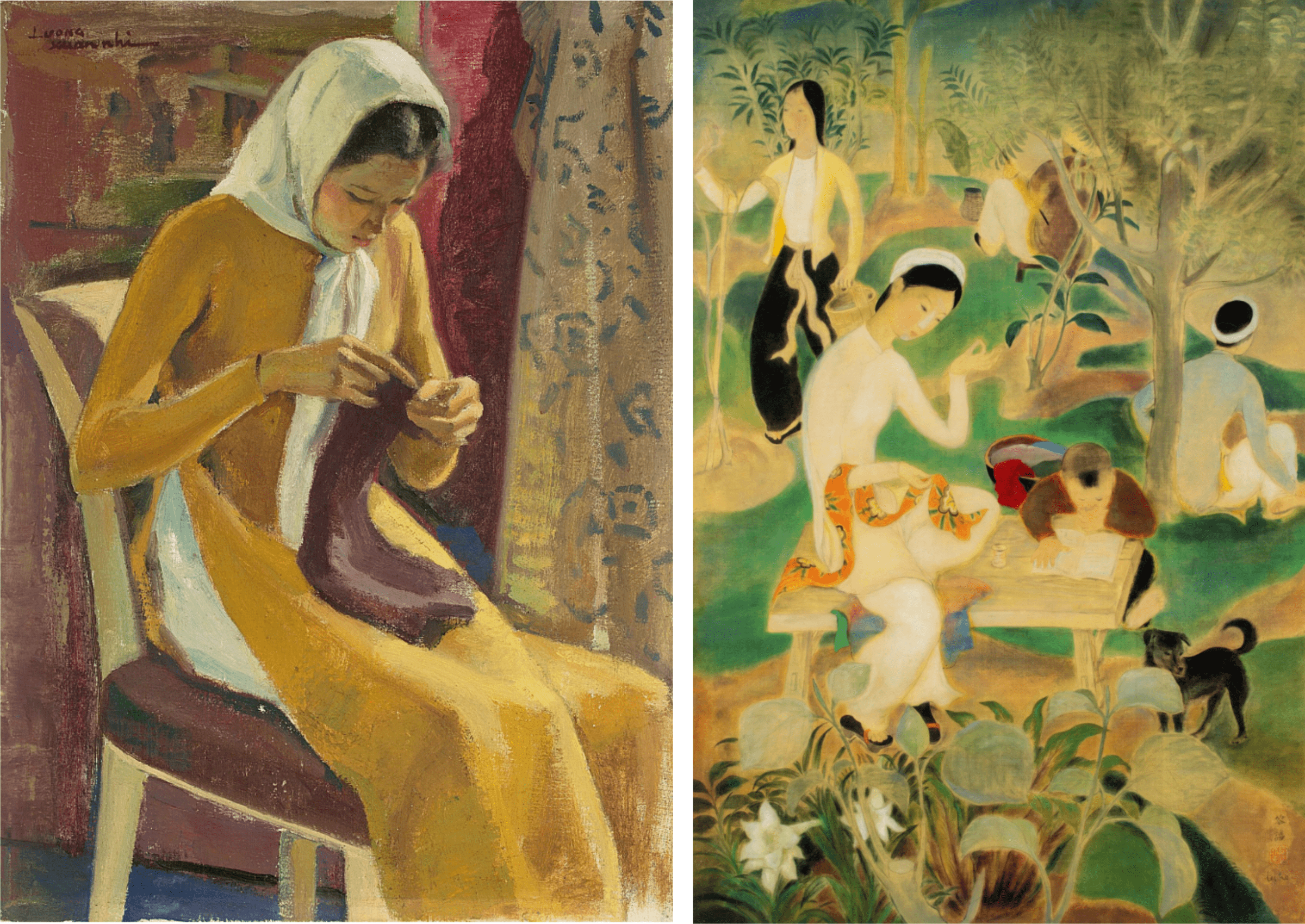
Watching someone sew or weave often awakens a primeval feeling within us: a sense of peace and gentleness, as though mankind’s ancient memories of home and of caring hands have been stirred. That sensation is instinctive, and when captured in painting, it is translated by the artist through colours, lights, and rhythms. In “Young woman knitting” (c. 1950) by Luong Xuan Nhi, a girl lowers her gaze as slender fingers nimbly knit a dark-toned sweater. The headscarf she wears suggests the chill of an early winter day, yet the entire scene – immersed in warm yellows, browns, and deep reds, radiates intimacy and quiet serenity for both the sitter and the painter.
In “Family in the garden” (1938) by Le Pho, the central figure is a young woman in a white ao dai bathing in light and greenery, her left hand gracefully guiding the needle, her right hand holding a soft scarf. With gentle composure she oversees her household servants, children studying nearby, while still working intently on each stitch. The movements of characters, the leaves and branches swaying in sunlight, etc. all seem to come to a halt as the viewer’s eye rests on her calm act of sewing, the embodiment of a harmonious home.
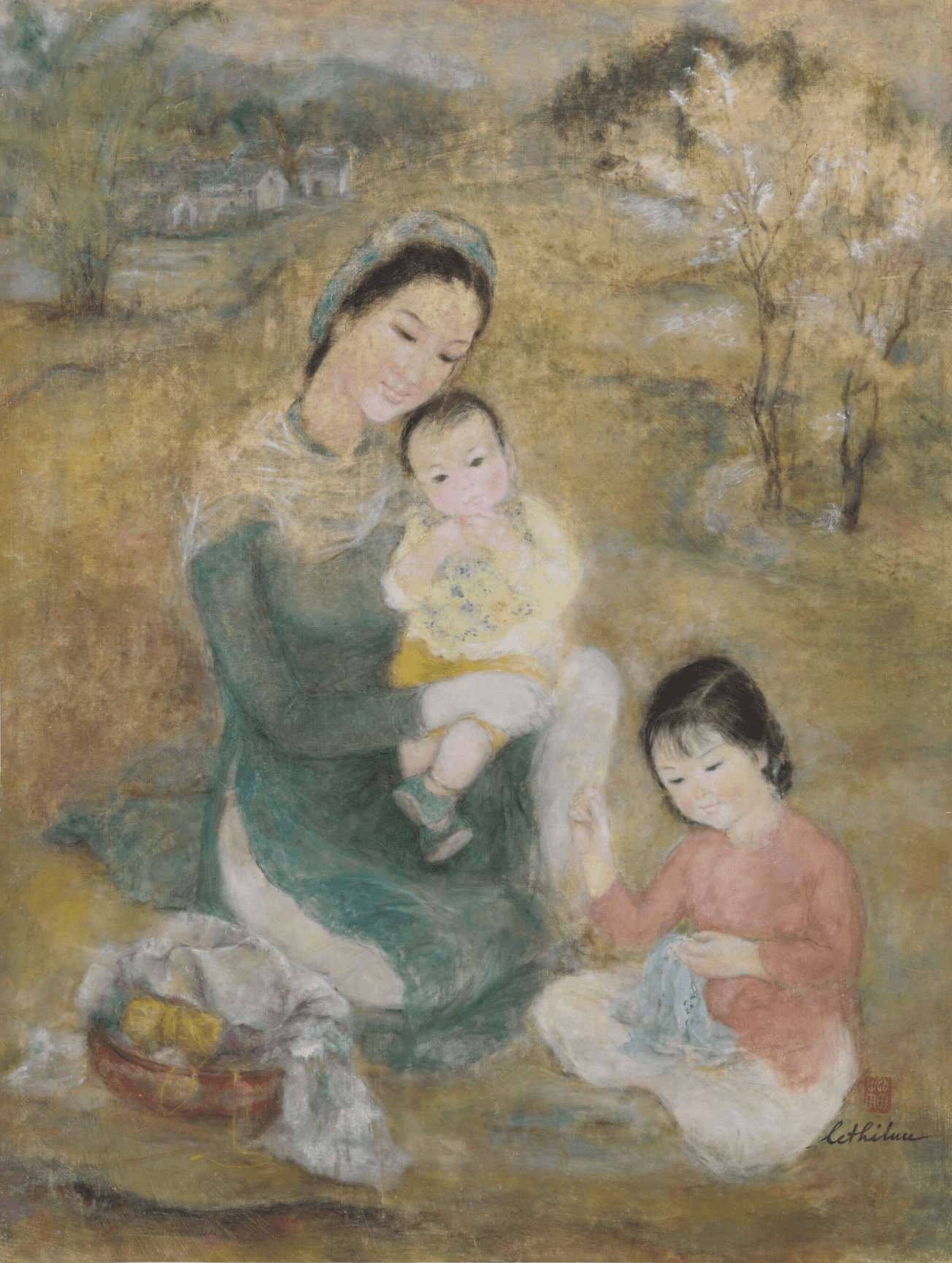
A particularly touching image is found in “Mother and children on the grass” (1960–1965) by Le Thi Luu. A mother sits in a garden, holding her baby while guiding the eldest daughter’s first attempt at sewing beside a basket of cloth and threads. Light falls softly on their faces, and the smile shared between mother and daughter suggests a moment of praise, perhaps for a stitch well made. The tender thread in the child’s hand becomes a symbol of maternal love – a line that connects generations, carrying warmth and affection across time.
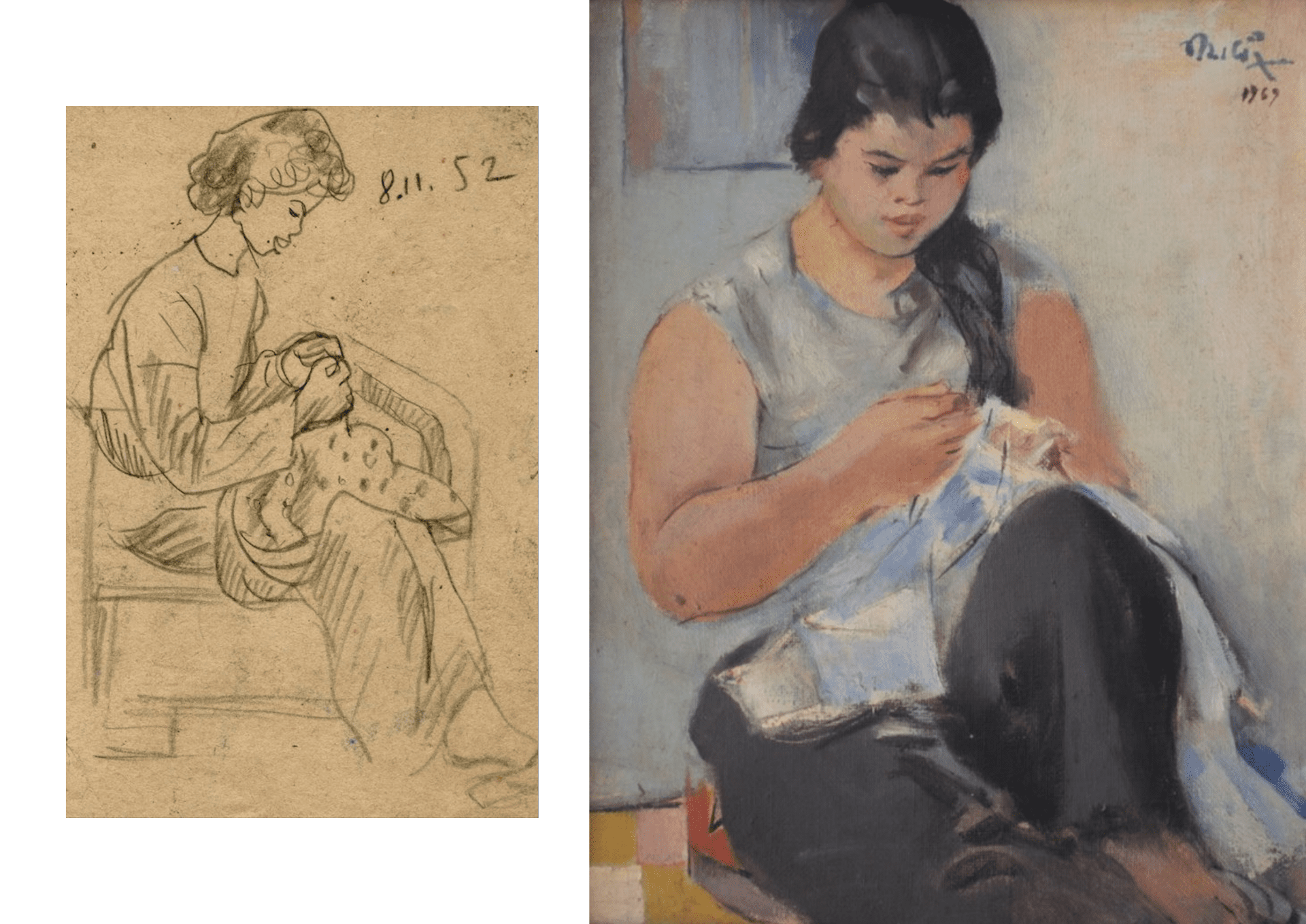
At times, everyday life enters paintings with a sudden intimacy. Bui Xuan Phai, in his sketch “Madame Phai sewing” (1952), quickly captured the figure of his wife with plain, flowing lines – unadorned yet heartfelt, preserving a private moment of deep affection. Tran Van Can, in “Girl sewing” (1969), portrayed a young girl sewing, her hands steady, her face at once innocent and contemplative. Here, embroidery is not merely labour but a moment of reflection, a glimpse into the inner self.
A seamstress’s stitch, a painter’s stroke
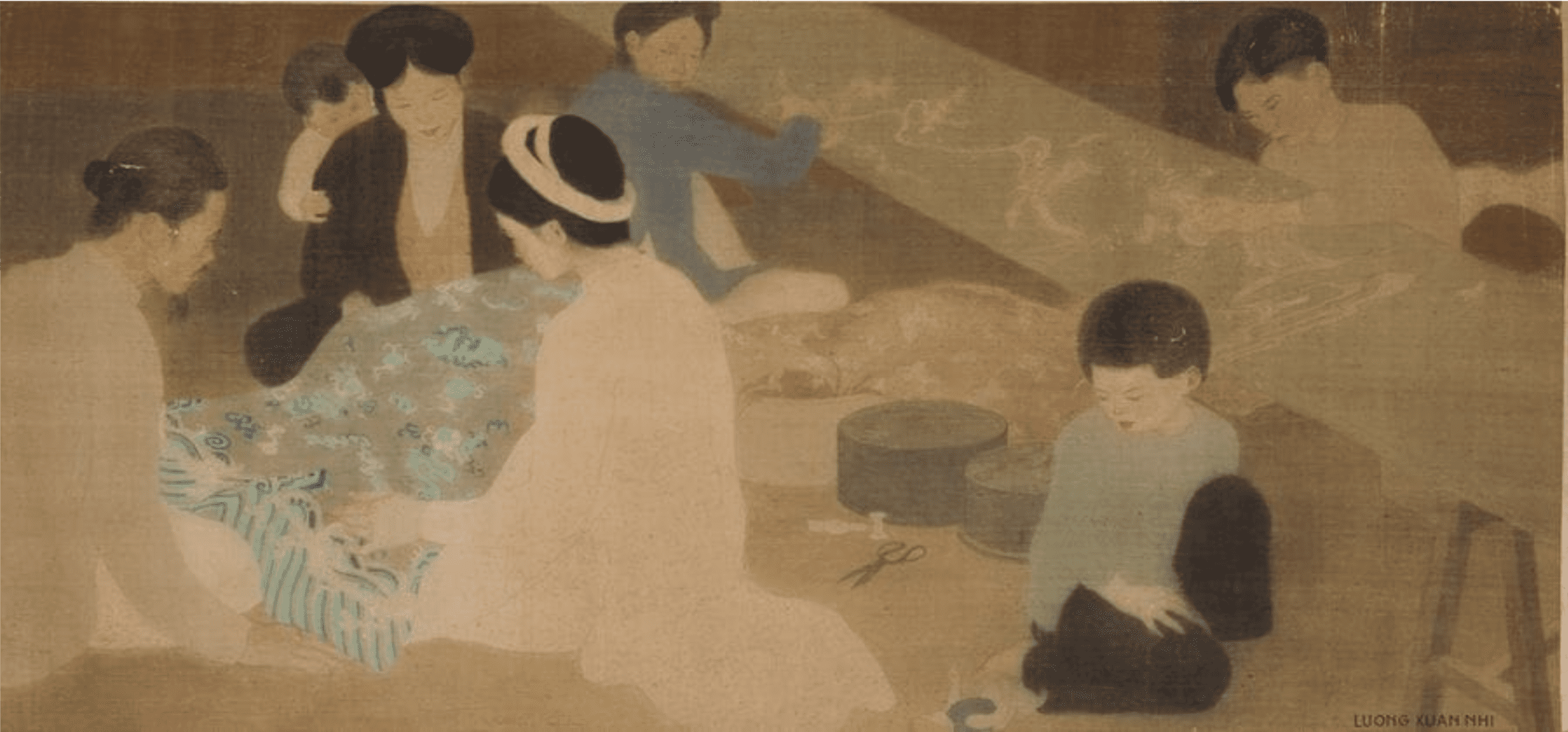
Beyond the domestic sphere, paintings also depict collective labour scenes that carry both aesthetic values and the weight of cultural memory, cementing embroidery’s significance as a Vietnamese intangible heritage object. “Embroidery workshop” (1950) by Luong Xuan Nhi portrays men and women assembling around a large piece of cloth embroidered with dragons and phoenixes, children hovering nearby. Precious tools – mother-of-pearl boxes, antique shears, reels of golden and silken thread – evoke a traditional embroidery workshop that has all but vanished.
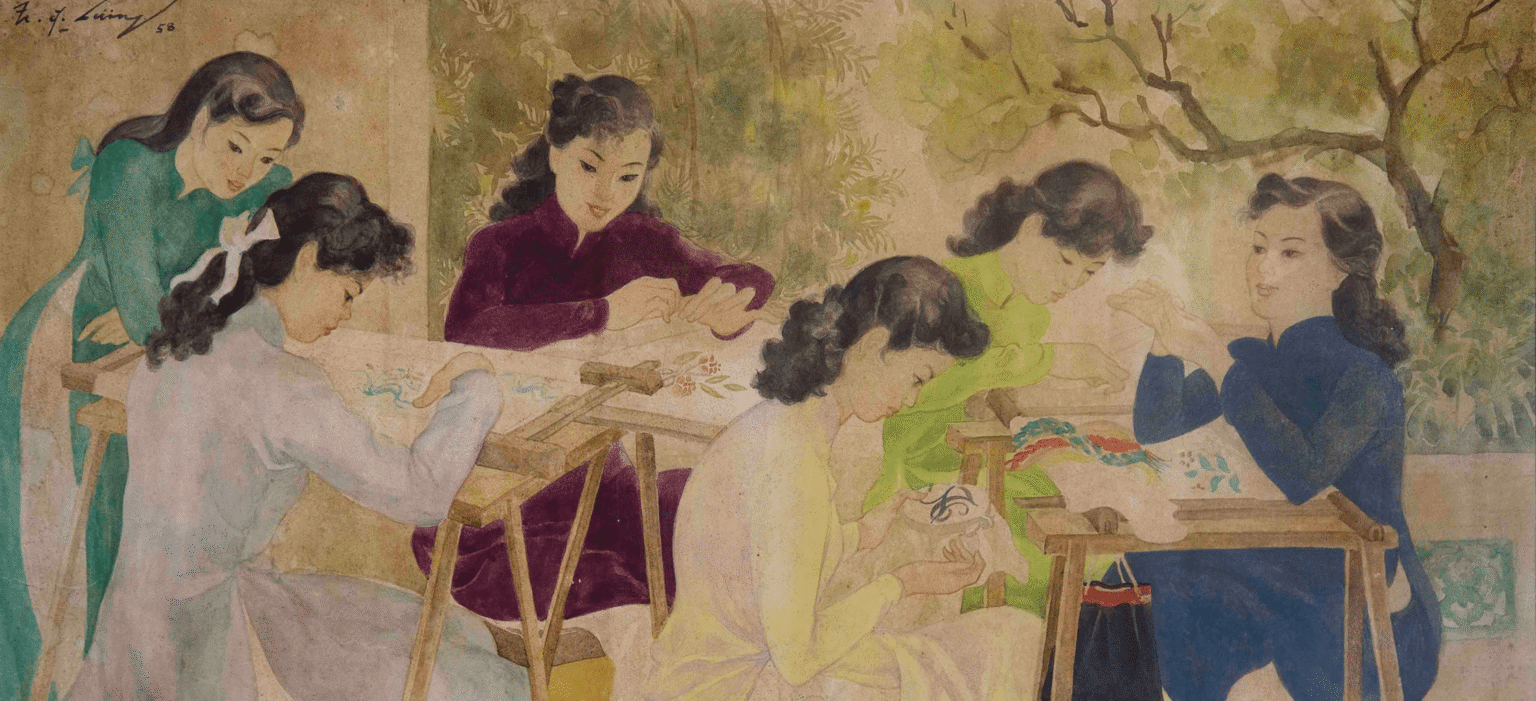
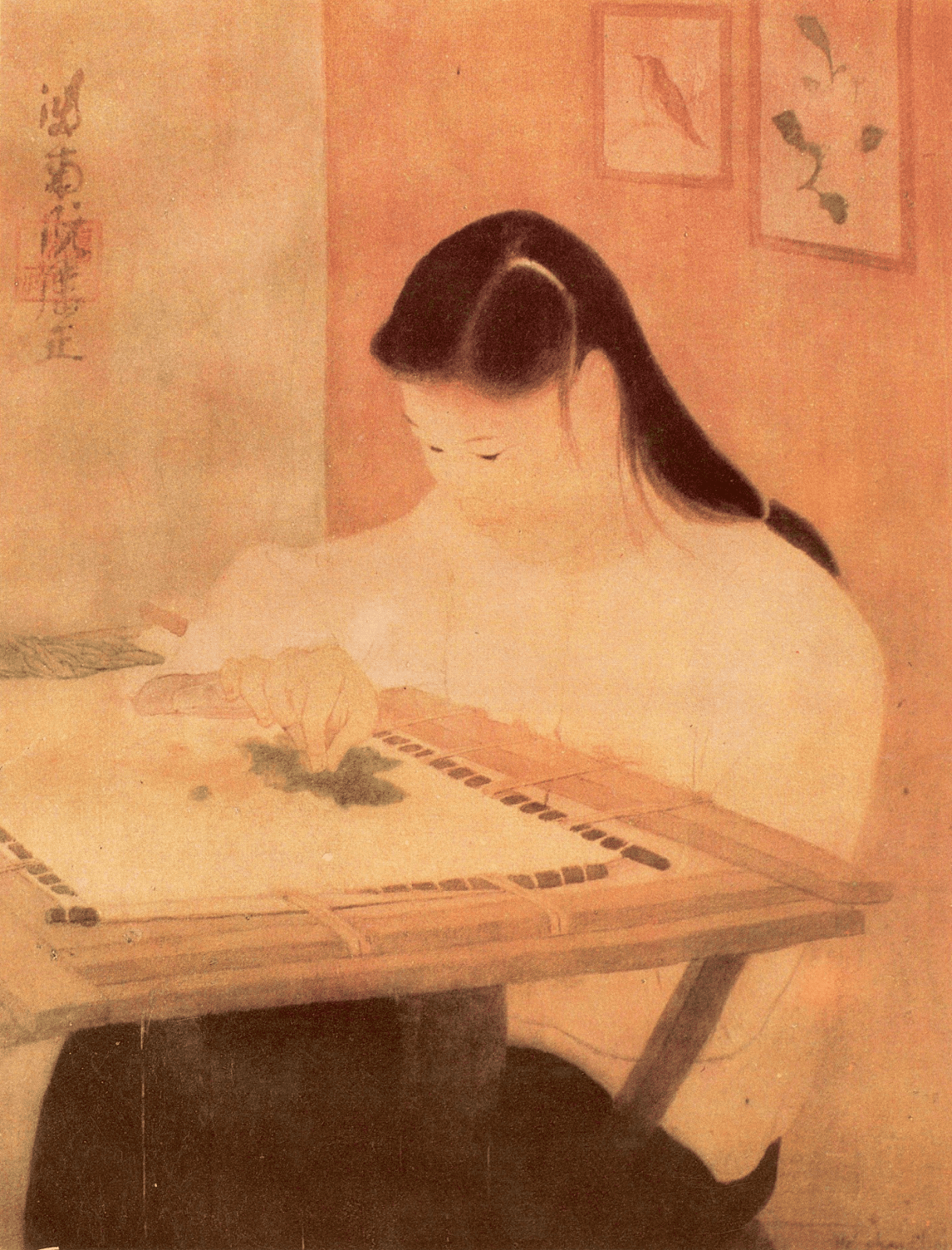
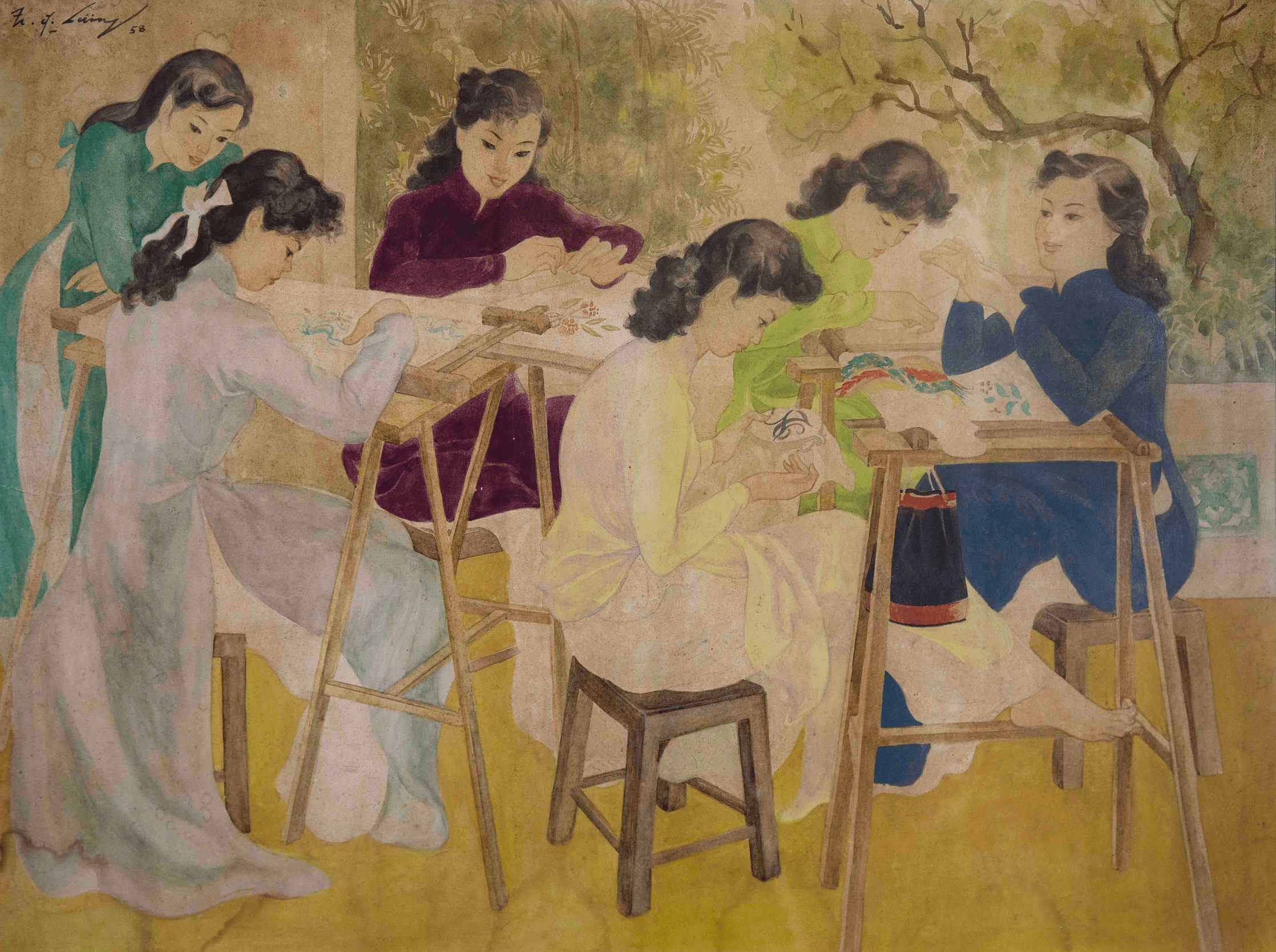
In “The seamstress” (1957), Nguyen Phan Chanh highlighted the distinctive hand postures found only in the most skilled embroidery artisans trained in village tradition: the thumb and forefinger hold the needle firmly, the middle finger pushing it vertically with precision, and the little finger curving upward to guide the thread evenly across the fabric. Tran Dong Luong’s “Embroidery class” (1958) introduced a different atmosphere: city girls in ao dai and permed hair sit upright around embroidery frames, eyes attentive, in an air of lively exchange. The presence of newly introduced floral motifs and the juxtaposition of round and square frames suggest a moment of transition, marking embroidery’s entrance into urban households as both a craft and a creative language.
Amidst these depictions lies a technical challenge: to paint embroidery is to paint hands. Teachers at the Indochina School of Fine Arts often reminded students with an old saying: “Skill is shown in the face, but flaws are revealed in the hands and feet”. To portray sewing, the painter must emphasise hands that are at once delicate and firm, dynamic and still. Especially in group scenes, the diversity of gestures reveals not only form and anatomy but also the very spirit of the figures. It is here that an artist’s mastery of drawing is most clearly challenged and highlighted.
Threading memories into rhythms
Today, contemporary artists rarely choose to explore this subject matter. Yet perhaps, if we look closely at life around us, we may still catch a glimpse of a mother or grandmother sewing quietly under the lamp, silently keeping the warmth of the household alive. The beauty of such unhurried peace, when recognised, continues to offer boundless inspiration for art. These images are not only depictions of life but also inadvertent records of intangible heritage: sericulture, spinning, weaving, embroidery – practices that have gradually faded from daily existence. They reveal postures, tools, and rhythms of women’s work once common, now seldom encountered outside memory or museums. In this sense, painting not only beautifies but preserves, recalls, and extends a heritage on the verge of disappearance.
The images of needleworks in Vietnamese painting, over a century, are also testimonies to artists’ ability to transform the ordinary into art. Each work becomes a chronicle of the hands – a milieu where forms are challenged and silent affection inscribed. From here, we understand that beauty is not always found in the grand or the dramatic, but often dwells quietly in the fine threads and steady rhythms of a woman seated by her embroidery frame.
Words & Translation: Pham Ngoc Tram