Đọc phiên bản tiếng Việt tại đây.
THE JOY OF MAKING ART TOGETHER
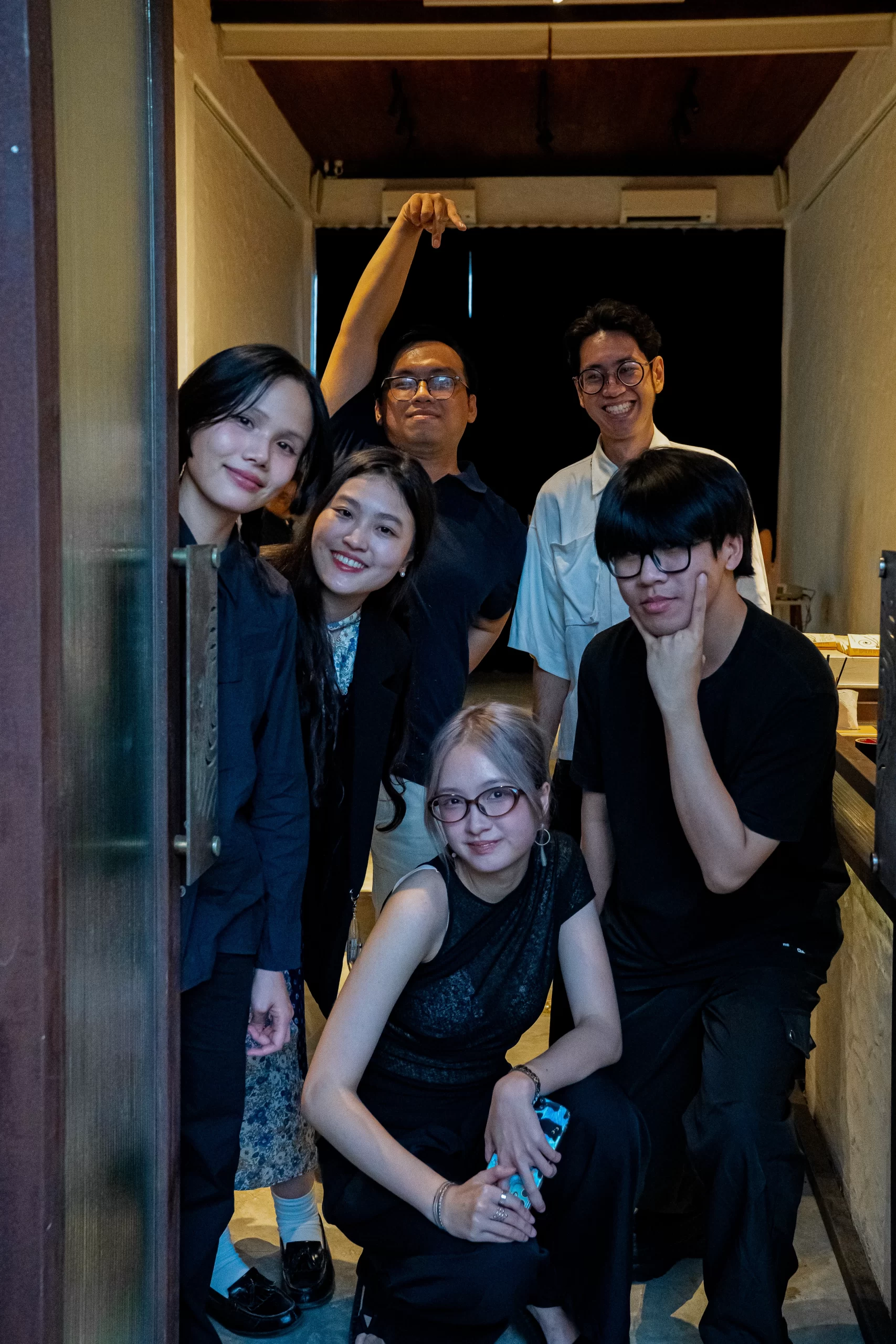
Rooted in shared perspectives on technology and art, Futile Devices Collective was initiated by individuals who, despite thinking alike, often felt somewhat “alone”, as artist Ha Chau Bao Nhi puts it. The collective therefore came into being “to create a space for exchanging ideas and supporting one another in our artistic practices, and eventually to open up opportunities for others with similar interests to join and grow together”. In early 2026, the fruits of this connection took shape in a modest space in Ho Chi Minh City. Driven by curiosity and a multifaceted approach, but above all by “the joy of putting together an art exhibition as friends and fellow collaborators”, the exhibition was an attempt to strip technology devices of the functions we have come to take for granted.
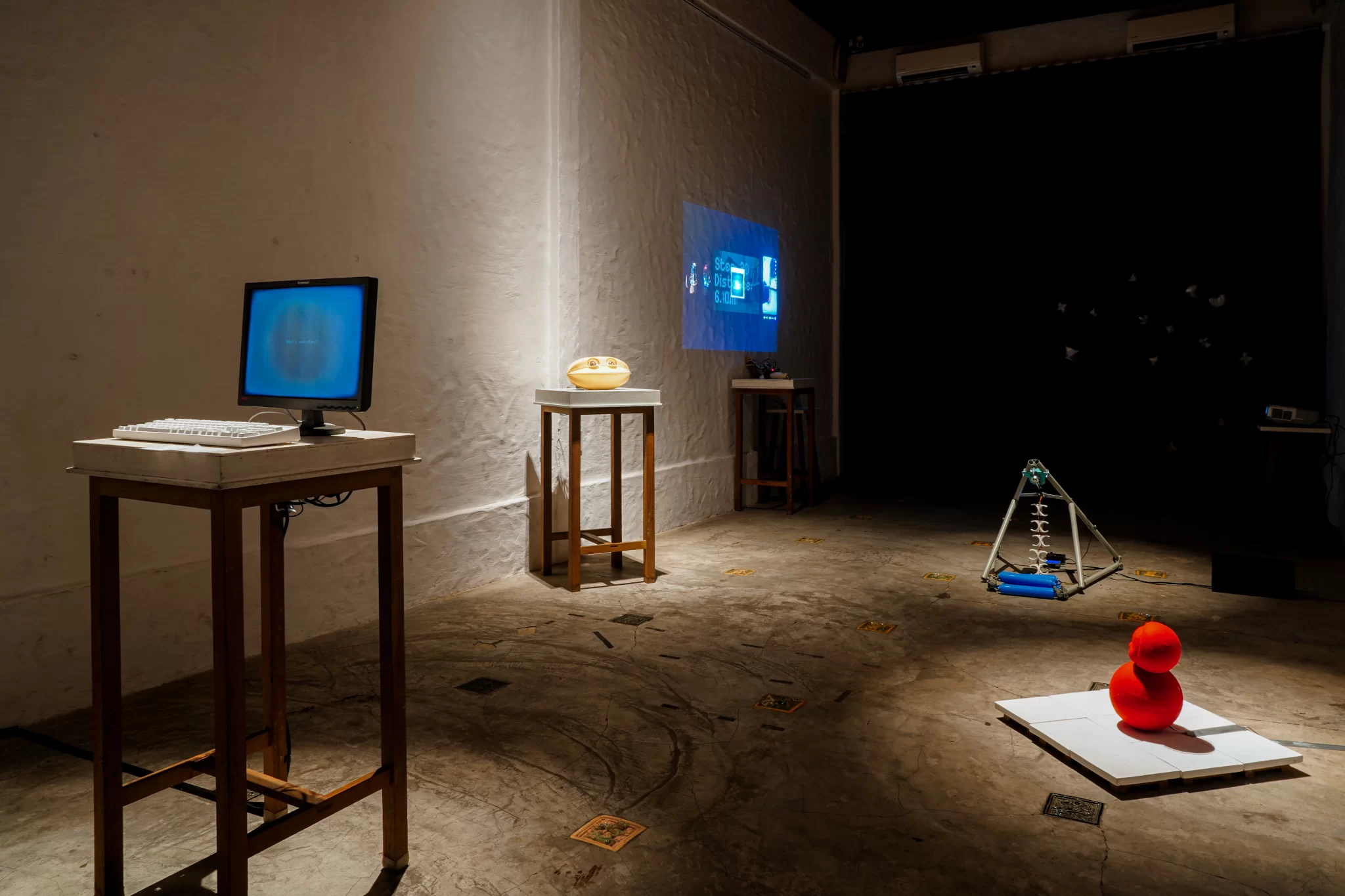
At the exhibition, the works brought to mind the small, familiar details of everyday life: snippets of daily conversation emerging from the stars in MCG+01-02-015; the habitual act of typing evoked by your secret is safe with me; memories and questions resurfacing through Fool Circle and eye for an eye for an eye for an eye. Other works prompted broader reflections, such as the ways technology exerts control over human beings, as explored in Ấp and Nhất bộ nhất Kiếp.
Each work emerged from an individual practice, yet came together within the same enclosed space. Collectively, they invited reflection on the ordinary aspects of life that we often overlook. Beyond these contemplations, the exhibition also brought long-standing concepts and ideas from history into the present through seemingly “inert” devices, questioning the excess of functionality that defines technology today.
WHEN TECHNOLOGY LOSES ITS FUNCTION
Inspired by the song of the same name by artist Sufjan Stevens, the title “Futile Devices” captures the sense of incompleteness that permeates the exhibition. This incompleteness lies not only in “the unfinished forms of the works themselves”, but also in “thoughts left open-ended, appearing only in fleeting, indistinct flashes and recurring”. Although these objects take the form of technological devices, they serve no clearly defined purpose or practical function. Yet, upon closer engagement, they give rise to questions and deeper contemplation. The title, therefore, is better understood as referring to devices marked by “futile gestures” rather than “uselessness”. As Khoi Nguyen explains: “Anything can hold a particular use-value for human beings, depending on the context in which it and the subject coexist.”
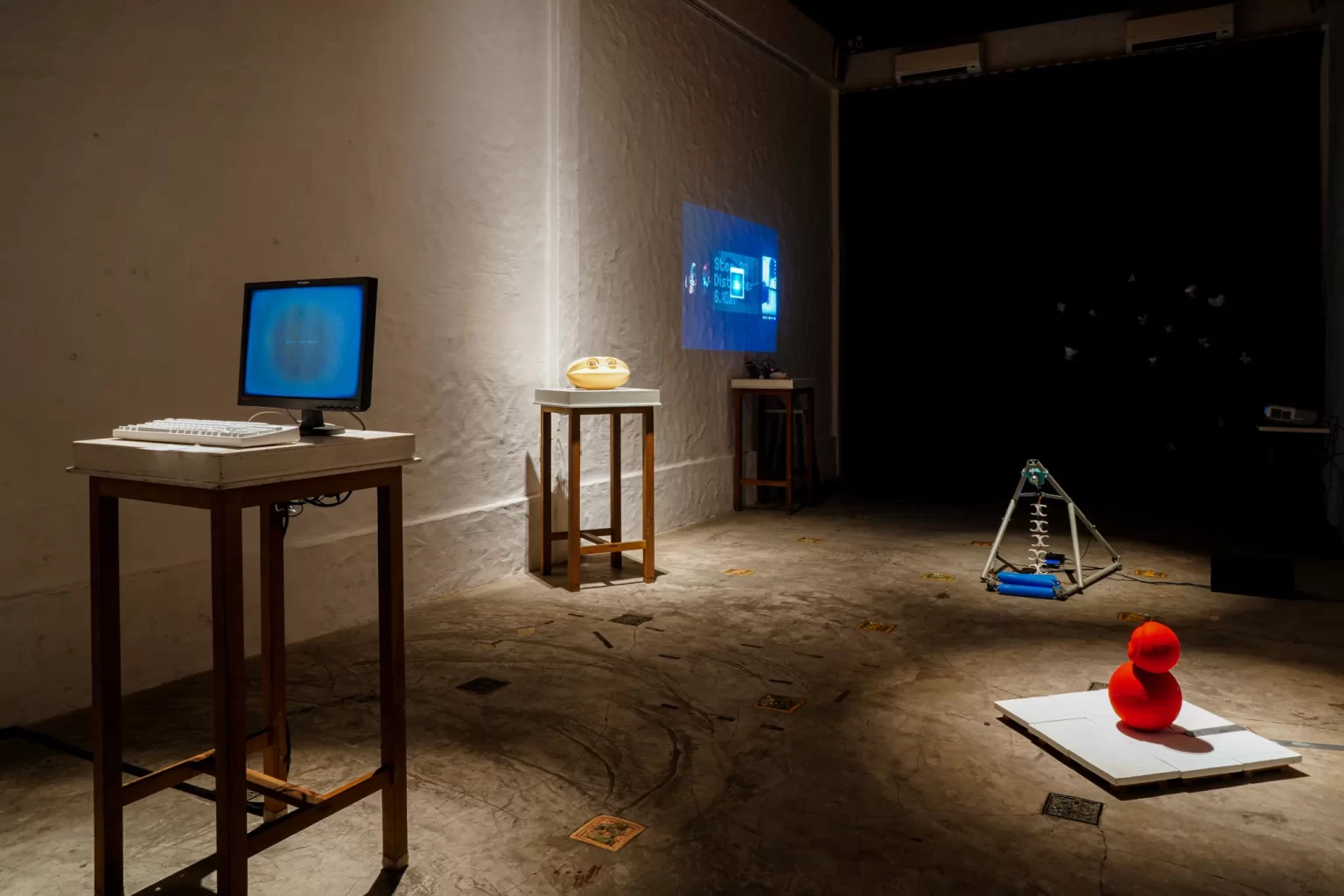
Within this space, these creations hold a particular potential: the ability to generate and play with meaning, rather than being confined by the limitations of conventional functions. This sensibility first emerges through Ha Chau Bao Nhi’s your secret is safe with me – a computer with a completely black screen, positioned at the centre of the room.
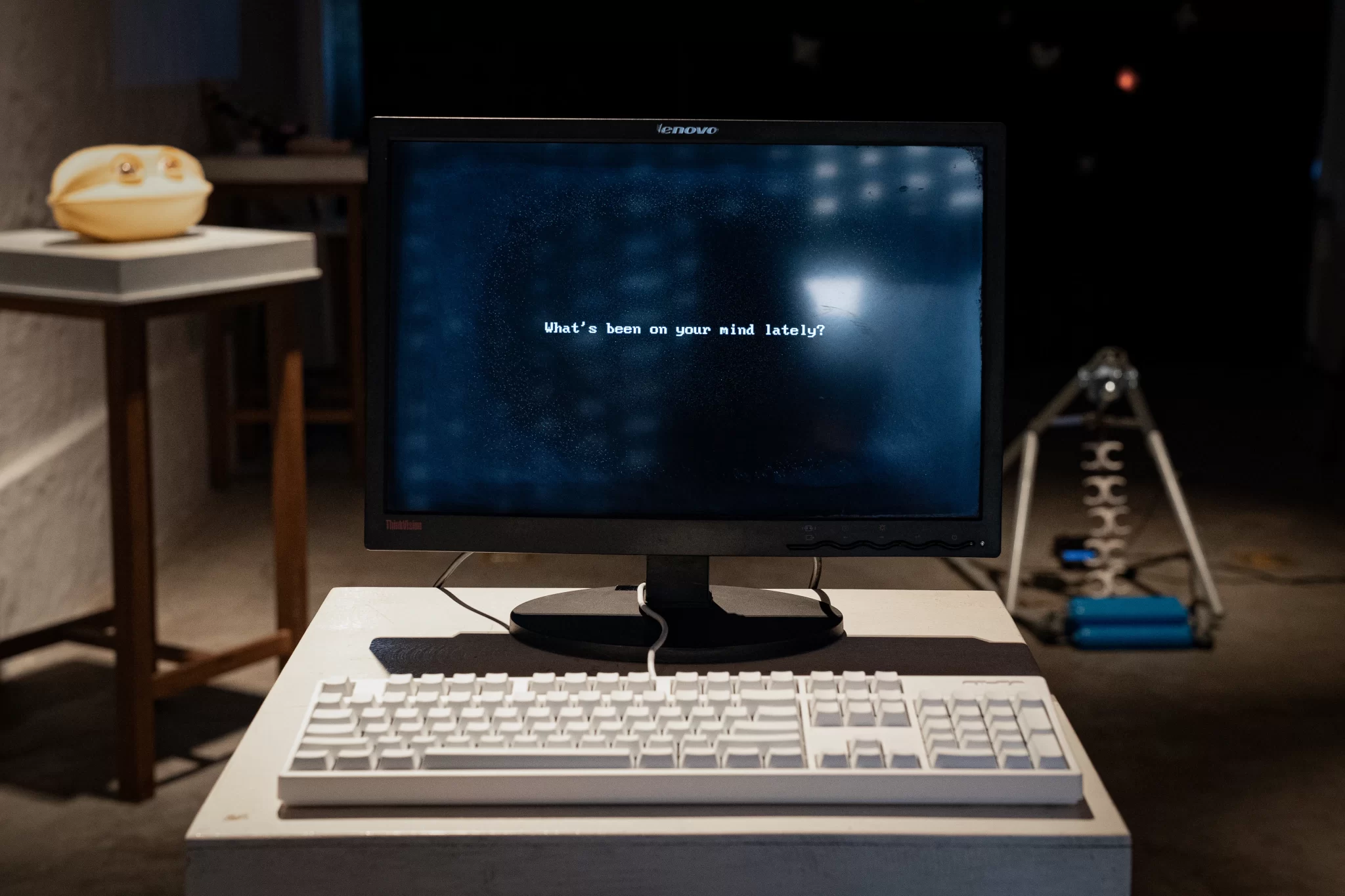
How long has it been since we last needed to look at the keyboard while typing? We understand that every keyboard is built upon a predetermined linguistic structure, and through hours of work, our hands have gradually memorised the position of each letter. Here, however, all expectations surrounding this form of muscle memory are brought to a halt. By rearranging the keys and erasing every trace of their original markings, Ha Chau Bao Nhi returns these plastic pieces to a blank state, stripped of any predefined identity. Now, even as we attempt to rely on old habits to convey our thoughts through the computer, the effort becomes futile, as nothing appears against the dark screen communicates any message. your secret is safe with me thus sets the stage for a reconsideration of what we initially perceive as a useless function. The computer opens up a dialogue about expectation: what happens when familiar outcomes, once assumed to be accurate, suddenly dissolve and give way to unexpected responses that cannot be anticipated?
Similarly, other works in the exhibition demonstrate that even after relinquishing the familiar conveniences of technology, these devices can still lead us to contemplate the very nature of those functions, even in their absence, and in turn, uncover unfamiliar yet intriguing ideas.
DIY – DO IT YOURSELF
First introduced by Ha Chau Bao Nhi and Vu Dieu Huong at the 2026 ACM SIGGRAPH DAC SPARKS, the works in the exhibition emerged from a process of experimentation and research into DIY methods – “building circuits by hand and finding ways to solve existing problems independently”. This approach runs like a common thread throughout the exhibition.
These methods take shape in custom-made computer programs that alter the characters displayed on Ha Chau Bao Nhi’s keyboard, as well as self-running mechanisms that set the objects in Fool Circle and eye for an eye for an eye for an eye in motion – two works that give tangible form to the artists’ memories.
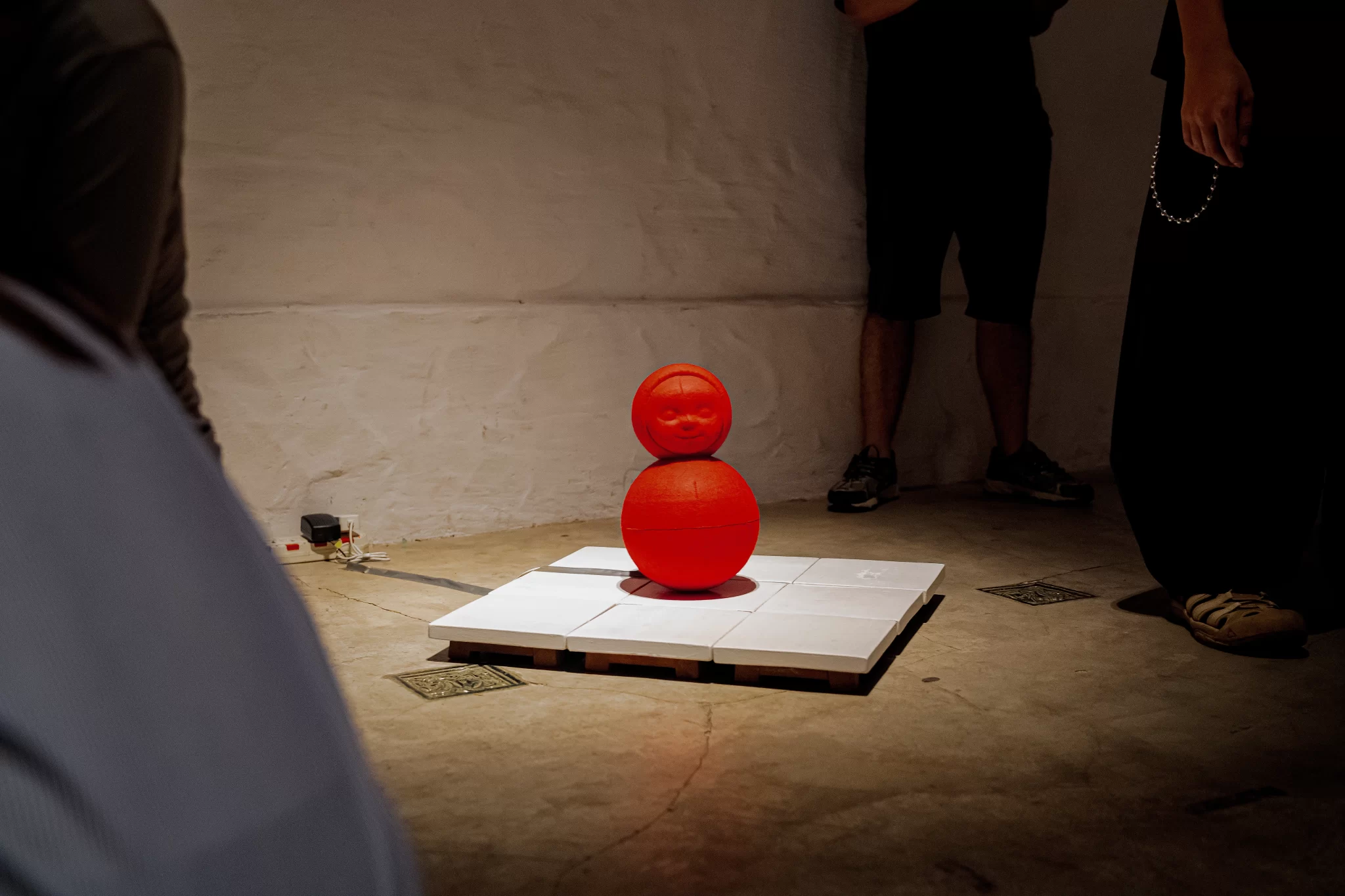
The tumbling doll, known as Nevalyashka, is an object many of us may remember from childhood, often placed on a living-room bookshelf. Fool Circle revisits this familiar figure as a reference to collective memory, while introducing an unexpected twist: the doll is housed within a motor that allows it to move continuously on its own, without any external force.
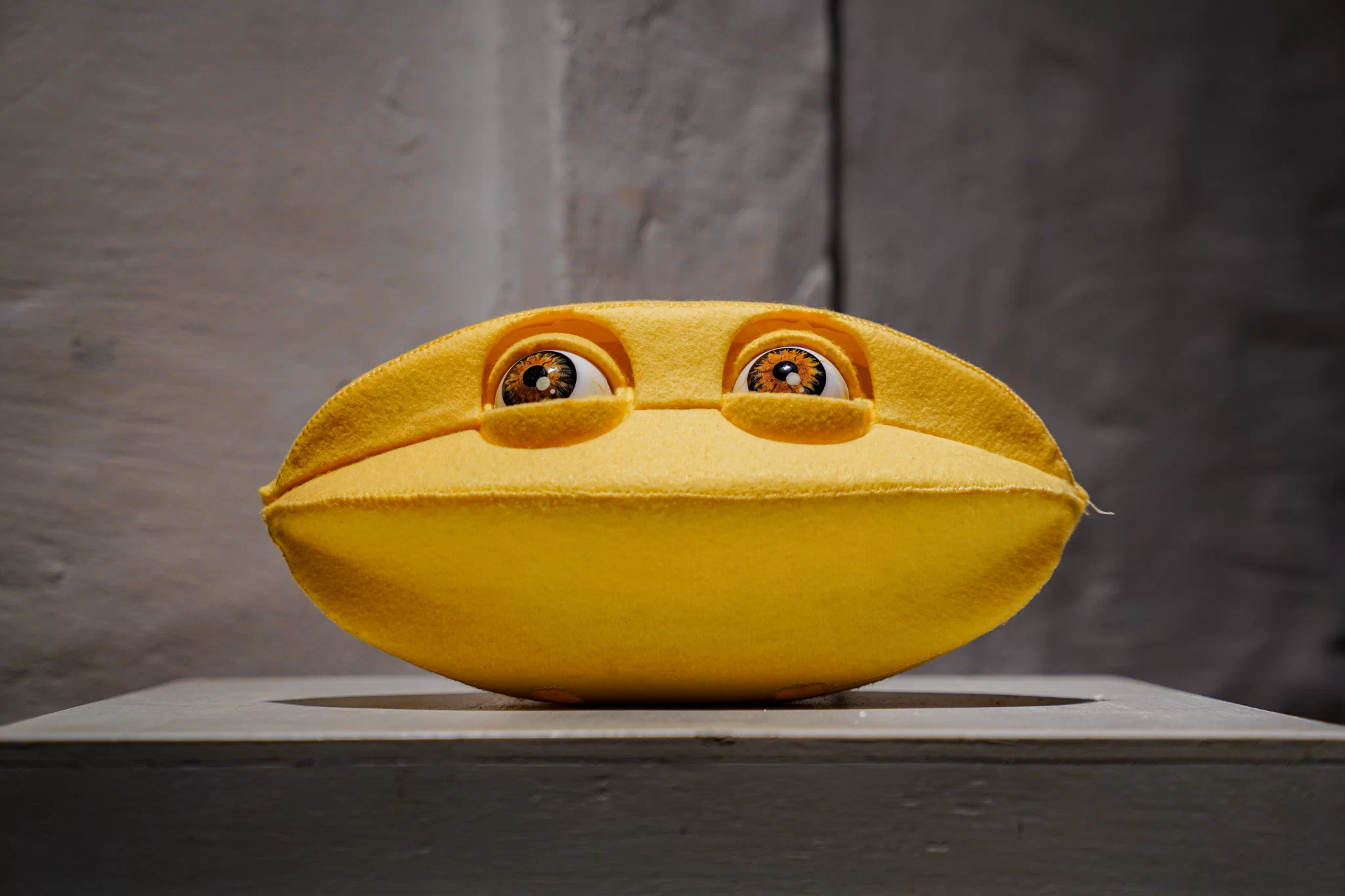
By removing all external influences, the work directs the viewer’s attention entirely towards the doll’s perpetual rocking motion. With each viewing, a series of questions inevitably arises: “Will this turn be any different?”, “Why hasn’t it stopped yet?” or “How much is enough?”. Similar questions surface when encountering eye for an eye for an eye for an eye, in which a personal memory is reimagined through the ceaseless movement of an eye across the work – constantly in motion, yet never following anything in particular.
What these two works share is their repetitive gestures, which defy the expectations and conventional logic we instinctively impose upon them. Yet it is precisely these gestures that spark curiosity about the meanings they might conceal. Each cycle evokes a thought, a memory or an idea, leaving us to wonder whether the act of remembering has ever truly reached its limit.
DIY AS A MEANS OF SURVIVAL THROUGHOUT HISTORY
The DIY ethos has existed since the mid-1970s, emerging within the punk movements of the United States and the United Kingdom, where it became closely associated with resistance to consumerism. In Vietnam, however, during the years of war and material scarcity, a similar practice had already taken shape as a means of survival, known as bricolage. Ha Chau Bao Nhi explains: “In Vietnamese, the term essentially means ‘making things oneself’, introduced by anthropologist Claude Lévi-Strauss in his 1962 book The Savage Mind. He distinguishes the ‘bricoleur’ from the ‘engineer’: an engineer plans ahead, gathering the exact materials and tools required for a specific task. A bricoleur, on the other hand, makes do with whatever is at hand, combining existing things in new ways.”
Today, this practice is perhaps most visible at Nhat Tao Market in Ho Chi Minh City, as well as among street vendors and repair stalls dealing in imported watches and second-hand rice cookers from Japan. As Bao Nhi observes, “most Vietnamese people, particularly older generations, have practised bricolage out of necessity, having had to make do with very little […]”.
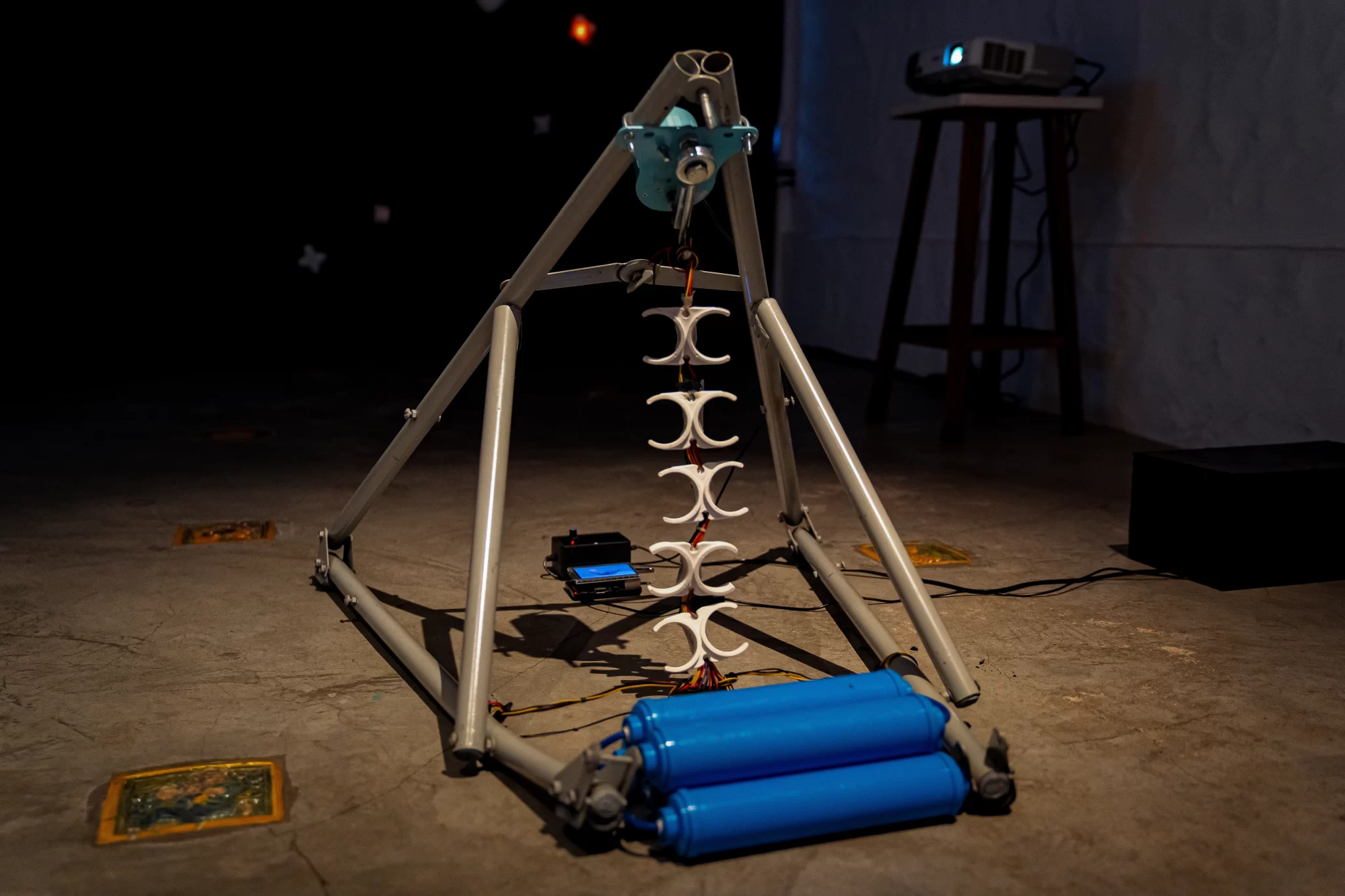
At the exhibition, this approach is most clearly embodied in Khoi Nguyen’s Ấp. Using discarded materials such as hammock frames, an old motorcycle motor and footage documenting the cloning of Dolly the sheep, the artist brings these disparate elements together to pose a fundamental question about reproduction and its origins.
From there, the work raises questions that are more technical than biological: “How is this work constructed, and how does it operate?”, “What drives – and what is the cost of – processes of disintegration and destruction?” More importantly, “What conditions would be necessary to reproduce an entity like this?” Although assembled from disparate objects into a cohesive artwork, Ấp ultimately becomes a dialogue with the artist’s own thought process.
TOUCHING, HOLDING, AND GRASPING IN THE DIGITAL AGE
Today, DIY practice can be understood as a way of questioning and resisting the harmful overreach of AI – a technology that creates a barrier between human beings and the material world. Reflecting on this, Vu Dieu Huong observes: “In an increasingly digitalised era, when interactions are gradually reduced to impersonal ‘taps and swipes’ across screens, working with tangible components and rendering them functionless carries two essential meanings: physical reconnection [and] resistance to functionalism.”
For the artist, the first meaning lies in an effort to rediscover genuine engagement with the world around us through holding and handling objects, rather than merely touching and scrolling through virtual spaces. The second takes the form of a protest against the extreme optimisation of technology, because “when materials are freed from their conventional purposes, they are given back the right to play”. Nguyen Thai Bao’s Nhất bộ nhất Kiếp offers a compelling example of this freedom.
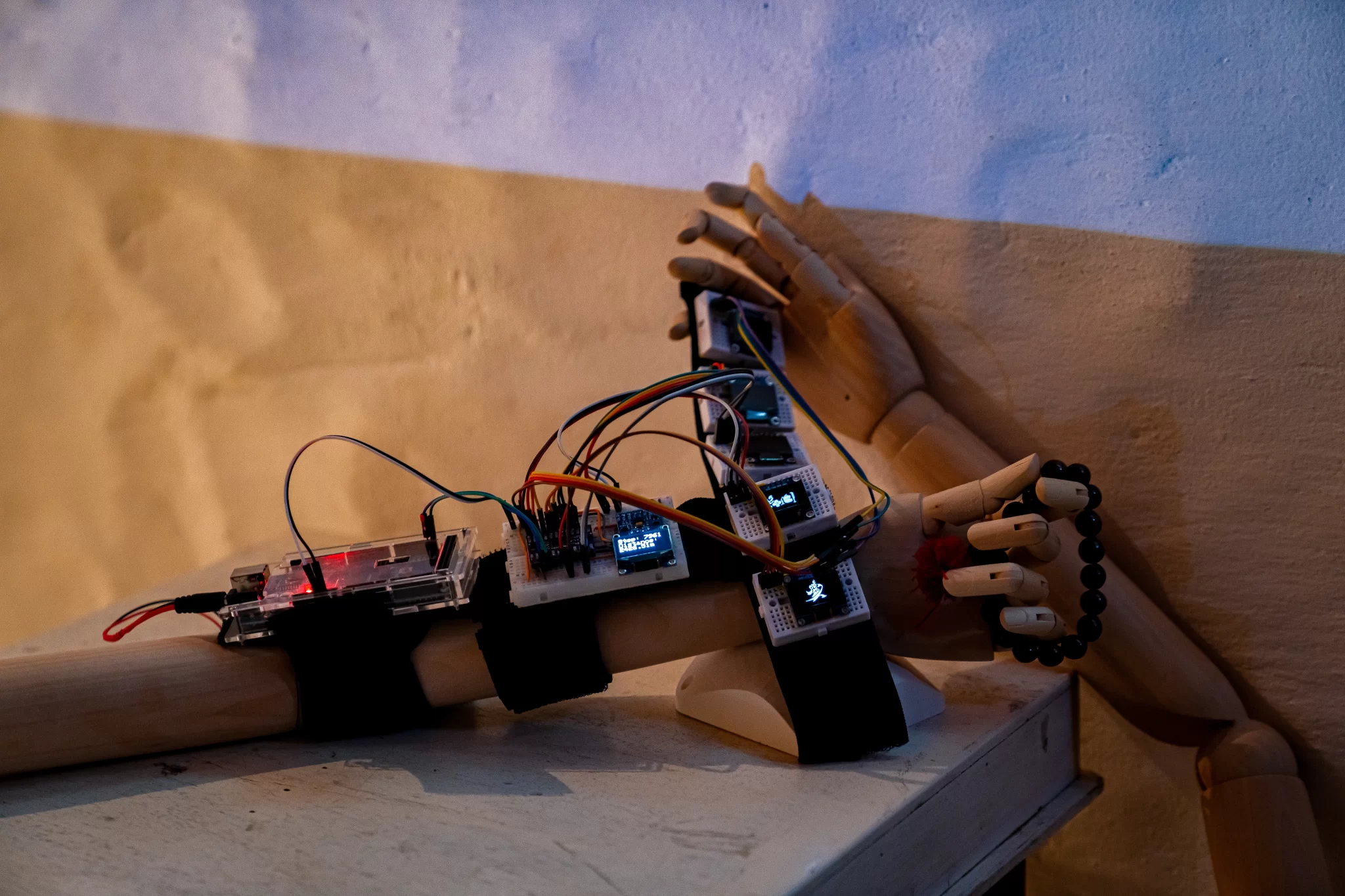
When worn on the wrist, the work displays a random stage in the cycle of human life. This detail prompts an unsettling question: what should we do if the word “Death” appears? Should we take another step forward, or stop? The cycle of Birth, Ageing, Illness and Death holds deep significance in Vietnamese culture. This belief is reflected even in architecture, where the final step of a staircase is traditionally designed to avoid falling on the Tử (Death) position in the Sinh, Lão, Bệnh, Tử cycle. But what if we happen to reach that word? Should we dare to take another step? Nhất bộ nhất Kiếp reveals technology’s attempts to measure human health and lifespan, suggesting how even the smallest deviations can bring about consequences far beyond what we might anticipate.
“TOYING” WITH TECHNOLOGY
At Futile Devices, the works embody a form of technological refinement. Here, “refinement” does not refer to technical mastery, but rather to the simplification and streamlining of functions that have become redundant within contemporary technological devices. Gia Khang believes that the subtlety once prioritised in technology has gradually been lost, resulting in unnecessary resource consumption and environmental costs. He recalls: “This is something I really miss about the 1990s and early 2000s, when technology brought with it so much joy, curiosity and the desire to ‘make’ things with technology.” This sense of simplicity can also be found in toys, which share a common characteristic with the exhibited works: limited functionality. Such limitations allow the works to focus instead on creating a deeper sense of connection with the viewer’s memories. The final “toy” in the exhibition is Ha Chau Bao Nhi’s MCG+01-02-015 – an arrangement of scattered, luminous white star-shaped forms, each seemingly suspended at a distance from the others.
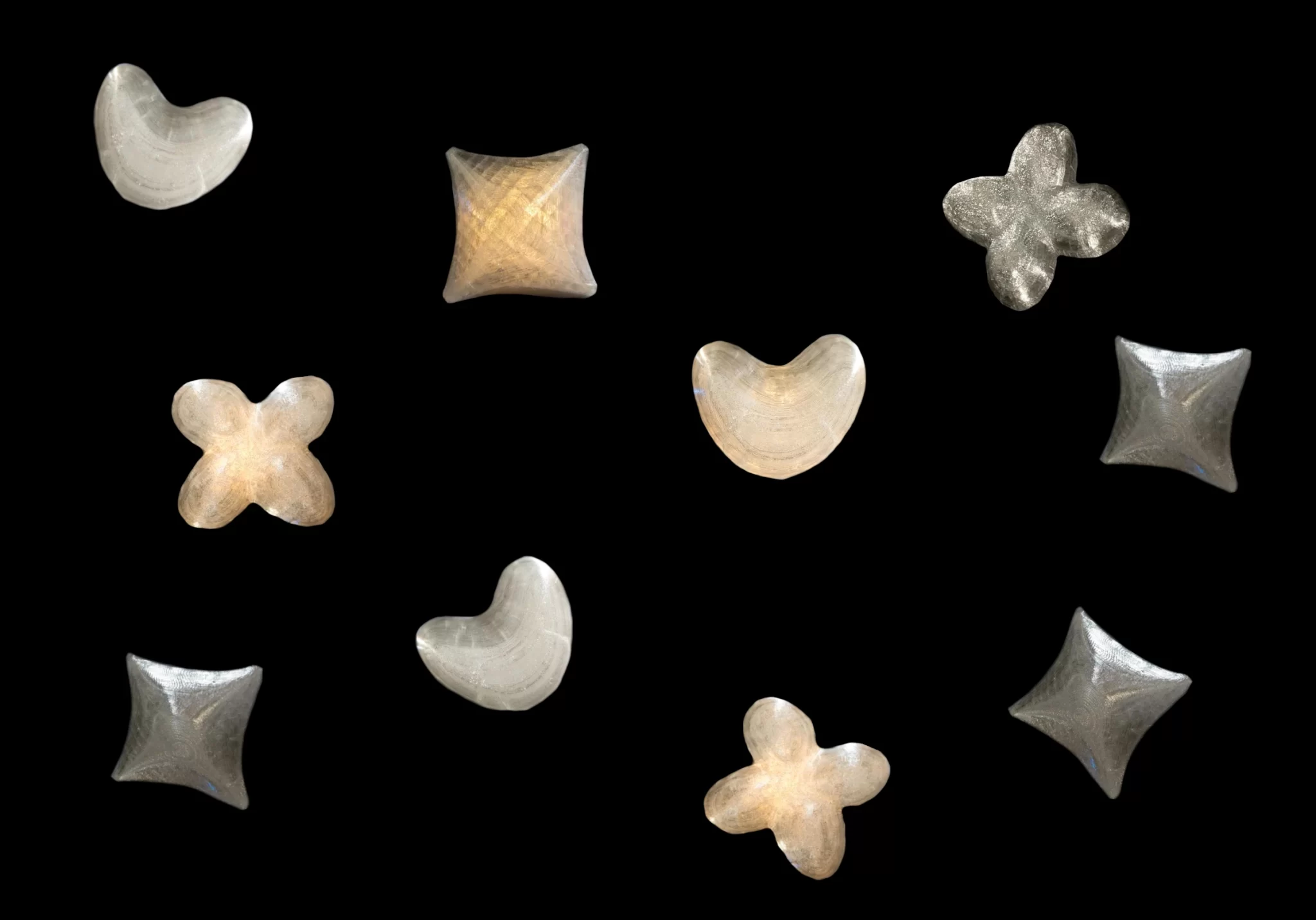
Resembling planets in a distant, disconnected universe, these forms unexpectedly give voice to fragments of everyday conversation deeply embedded in our memories. They are questions about what to eat for a meal or the familiar call of a delivery driver. Unlike the quiet, almost meaningless silence of your secret is safe with me, however, the voices of MCG+01-02-015 lose their meaning when removed from their original contexts. Each utterance emerges without any discernible order or interaction with the others. With a playful approach, the work offers no answers. Instead, these fleeting statements simply appear and disappear.
FROM SHARED IDEAS TO COLLECTIVE PRACTICE
Each work in the exhibition is deliberately open-ended. As curator Nhi Phan explains, they invite us “to slowly peel back the complex layers of human life in relation to technology […] [and question] how readily we take for granted the conveniences and functions provided by our devices and applications”. In doing so, the works encourage us to discover what is new and different – an approach that reflects the collective’s pursuit of value in even the smallest and most seemingly insignificant things. Ultimately, they leave viewers with a question: “Can we use technology as a means of reflection, rather than simply as something to use?”
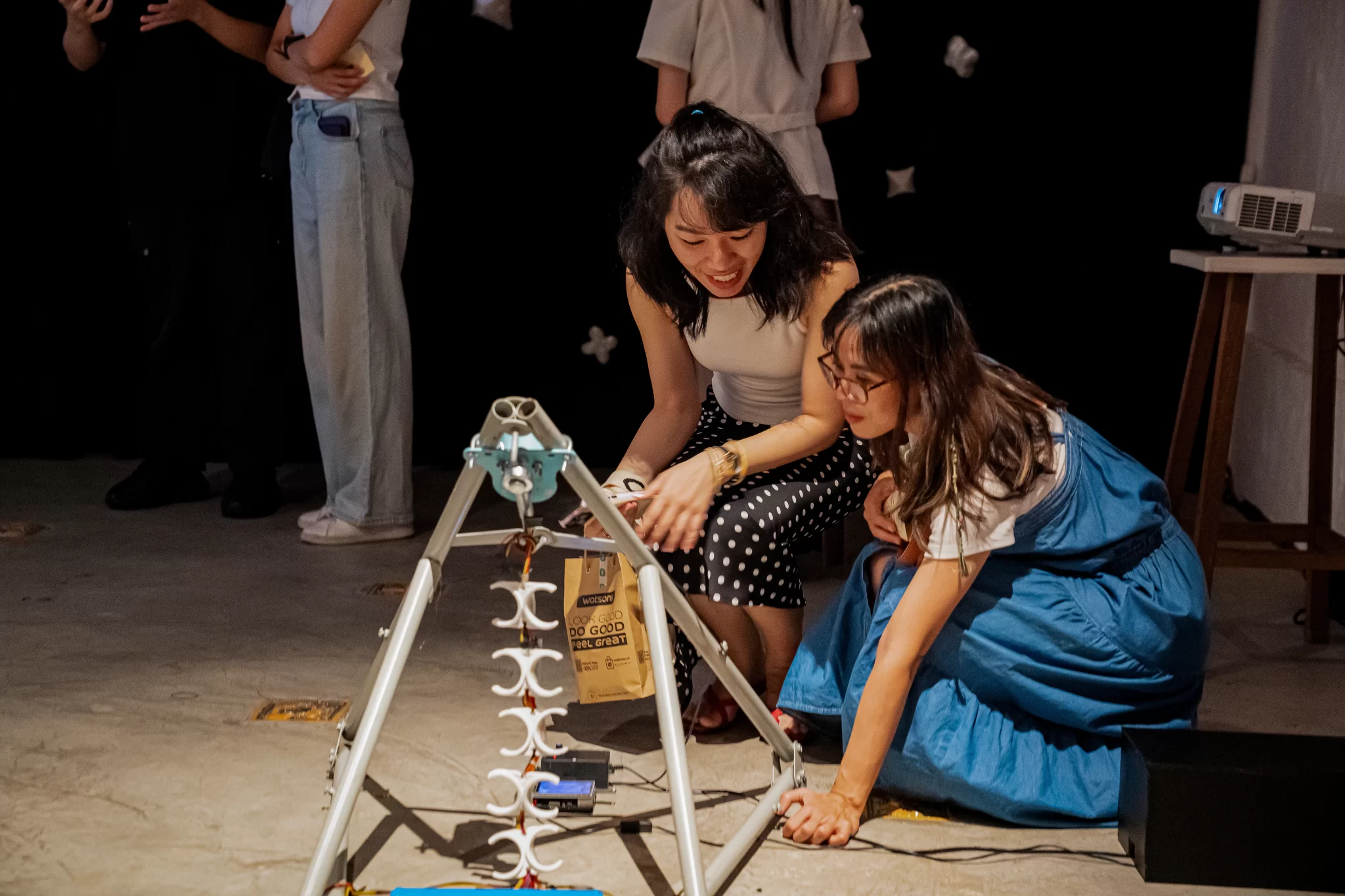
Growing from a group of like-minded individuals into a collective, with aspirations to establish an artist residency programme, Futile Devices Collective invites viewers to reconsider the familiar through the lens of the unusual. As Nhi Phan puts it: “Whether in their completed forms or as ideas just beginning to take shape, the works never truly remain still. They continue to evolve through their relationships with themselves, the artists and, in turn, the audiences who come to experience the exhibition.”
Words by: Khoa Duong