
Your research has been instrumental in highlighting the art historical significance of Emperor Ham Nghi as Vietnam’s first modern artist, in addition to him being a national hero. How has the public opinion on Ham Nghi in France been, before and after your publication and the exhibitions you co-curated?
Ham Nghi was not known in France before I dedicated my doctoral thesis to him. Only the major dates of the history of French colonisation in Indochina are taught in schools. Very few people in France know that the French government exiled monarchs in order to colonise their countries! Only French people with Vietnamese roots knew that he was a national hero! French historians of Vietnam were unaware that Ham Nghi had become an artist during his exile. My doctoral thesis shed light on an unknown aspect of Vietnam’s history. The publication of my thesis allowed the public to discover the story of this exiled emperor. The reactions of the French public have always been very touching. Often, there is a sense of shame towards the French government of the time, along with much sympathy and admiration for the exiled emperor. There is also a fascination with his life because he was called “Prince” and was in contact with great artists of his time. The exhibitions I curated helped make his work more widely known. As in Ham Nghi’s time, the French are generally surprised not to find more Vietnamese elements in his work. But everyone is moved by the quality and sensitivity of his art.


In the art world, the dominant language is still that of the West. How do you navigate such Euro-centricity to ensure your findings are also locality-informed and relevant to the public in Vietnam?
To conduct my doctoral work, I also undertook Vietnamese studies at INALCO and Paris-Diderot University. This enabled me to do 2 years of research on the ground in Vietnam, visiting places Ham Nghi knew in his life, searching for archives and understanding the cultural context of the early part of his life.
From an art history point of view, my doctoral work involved studying the artistic influences that inspired Ham Nghi’s work. I first studied what the concept of art was in Vietnam during the time he grew up; then I analysed his work with a view that looked both towards Europe, with the influences of French artists, and towards Asia, with the history of Vietnamese art and Chinese painting, which was present in Vietnam during Ham Nghi’s time. I first analysed Ham Nghi’s work in light of Vietnamese art history, to make sure I didn’t miss anything, before analysing the French influences in his work. This aspect was very interesting as “art” and “artist” had very different meanings in these cultures at the time of his life.
“Only French people with Vietnamese roots knew that he was a national hero! French historians of Vietnam were unaware that Ham Nghi had become an artist during his exile.”
Studying Ham Nghi’s life and work is an interesting case regarding Euro-centricity of art history. He was Vietnamese, but from the age of 18, he lived in Algeria, another French colony. He was trained in fine arts by a French orientalist painter and grew as an artist surrounded by French art. Thus studying this very peculiar destiny requires a good grasp of both Vietnamese and French cultures.
You prefer to refer to the Emperor as “Tử Xuân”, a very poetic name.
The name “Tử Xuân” was the nickname Ham Nghi was given from birth. He used it as a first name all his life, and he chose this name as his artist name to sign his works.

Besides painting, what other forms of arts/scholarship was Ham Nghi practising?
Ham Nghi practised painting, drawing, and sculpture. But like the scholars of his time, he made no distinction between fine arts and craftsmanship. He also practised woodworking. Several pieces of furniture made by him have been preserved. Thanks to his personal archives, we also know that he did basketry, although none of the objects he made have been preserved.
“I first analysed Ham Nghi’s work in light of Vietnamese art history, to make sure I didn’t miss anything, before analysing the French influences in his work.”
You are also the Emperor’s descendant of the fifth generation, so this is both a professional and personal quest. What are some of the most emotion-provoking memories during your research journey thus far?
My first memorable memory is the day my grandmother gave me the poem titled “Son of Spring,” written by Judith Gautier. This poem is so beautiful and it took me by surprise. At that moment, I realised that Ham Nghi had been recognised by some of the great names of his time. I didn’t yet know the importance of Ham Nghi to the Vietnamese people.
My second memorable memory is discovering Ham Nghi’s personal archives. After desperately searching for months for any clues about his life, I suddenly uncovered 2,500 letters, drafts of letters, and personal papers. This was like finding a treasure! Diving into all these letters and analysing them made me feel very close to him and proud of him.
My third memorable memory is my first trip to Vietnam in 2011. I was very moved to walk on the land of my ancestor, to visit the tomb of his father, beside whom he wished to be buried. I was also very impressed to feel how much Ham Nghi is a national hero, a patriotic emperor. The devotion and respect the Vietnamese people have for him deeply touched me.


Hue has always been a centre of history, culture and politics. What is your impression of Hue through your research, and what was the actual experience when you visited the city?
The city of Hue has a special significance for me because it is the city where my ancestor lived. It is the place where he experienced most of the pivotal moments of his life in Vietnam. Every time I walk around the citadel, I think about the fact that he knew these monuments and spent time there. Hue is the place in Vietnam where I feel closest to my ancestor.
Can you pick some of your favourite artworks by Ham Nghi for us, and tell us why?
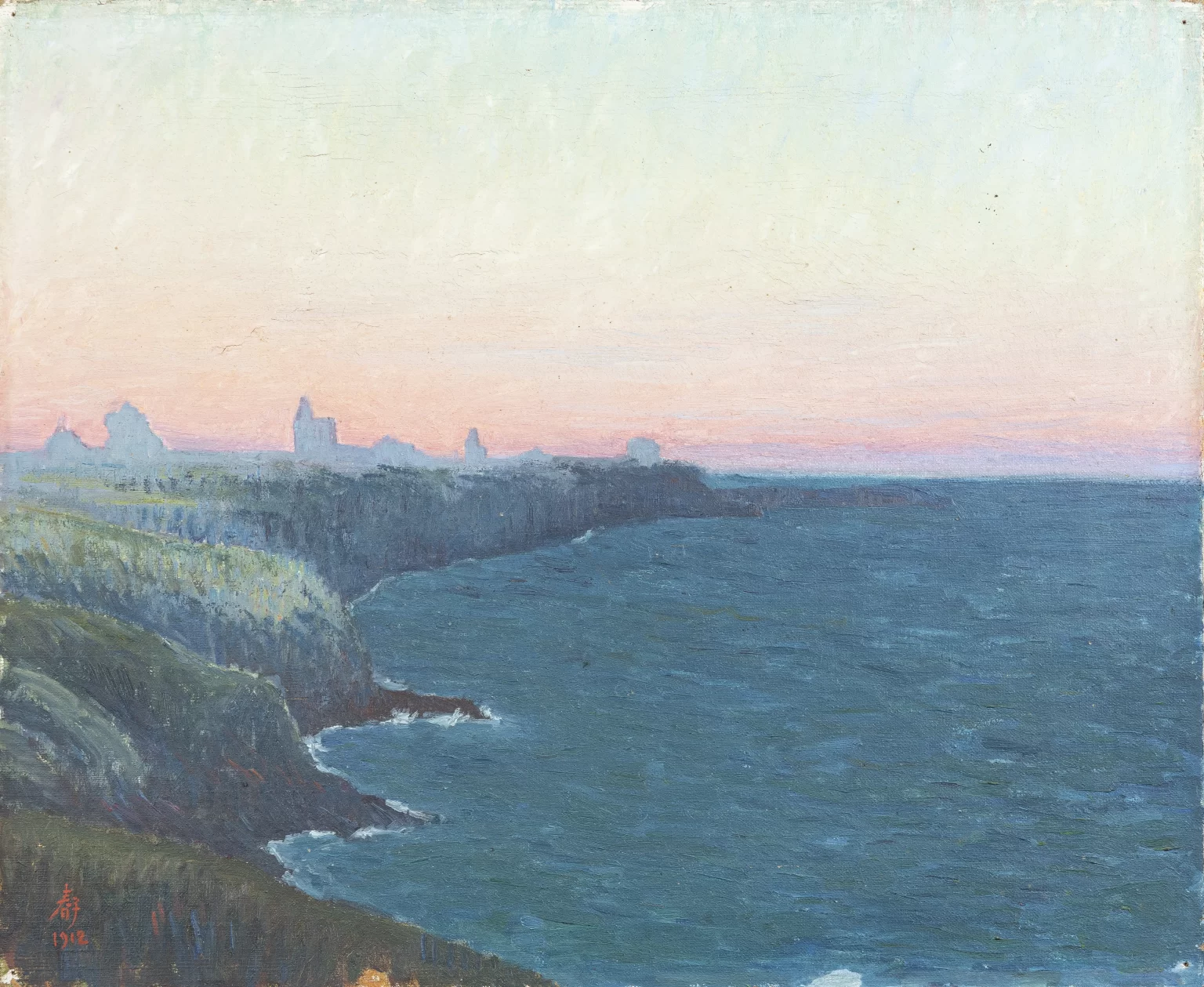
I love all of Ham Nghi’s works. Each one tells a part of the story of his life and reflects an inner emotion towards a particular landscape. I love both those that he painted daily, on location, to practise and study the variations of light on the same landscape, which are less known, and those that are more refined, with more marked stylistic research.
Ham Nghi’s self-portrait, drawn in 1896, is particularly moving. It is his only known self-portrait, made from a photograph. In this work, we can feel both the hesitations of an artist in training and the sensitivity and strength of an emerging artist.
One of my favourite paintings is the oil on canvas titled “The Old Olive Tree”, because Ham Nghi painted it in 1905, shortly after his marriage, at a time when he introduced into his work the palette of the French artist Paul Gauguin.
I also really love the sculpture titled “Woman with a Gourd”, because it expresses both great strength and a lot of fragility, and it is inspired by the works of the great sculptor Auguste Rodin.


Your book is now available in Vietnamese. Many of our readers can’t wait to get hold of a copy, and I wish you all the best with the launch plan!
Thank you! I am excited and eager to share the story of Ham Nghi in exile with the Vietnamese public!
Words & Translation: Ace Lê