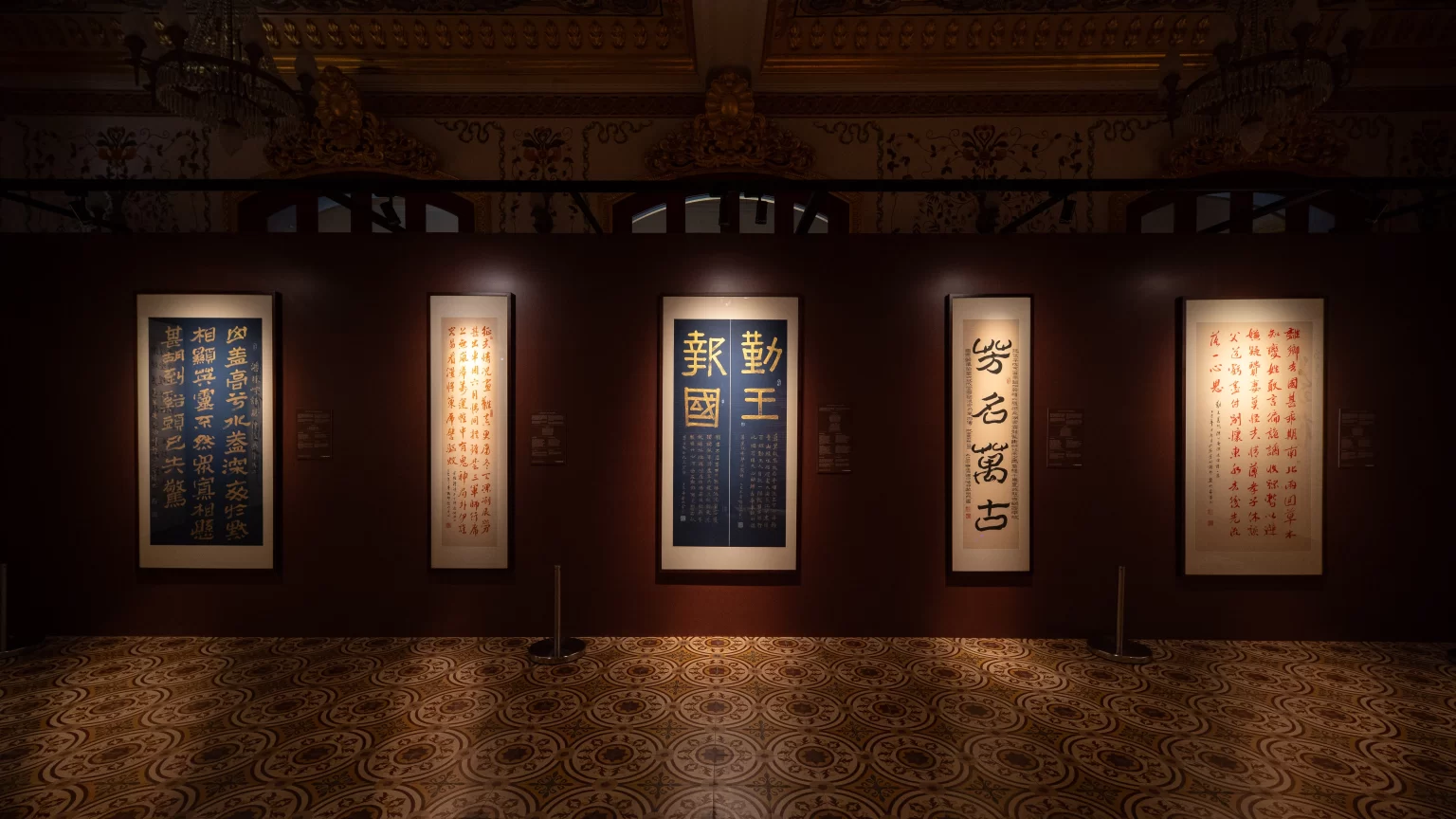


“Allusive Panorama” is a rare artistic event that not only reaffirms Emperor Ham Nghi’s status as Vietnam’s first modern artist but also intricately weaves a richly layered historical narrative imbued with a deep sense of national spirit. Within this broader vision, the display of Can Vuong-era literature by calligrapher Chau Hai Duong stands out as a poignant bridge connecting tradition with modernity, and Eastern with Western aesthetics. Each calligraphic piece pulses like a quiet heartbeat, resonating with the exhibition as a whole and evoking profound reflections on history, art, and Vietnamese identity. This is also the first time that two distinct forms of visual art — one deeply rooted in Eastern aesthetics, the other in Western — have been placed side by side within the same historical-artistic continuum.
Here, calligraphy is not merely the art of beautiful writing; it has become a vessel for reviving the spirit and voice of the patriotic scholar-gentry who once inscribed their unyielding love for the homeland into the very fabric of history. Rooted in traditional materials — Sino-Vietnamese script and classical brush techniques — Chau Hai Duong does not confine himself to a single, fixed style. He works with remarkable fluidity: at times employing the angular firmness of the square brush tip (筆鋒方, “phuong but”), or the flowing grace of the round brush tip (筆鋒圓, “vien but”) , adapting each stroke to suit the emotion and temperament of each piece, each literati. Some works emphasise decisiveness and intensity, while others lean into quiet contemplation or lyrical spontaneity. Yet all are underpinned by meticulous intent.
“Here, calligraphy is not merely the art of beautiful writing; it has become a vessel for reviving the spirit and voice of the patriotic scholar-gentry who once inscribed their unyielding love for the homeland into the very fabric of history. “
This approach prevents the calligraphy space from being framed into a merely “classical” aesthetic. Instead, it becomes a vivid visual realm brimming with a distinctly contemporary spirit. Viewers are not simply beholding works of art — they are invited into a dialogue between past and present, East and West, and heritage and renewal. After extensive discussions with the production team, Chau Hai Duong chose to work with only two standard paper formats. Whether crafting four-character idioms, eight-character couplets, a quatrain, or a single poetic inscription, he arranged the layout (佈局 – “bo phap”) with precision to maintain visual harmony throughout the exhibition while preserving the unique character of each piece.
Rather than emulating word for word, Chau Hai Duong deliberately selected the most poignant, distilled lines that best convey the poets’ inner resolve and spirit in the face of zeitgeist. Take, for example, Nguyen Thien Thuat’s “Inscription at the Temple of Tran Hung Dao”: instead of transcribing the entire poem, Chau Hai Duong had chosen only the two final lines where the poet’s fighting spirit and fervent wish to wield Tran Hung Dao’s sword against the enemy reach its climax, “Sacred sword, I beg to wield, to slay the demons / More ruthless than Ba Linh’s reign.” After visiting the Temple of Tran Hung Dao, Nguyen Thien Thuat expressed a burning desire to borrow the sacred sword to vanquish the invaders. The line “More ruthless than Ba Linh’s reign” makes a reference to the infamous Yuan general Pham Nhan, who, according to legend, transformed into a demon after death and was destroyed at the hand of Tran Hung Dao’s mighty sword. In evoking this image, Nguyen Thien Thuat expressed his own era’s fierce determination to expel foreign aggressors that were becoming more ruthless than ever. Selected as the focal text, these two lines of verse carry more than lyrical beauty; they are weighted with historical resonance. The calligraphy does not aim for decorative flourish, but rather to evoke a deep, reflective response, inviting the viewer to read but also to absorb, ponder, and vividly imagine a turbulent, heroic chapter of Vietnamese history.

In Eastern philosophy, it is believed that calligraphy and painting share the same origin (書畫同源 – “thu hoa dong nguyen”), as both originated from the brush (聿, “duat”). Chau Hai Duong draws on this legacy, skillfully employing a range of script styles: the regular script (楷書, “khai thu”), the semi-cursive (行書, “hanh thu”), the cursive (草書, “thao thu”), and the clerical script (隸書, “le thu”). Each script is carefully chosen to resonate with the content and emotional register of the text, combined with a deliberate interplay between the square brush tip and round brush tip. The result is a calligraphic spirit (書氣, “chu khi”) where each stroke exists not only in the textual form but also carries a strong presence, vitality, and expressive essence.
Instead of limiting himself to traditional black-and-white ink on Do paper, Chau Hai Duong explored a wider spectrum of pigments: vermilion red, ultramarine blue, ochre yellow, and even metallic gold, to extend the visual expressiveness of calligraphy and introduce a refreshing sensory experience. All works are rendered on xuanzhi paper – a fine medium traditionally designed for usage in both calligraphy and painting. However, he made a deliberate choice to work with a variety of background colours, carefully pairing them with compatible ink tones and experimenting with diverse ink-handling techniques to achieve optimal visual results. For instance, golden metallic ink is used on a teal xuanzhi, while white xuanzhi serves as the base for compositions using transformed ink (變墨 – “bien mac”) – a method of blending black ink with water and gold pigment to create subtle gradations in tone and texture. This flexibility brings further visual depth and compositional variety, evoking an impression of open space and continuous transformation, turning the calligraphy display into a dynamic visual environment that stimulates the viewer’s curiosity.

The exhibition “Allusive Panorama” not only showcases the oil paintings of Emperor Ham Nghi – Vietnam’s first formally trained artist in the Western style – but also reanimates a heroic chapter of national history through poetry and calligraphy. The juxtaposition of Eastern calligraphy with Western oil painting initiates a rare and meaningful artistic conversation. This is no accidental pairing, but a conceptual curatorial decision, one that attests that tradition is not confined and modernity is not severed from its roots. Rather, the two coexist and reflect each other, and together, they narrate the story of Vietnamese history, art, and national identity.

If Ham Nghi’s Western oil paintings were his way of expressing a soul in exile and a longing for home, then the Sino–Vietnamese poetry and calligraphy of the Can Vuong movement represent the scholar-gentry’s impassioned resistance and defiant hopes in the face of political upheaval. These two seemingly divergent artistic streams converge in “Allusive Panorama”, merging and amplifying one another, underscoring a profound truth: that art, regardless of form, is the deepest expression of human response to history. The Can Vuong spirit does not belong to the past alone; it remains relevant whenever we are willing to look back, to learn, and to carry it forward. For the written word is more than shape, and the brushstroke more than ornamentation, it is a bridge linking past to future, tradition to innovation, helping us stand grounded in our history while carving a path outward to the world.
Khuê Nguyễn