What exactly constitutes cultural labour within the ever-expanding spectrum of the plastic arts? Could one imagine art-making as a practice that transcends the often binary divide between production and extraction? Hidden away in an unremarkable warehouse in Glendale, Queens, New York City, lay a series of creative responses and provocations in a show aptly titled “Means of Production”. Curated by Lunch Hour, an artist/curator collective that explores and critiques the mythologies surrounding authorship, work, and labour, the show was an ambitious curatorial and collaborative effort featuring over 75 New York-based and international artists, many of whom are of Asian American and Pacific Islanders descent.


From the exterior, the discreet warehouse building did not project the normalized vision of how cultural institutions typically appear. This is, of course, intentional. However, upon entering through the small metal doors, which leads directly into the inner loading ramp, the exhibition space opens and attention is drawn to the building’s multipurpose use. In this grandiose “foyer,” artworks are installed in all directions, scaling the walls and dotting the passage further inwards. Why here? Why this space? Indeed, these questions flash on the lips of visitors as they traverse through what is otherwise a container to materiality, a space of storage and of marked and packaged labour.
Upon entering further into the space, visitors find that lodged betweens the ordered and maze-lize, rows of pre-packaged materials, are a myriad of paintings, videos, multi-media installations, and timed, live performances. Like its name suggests, the “Means of Production”, is not a delineated marker of what is presently concluded. Instead, it is an invitation to an onslaught of possibilities. If taken politically and explicitly, the title invokes the wrestling of labourers and producers; between those who produce culture, who work with the very material conditions, which allows for art to exist, and the larger formulaically hierarchical institutions that either ordain or discard both artists and their productions.
Immediately apparent from the show is that the objet d’art and art making by human beings are not isolated practices, which are safe from the forces of a materialist reality, rather, both the artists and their works are exposed and displayed as a synergetic analogy between the individual and their market – neither the artist nor their art can escape the market forces under which we all operate. Here, value lies not in the nebulous rhetoric of an aesthetic sublime, but instead, is laid bare in its
ragged edges, its off-centre placement, its hiddenness amongst the overwhelming darkness, crevices, and suffocating packaged materials that surrounds it. To find the scattered works, visitors are required to be more alert and attentive, to walk slowly, minding both their feet and what lies all around them.
“To find the scattered works, visitors are required to be more alert and attentive, to walk slowly, minding both their feet and what lies all around them.”
This way of treading through the space, in rather positive terms, is actively and productively disruptive to the viewing experience. Once more, this is intentional. Despite the numbered rows which are not always visible because of the dim, if not hauntingly dark lighting, there seems to be no inherent or predetermined order to the path that one can take. Indeed, this setup rejects the very notion of the orderly and, instead, prioritizes and emphasizes a more attentive method of viewership in the sauntering and visual sampling of the materials strewn about.
Borrowing from Marxists language to articulate its ethos, as evidenced by the collective’s own citation of Jacques Rancière’s critique of art and labour, the show’s title also delves into the internal borders and separations of the formalized art world, whereby the politics of recognition can either acknowledge certain art practices as labour or not. If, according to Marxist beliefs, that liberation of the lower classes (here artists left out of The Institution) is predicated on seizing the means of production from the bourgeoisie, then, implicitly, the practice of art must be made transparent as an extractive and exploitative economy within the labour market. Once more, the veil is pulled back from the notion of artists as donned clairvoyants who look at objects through the lens of muses and transcendental inspirations. Instead, artists and art objects alike are grounded within a mediated, corporal interplay between producer and product. The following are a highlight of some of the Vietnamese artists whose works were included, which deals directly with the show’s larger thematic:
In Koa Pham’s, “Invitation to a Dream,” viewers are presented with a mechanized installation suggestive of an erotic scene. Inspired by the “premium fantasy package” in the film “Lost in Translation”, the piece recalls the lurid lines between commodified desires and carnal gratification. Although draped in fabric, Koa Pham’s invitation is laid bare as a deconstruction of sexual desire into its mere form and function.
Similarly, taking cues from the Marxist conception of commodity fetishism, Anh Vo’s choreographed dance performance in “Common Fetish” challenges the drive toward possession and domination. Partly inspired by contemporary anthropological research on ritualized, northern Vietnamese spiritual possession, this trance-like performance with rhythmic chants pushes the idea of the body as vessels to be instrumentalized. Here, the performance asks viewers and participants to ponder: where am I situated in relation to the consumptive gaze?

Moving away from the sexual economy, artist Z.T. Nguyen’s star-shaped wall mount, entitled, “Perfect,” thinks about political economy and socialist iconography. Gesturing towards this oft-used symbol of unity and brilliance for country flag and propaganda, Z.T. Nguyen’s use of packaging materials for these human-sized stars presents a conundrum for viewers of the vexed relationship between political collaboration and competition.

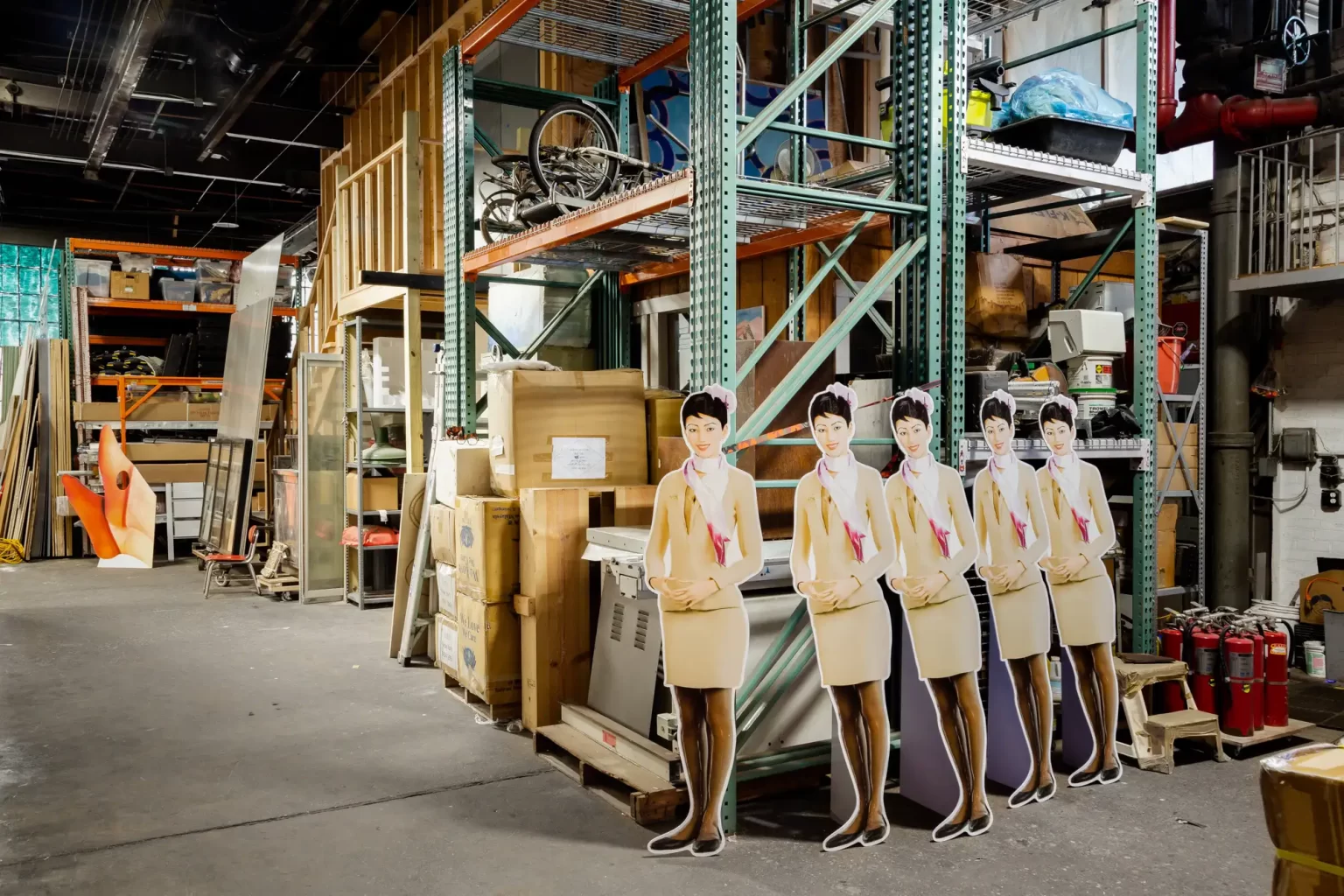
Furthering the theme of socialist iconography while retaining sexualized commodities, multidisciplinary artist Anh-Phuong Nguyen’s, “SilkAirways_GirlStandee_NEW.png” is a series of life-sized cut-out figures resembling female stewardesses from non-distinct Asian airlines. As part of a future video project, the figures stand quite literally as awkward reminders of the women whose labour and personhood is often flattened by the weight of a profession that demands conformity and pliability.

From life-sized to miniature, Gabi Dao, presents four of their forty marionette sculptures from previously exhibited installation series entitled, “Uncharismatics” and “Lucifer falls from Heaven at Dawn”, which had two different iterations at separate venues. Made from second hand materials using fabric and ceramics, these bat-shaped marionettes are uncannily human-like and offer a mediated contemplation of the otherness formed by the broad, dividing lines of race and gender.

In another piece, installation and visual artist Tran Thao Mien, uses up-cycled fashion waste to comment on the downside to creative production and our culture’s obsession with processed materiality. Entitled, “Have a Good rest,” Tran Thao Mien’s embroidered pillows take the ethos “Busy living slow” to heart. Placed upon Vietnamese straw mats, these pillow books are directly inspired by Karl Marx and Sei Shonagon’s “The Pillow Book (枕草子 – Makura no Soshi)” of the tenth and eleventh century. Here, as stated in the embroidered messaging, the message is a clear invitation to slow down and that resting, in an art world that is incredibly fast-paced, is also a “form of protest.”
Different from Tran Thao Mien’s use of upcycled materials, fashion designer Nguyen Kha Han rethinks labour and community in her sculptural gown “Bond in Differences.” Han’s piece, made from sheerly touch-ya, sheer chiffon fabric, aluminium wire, and sequins is a pensive commentary on the possibility of harmony between the industrial and the hand-made, as well as between softness and rigidity. In situ, the sculpture-dress both blends in and stands out against the rough industrial backdrop, blurring the object of fashion and its condition of possibility.

From hand-made dress to the state of undress, Tram Nguyen/vinacringe’s ten-minute, nude live performance titled, “a wound in the shape of the world,” is a performance of ritualised purging, shedding, and a search for intimacy. Deploying a visceral soundscape that acts as a backdrop to the artist’s slow stilted movement between the warehouse aisles, the performance is an exploration of the body’s suffocated struggle against life and death. Grounded in the ambient sounds of a fragmented sex tape, the performance climaxes in the halting screams of a naked feminine, body longing to be free. Here, the womb and the wound are as mutually constituted as they are confounded. As the screams subside, the artist breaks the cycle by wandering into the distance beyond the spectators’ gaze.
Extending the theme of engendered femininity, Thuy Nguyen’s playful calendar entitled, “GRRR,” is a series of twelve images made in collaboration with photographer Jennifer L. Czyborra. Utilizing the visual language often seen in pin-up calendars, the series is a playful and defiant take on the non-conformity of engendered bodies. Tittering between fantasy and personal self portrait, this reverse casting of traditional gender roles in the media asks whose time is it to shine?

“Tittering between fantasy and personal self portrait, this reverse casting of traditional gender roles in the media asks whose time is it to shine? “
Rounding out the show, Berlin-based artist Tra My Nguyen stays on the thematic intersections between fashion, migrant labour, and the feminine form. Building on her previous series, this work appropriately titled, “Bodies,” is a sculptural series that is a mixture of silicone, mesh fabric, and hosieries that materially blends with its surroundings. Here, the female body is once again recast as empty human-like shells. Dangling somewhere between the organic curves and inorganic materials, this gesture towards the post-human industrialized machination.

Words: Vinh Phú Phạm
Translation: Rylan Nguyễn