
Dr Lenzi, over the last decades, you have been the most prolific and consistent voice in situating Vu Dan Tan as a pioneer of Vietnamese contemporary art, with a rich repertoire of publications, exhibitions and seminars. This time, Vu Dan Tan Museum is your most ambitious and impactful project on the artist to date. Please share with us your curatorial vision and strategy?
Iola Lenzi (IL): This project is a collaboration with Vu Dan Tan’s widow Natasha and daughter Nhusha Vu. The plan was first hatched in 2012 when I was researching “Venus in Vietnam”, an exhibition commissioned by the Goethe-Institut Hanoi, that extended my 2001 research on Vu Dan Tan’s art manifesting critical ideas about sexuality and gender and their connection to Vietnamese social dynamics. I started delving into Vu Dan Tan’s vast corpus and realised that much of it remained unknown in the field. Scholars are currently debating methodologies for the study of Vietnamese art history, as well as definitions of contemporary art. But before arguing over frameworks, it is imperative to look closely at the art itself. Primary materials and their understanding are foundational, before frames and discourses. The Museum, which houses a good swathe of Vu Dan Tan’s production; his writings and papers; documents linked to his life and career; and crucially, papers and publications relating to Vietnamese art over the decades of 1980s–2000s will afford art historians primary and secondary materials necessary for art historical research.

“I agreed with Natasha that ‘Salon Natasha is over’, and we were going to work on a new project that would surpass ‘30 Hang Bong Street’ in terms of physicality; yet, dealing with the last memories was still unavoidable and transmitted naturally through architecture.” – Hoang Le
The curatorial strategy emerges organically from the materials: Vu Dan Tan’s art is so rich in ideas and critical threads revolving around philosophical and tangible questions – the nature of art and aesthetics, human progress, technology, Vietnam’s place in the world, the meaning of the nation in a globalising world, music, and more. So the plan is to present thematic exhibitions unpacking and connecting these ideas. The inaugural exhibition in December, which I am curating, is called “Vu Dan Tan Citizen of the World”. It presents Vu Dan Tan’s origin story, showing how his early innovations seeded his 1990s contemporary art breakthroughs.


Hoang Le–you and I were both born in the 80s and grew up in the 90s, with our respective memories of Salon Natasha, Vu Dan Tan and the first generation of contemporary artists in Hanoi. I am curious: when implementing this project, did you draw from these memories in the process of designing and building the Museum?
Hoang Le (HL): At first, I worked quite independently with what I remembered about Salon Natasha on 30 Hang Bong Street, as there is always a theme in designing a museum, unlike doing an exercise in “describing your memory of someone…” Besides, I found recollections, or memories like these, quite fragmented, despite being repeated over and over in our generation; and I didn’t know how to gather and turn them into input data for the design.

Initially, I read up on the late artist Vu Dan Tan and his environment, mainly through Natasha, then referenced more information from writers I have been quite interested in such as Dr Lenzi, Bui Nhu Huong, Dao Mai Trang (who connected me with Natasha), and other international sources. It mainly stemmed from personal curiosity and involved piecing together, systematising my previous fragmented memories, even from a very young age, but without any intention to convey anything.
I agreed with Natasha that “Salon Natasha is over”, and we were going to work on a new project that would surpass “30 Hang Bong Street” in terms of physicality; yet, dealing with the last memories was still unavoidable and transmitted naturally through architecture, perhaps thanks to the period of discussion and information exchange above.
Dr Lenzi, in your recent book “Power, Politics and the Street: Contemporary Art in Southeast Asia after 1970” (2024), you pointed out (p. 89) that Vu Dan Tan – alongside Truong Tan and Nguyen Van Cuong – was among the few artists in Vietnam to have “produced contemporary art of the kind discerned across Southeast Asia” as globalisation swept through the region in the 1990s and early 2000s. Are regional narratives an inspiration for your curatorial direction of the Museum?
IL: While Vu Dan Tan, Truong Tan, and Nguyen Van Cuong knew little or nothing about regional art in the early-1990s, their works reveal comparable critical engagements with societal and cultural issues, and inventive circulation strategies for enlisting audiences outside institutional frameworks, as those evidenced in Thai, Indonesian, and Singaporean contemporary art. I establish various reasons for this, evoked in the book and other publications. The Museum is centrally focused on Vu Dan Tan and his prolific career oeuvre. But Vu Dan Tan was highly curious, keenly interested in the world beyond Vietnam, and sophisticated in his art that connected ideas and images across geographies, cultures, and time. Therefore, creating dialogues between his pieces and regional and global art via special exhibitions is indeed one of the many ideas we have for the Museum. The Museum is a research institution, and curating offers an essential path to shaping art historical discourse, so exhibitions of all kinds, beyond those exclusively focusing on Vu Dan Tan, are on the cards.

Vu Dan Tan Museum is on track to becoming the first private contemporary museum to be licensed in Hanoi. What are the main functions of the museum, and how was the space planned to accommodate them?
HL: First, the basic functional group of the Museum is relatively complete, despite being compressed into a modest area, featuring permanent and temporary exhibitions, storage, office, entrance, etc. Additionally, there is a system of auxiliary works, accommodation block, studio extensions), or landscape. This is probably a rare project where the design had been expanded even before construction commenced. Originally, this land fund was reserved for future developments, but during the construction process, we decided to implement this category at once to boost the project’s efficiency. The steel deck system is set up to connect these functions, ensuring seamless movement. The functions can be separated when needed, but can also be intertwined at certain events… I hope so.
Can you give us a sneak-peek of some must-have artworks in the permanent display?
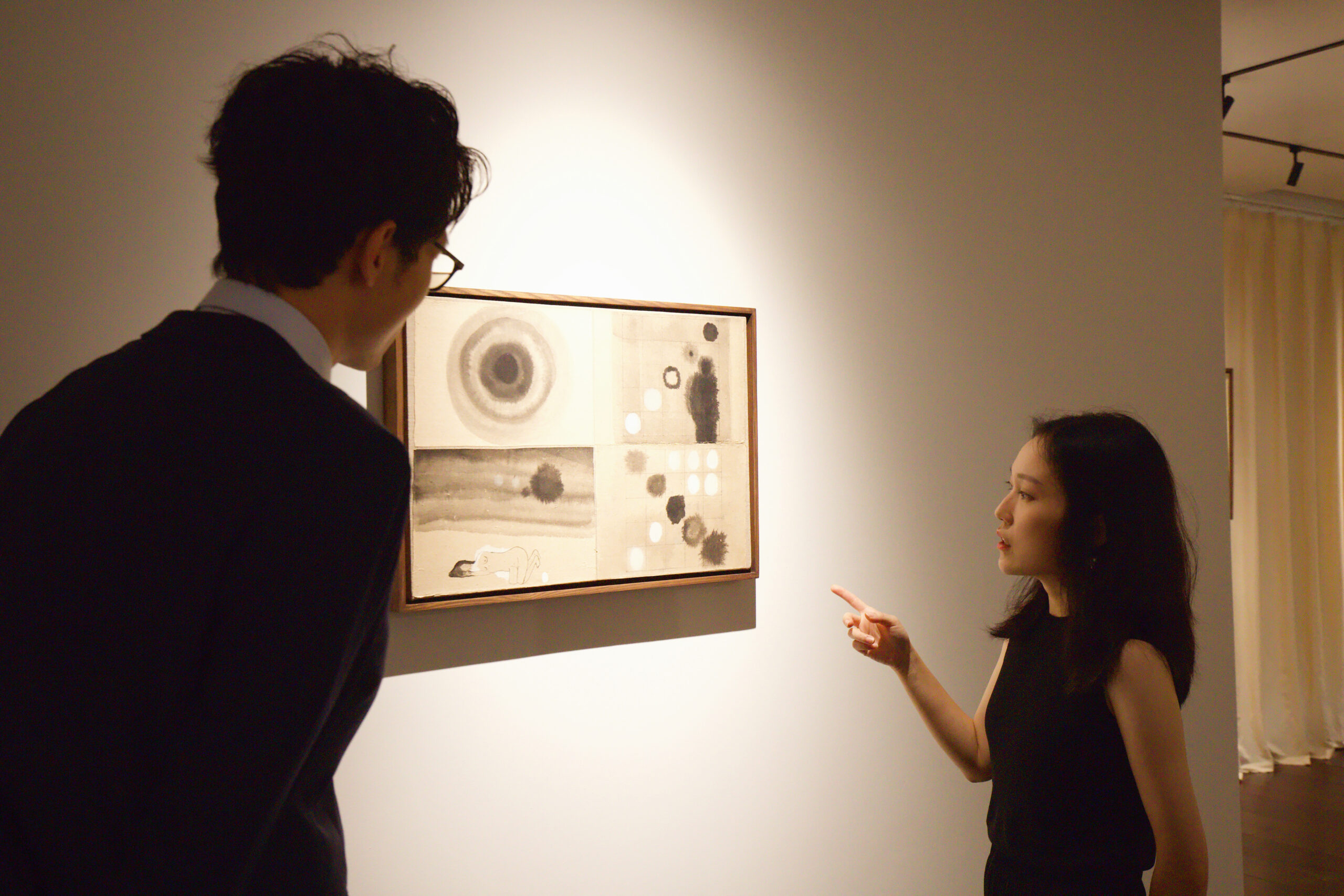
IL: Vu Dan Tan early on in his career worked in series forms, developing an idea over time, and through variations. One of my favorite series is “Money”, which he began circa 1993–1994, and continued over a decade or so. Among “Money” sub-sets, “Money (currency)” is my super favorite. It features all the essential traits of contemporary Southeast Asian art and is as aesthetically and conceptually engaging today as it was 30 years ago when produced. “Fashion” and “Suitcases of a Pilgrim” will also be part of the permanent display. Both are highly original, and the latter is especially historical as it was shown at the 2nd Asia Pacific Triennial of Contemporary Art in 1996, and then acquired by the Queensland Art Gallery, which has one of the best Southeast Asian contemporary collections in the world.

“Referencing Vu Dan Tan as a ‘court jester’ translated his covertly critical engagement of Vietnamese society and its paradoxes in the globalising 1990s with a sophisticated but accessible pluridisciplinary idiom.” – Dr Iola Lenzi
The first time Hoang Le brought me to visit the Museum, I exclaimed that this would be a new icon along the Ngoc Thuy dike. The outline of the architectural block stood out against the violet sunset. Could you share more about the project’s style and system of visual language – both exterior and interior – and its relation to the late artist?
HL: The landscape here makes the architectural experience between the two areas above and below the dike relatively separate. As soon as you reach the gate below, there is no longer any opportunity to take in the entire architectural scene, although the volume is not too large – it is simply an internal experience behind the door. On the dike, quick and fleeting movements will be repeated every day with many people around. Just a small group walking around there every day is enough to remember the symbol and create memories. It’s a bit like if one day you passed by Salon Natasha and saw it painted pink, and then it just kept going on and on… What we need to do is to research more programs for experiential architecture and create a “silhouette”. Here, I am “favoured” by the relatively uniform height management of the neighboring buildings, which is enough to have a “free sky background” for any symbol the architecture creates.
To be honest, I am not trying too hard to escape the “white cube”. In the context of today’s Vietnamese urban area, even a purely sacred religious structure finds it difficult to achieve a state of absolute “immaculate visuality” – in the Western sense. In addition, visitors may easily be “overwhelmed” by the visual system in Vu Dan Tan’s works in both quantity and energy. So in reading and looking at the artist, I favoured an approach that’s more inclined to enjoyment and assemblage. However, Vu Dan Tan has a series of sketches on “fantasy of architecture” that I am quite interested in. They are both specific, repetitive but also suggestive, elusive, and inductive.

In an introductory note from 2010 to Vu Dan Tan’s “Money” series, Dr Lenzi wittingly coined him as “the court jester”. The artist had indeed embodied an unconventional, quirky yet critical approach to art at the time, marginalised outside of Vietnam’s institutional framework. Now that a museum dedicated to him is in the picture, how do you intend to project such attitudes in this seemingly “institutionalised” setting?
IL: You are correct. Referencing Vu Dan Tan as a “court jester” translated his covertly critical engagement of Vietnamese society and its paradoxes in the globalising 1990s with a sophisticated but accessible pluridisciplinary idiom. The Vietnamese institutional art scene has evolved since I began researching Vu Dan Tan and his peers Truong Tan, Nguyen Van Cuong, and others who changed the nature and function of Vietnamese art in the 1990s. Since I started analysing their work in the early 2000s, and historicising their corpus in relation to wider Southeast Asian art history, Vu Dan Tan and others of the 1990s vanguard have become far less historiographically marginalised in Vietnam. I have published extensively on Vu Dan Tan, Nguyen Van Cuong, and Truong Tan in the last 15 years, including in Vietnam in various institutional journals, like that of Vietnam University of Fine Arts. Since 2011, I have also presented conference papers in Hanoi on these same artists. Therefore, it seems Vu Dan Tan and the others’ socially-slanted, discursive perspectives are now accepted in Vietnamese academia, particularly when located within the wider Southeast Asian contemporary art history.
Indeed, building a museum requires extensive efforts in every aspect of construction and curation; and constant feedback from all stakeholders. How did the team manage to balance all interests and inputs?
IL: The stakeholders are Vu Dan Tan’s family and owners of his estate, Natasha and Nhusha Vu. I am a family friend and researcher stakeholder in that I have been researching and writing about Vu Dan Tan’s art for a quarter century, locating it in Vietnamese and Southeast Asian contemporary practice and discourse. I produced my first Vu Dan Tan exhibition and publication in 2001 in Singapore and interviewed Tan over many hours in that process. More interviews followed for two subsequent publications and exhibitions in 2003 and 2009. I conducted yet more research after his death, examining his corpus, papers, books, and archives.
For the Museum, there was no need to balance the team’s interests as we are all aligned in terms of goals: that is to present the work of Vu Dan Tan and facilitate research on him. Mr Hoang Le has a deep understanding of art and takes a scholarly approach to museum design and architecture. From the beginning of the project, he immersed himself in Vu Dan Tan’s art and read all my essays on the artist, as well as anything else available. He has also read up on Southeast Asian contemporary art, so I can safely say Natasha, Hoang, and I are a unified team with a single objective: to bring Vu Dan Tan’s art and vision to the Hanoi and wider public in a beautiful space designed especially for his art.

HL: This is a long story. In this three-people project, I will not mention agreements and consensus; stories of disagreements are more enjoyable. Basically, each has a very systematic knowledge and experience in their field of expertise, and is quite radical in terms of viewpoints. I am sure that Mr Ace Le shares somewhat similar sentiments and experiences in collaborating with them, for example, in their participation in discussions from pre-concept to detailed stages, or when they reacted quite strictly to any “expression”. Natasha once jokingly said, “Tan was too flamboyant and advanced. I have lived my whole life with that, so I want a different space…”
But now, after a long period of collaboration, I have realised that before working with me, they have actually had experience working with people much younger, and they provided just enough knowledge, space, and patience for my practice.
Dr Lenzi was really instrumental academically and theoretically, and almost all of my proposals required discussions with her, albeit not so seamlessly sometimes due to geographical distance.
Vu Dan Tan Museum is the first museum project by lestudioarchitects. What distinguishes this project from other projects you have done, and what interesting challenges and solutions does it come with?
HL: The first difference is in the genre. Private museums belong to the category of public works, although the scale may be limited. Another difference is the object of reception and enjoyment: it serves a community interested in art and culture. Hence, it is selective but still more popular than some of my previous projects such as monasteries or chapels which, despite being open to the public, cater to a much more limited and localised base of beneficiaries.
Along with that is the challenge of introducing additional accommodation (private) functions, which are secondary but cannot avoid conflicts with the main public activities. In fact, this has appeared quite often in the project’s plot. I observe that this form is quite common in Hanoi city centre. Basically, I like this type of space as it is both here and there, but there is a negotiation (or is it a compromise?) when it comes to actual use… In the past, when I participated in large museum projects, I only worked at a specific role in large firms, where regulations, standards, and directions were clearly delineated and pragmatic. However, at this scale, some of the firm’s thoughts and my own could be tested in the process of physical construction.

“Natasha, Hoang, and I are a unified team with a single objective: to bring Vu Dan Tan’s art and vision to the Hanoi and wider public in a beautiful space designed especially for his art.” – Dr Iola Lenzi
Any other interesting story, challenge, or memory during the making of the museum that you’d like to share with us?
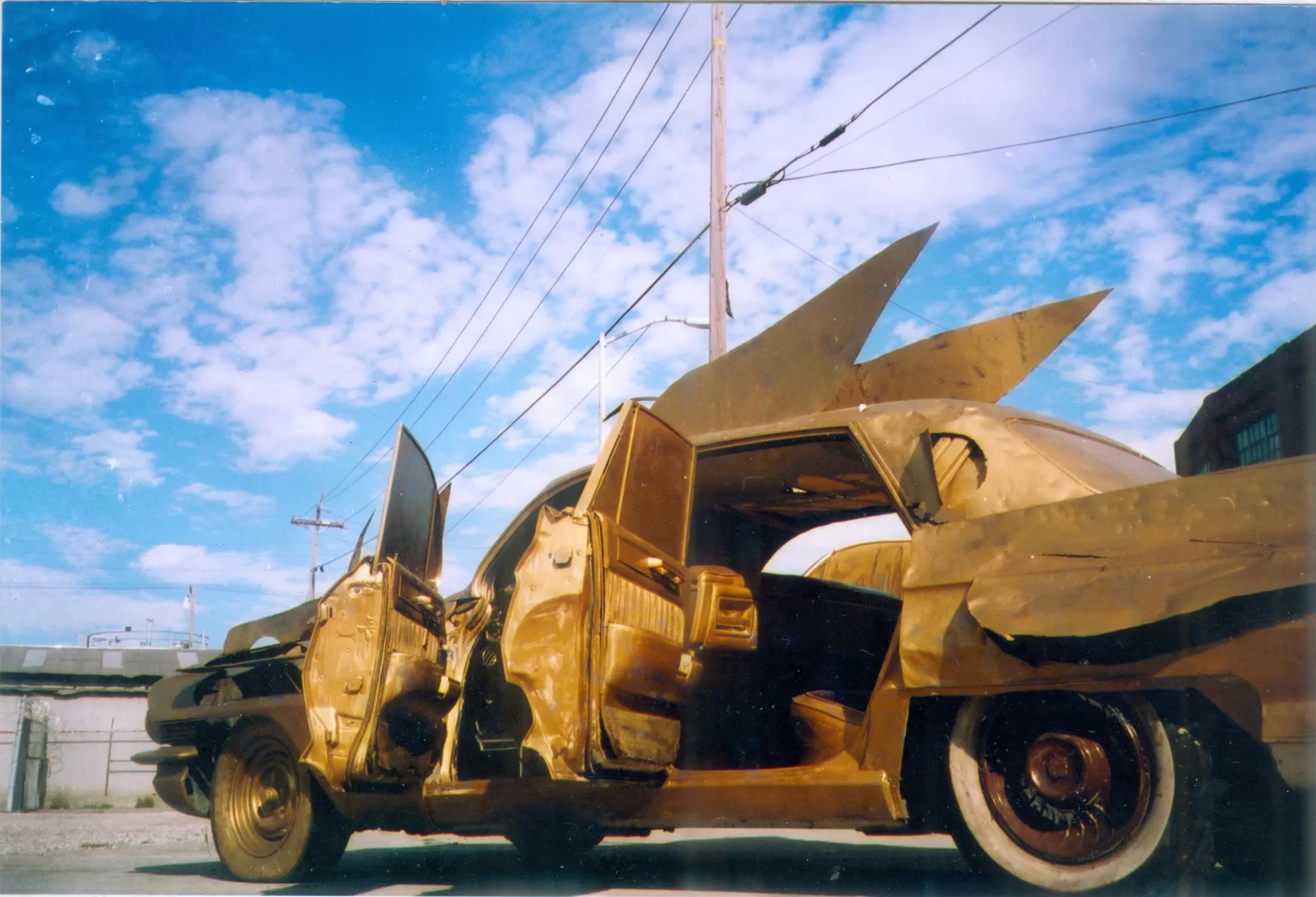
IL: One of my favorite Vu Dan Tan works is his “Cadillac / Icarus” performed installation from “RienCarNation”. The piece is seductively playful, yet contends with so many ideas germane to our times: the evolving meanings of history, the impacts of capitalism, of money, of globalisation, and questions of power. The material work, a transformed 1960s Cadillac, was produced in California in 1999 then transported to Hanoi, where it was performed in 2000. It crosses time, geography, culture, and ideology, and is in dynamic dialogue with mythology, economics, citizen’s choice, and more. It is performative, but also materially grand, emblematising Vu Dan Tan’s genius for creating a form able to probe complex ideas legible to all – the embodiment of Southeast Asia aesthetic-conceptual practice. Over the years, the piece, kept on the land where the museum now stands, slowly disintegrated slowly in the Vietnamese climate. It was our plan to show the relics of the work in the Museum, but the engine mysteriously disappeared a few years ago, and then the last bits of the Cadillac were washed into the Red River in the great typhoon of autumn 2024. So today, “Cadillac / Icarus” lives on as prints, photographs, and a video, the artwork itself now mythologised.
Thank you for your sharing and we look forward to the launch of Vu Dan Tan Museum!
Words: Ace Lê
Translation: Ally Lê