
When Nguyen Dang Tuyen, Master of Temple Mong Lien1 – a contemporaneous kindred spirit of Nguyen Du – prefaced the epic poem “Doan truong tan thanh (斷腸新聲, A new cry from a broken heart)” with the memorable turn of phrase, “The story of romantic love is ever the same, yet the cry of woe is henceforth heard anew,” perhaps it was already destined for a spectacular fate: over two centuries since its creation, the poem’s old lament continues to be endowed with new voices and forms.
Indeed, amidst the turbulence of the mid-20th century, two lavishly illustrated editions of “The Tale of Kieu” (“Kieu”) appeared within the span of a single decade. Published to mark the centenary of the great poet’s passing, the collection “Commemorating Nguyen Du: An Illustrated Book of Verse” (Quang Tri Hue Publishing House, 1942), compiled by Prof Dao Duy Anh, is still recognised as a rare and ambitious interdisciplinary undertaking, assembling 11 illustrated plates by some of the foremost artists of the Indochina period.
While less frequently mentioned in contemporary accounts, the 1951 edition of “Kim Van Kieu” has earned the praise of scholars like Vuong Hong Sen who hailed it, among his vast collection of books, as “a collector’s treasure, a delight for moments of reverie.”2 This rendition features 6 illustrated paintings from renowned graduates of the Indochina School of Fine Arts: Pham Thuc Chuong, Le Pho, Vu Cao Dam, Mai Trung Thu, Le Thi Luu, and Japanese artist Sekiguchi Shungo. Thus, just nine years after the 1942 collection, the most notable painters of the period were once again united to illuminate Nguyen Du’s magnum opus.


The emergence of two ambitious projects at the intersection of literature and art, both based on the same source text within a short span of time, not only reflects the effort to disseminate and preserve the Sino-Nom heritage within the 20th-century reception of “Kieu,” but also reaffirms the work’s enduring resonance in the realm of visual arts. The poem’s 3,254 verses have long held a central place in Vietnamese aesthetic sensibility, giving rise to a wealth of imagery rooted in the collective imagination as enduring benchmarks of beauty, both in form and consciousness. Numerous studies have been devoted to meticulously analysing the aesthetic categories of Nguyen Du’s exquisite representational landscape. It is against this backdrop that one can trace the origins and literary positioning of “Kim Van Kieu” (1951) – a work imbued with the spirit of refined beauty from the very first page.
Despite limited documentation concerning the book’s production, e.g. liaisons with artists and selections of verses for illustration, the preface alone reveals that the publisher had devoted exceptional care to curating a reading experience worthy of the epic poem: “An edition of ‘Kim Van Kieu’ printed with elegance and sophistication has long been the wish of many readers and book lovers alike, and is also the ambition of every Vietnamese publisher. […] Fine books adorning patterned poise, fine arts shaping poetry and lyrics – we humbly confine our tasks to these two aims.” Except for the two pages of the preface set in letterpress type, the entire poem is rendered in Pham Ngoc Tuan’s graceful modern penmanship. Printed on large ivory-coloured sheets, every page is neatly framed within an ornamental border, a golden dragon motif faintly embossed underneath the text, turning the book into an artwork in its own right.
A colophon on the last page of the book identifies the printer as Imprimerie Paul Dupont – a French printing press renowned for its chromolithographic posters. This affiliation helps explain the collaboration between the Vietnam-based publishing house and the contributing artists, all of whom were then living in France. In light of this, the plates in “Kim Van Kieu” stand apart from those in other contemporaneous publications of the same genre, such as “A Rural Landscape” by Anh Tho, in collaboration with artist To Ngoc Van (This Life Publishing House, 1941); “Echoes and Shadow of a Bygone Era” by Nguyen Tuan, featuring artist Do Cung (Times Publishing House, 1943); and the aforementioned “Commemorating Nguyen Du: An Illustrated Book of Verse.” Whereas these books were produced by woodblock printing on do paper – the prevailing method for reproducing art in Vietnam until the mid-20th century, the plates in “Kim Van Kieu” were machine-printed in France, presenting a markedly different aesthetic characterised by a freer, more fluid interplay of colours, rather than bold forms and sharply defined lines typical of the woodcut tradition.
“Printed on large ivory-coloured sheets, every page of verse is neatly framed within an ornamental border, a golden dragon motif faintly embossed underneath the text, turning the book into an artwork in its own right.”
With regards to the plates, compared to the collection “Commemorating Nguyen Du: An Illustrated Book of Verse”, which devotes a full page to numbering and specifying each depicted verse, “Kim Van Kieu” only contains two out of six plates bearing artists’ inscriptions of the corresponding verses. The rest focus mainly on early episodes in the tale, specifically the romance between Thuy Kieu and Kim Trong. Whether this editorial decision was deliberate remains uncertain; nevertheless, it signals that the illustrations were not intended merely to support the linear plotline, but to serve a distinct aesthetic function, allowing the artists, now co-authors of the hybrid text, to freely chart their own aesthetic currents.
The first plate by Pham Thuc Chuong is one of the two illustrations labelled with the lines:
“Forlorn, he missed the scene, he missed the girl:
he rushed back where by chance the two had met.“

A graduate of the Indochina School of Fine Arts who migrated to France in 1946, Pham Thuc Chuong was nevertheless deeply influenced by Eastern painting techniques and philosophy. In depicting the scene of Kim Trong returning alone to the place of his first encounter with Thuy Kieu after the spring festival, the artist adopts a wide perspective and an austere composition to reveal the character’s profound melancholy in an equally pensive landscape: “A tract of land with grasses lush and green / with waters crystal-clear: he saw naught else.” In a restrained approach to symbolism attuned to East Asian sensibility, the focal subject in Pham Thuc Chuong’s painting is no longer Kim Trong but the very texture of longing itself – a gentle yet palpable sorrow that permeates the entirety of the poem.As if composing a couplet alongside the first plate, the second illustration by Japanese artist Sekiguchi Shungo extends the wandering cadence with a sweeping gaze, dwarfing the human figures just enough to conjure a sentiment. After completing his art studies at the École nationale supérieure des beaux-arts in Paris, Sekiguchi returned to Japan and was later appointed to work in Hanoi, before eventually settling down in France, where he produced his illustration for the 1951 “Kim Van Kieu”.4 As Prof Junquo Nimura notes, Sekiguchi most likely have read the 1941 Japanese translation of the poem, translated by writer Komatsu Kiyoshi from the French. Such an encounter, twice removed from the original text, might have eclipsed the poem’s distinctive Vietnamese elements in the artist’s imagination, making it difficult to assign the work to any specific verse, instead evoking the impression of a landscape ukiyo-e5. However, from the image of the bridge arching across the middle distance and the willowing tree in the foreground, the illustration may be read alongside the lines:
“Below a stream flowed clear, and by the bridge
a twilit willow rustled threads of silk.”
In his commentary on this verse, scholar Tran Trong Kim invokes the Eastern literary notion of the “residual waves of the text 文有餘波”6 – the subtle ripples that extend beyond the written word and impart onto the reader an aesthetic resonance that is at once dialogic and introspective. Sekiguchi’s artwork very much embodies this intuited mode of interpretation, lending figurative brushstrokes to the poem’s lingering echoes.

“Sekiguchi’s artwork embodies this intuited mode of interpretation, employing figurative brushstrokes to give shape to the poem’s lingering echoes.”
Unlike the suggestive, open-ended ambience evoked by the first two plates, the illustrations by the quartet Pho-Thu-Luu-Dam favour more detailed imagery to articulate the relationships between the characters. The two paintings by Vu Cao Dam and Le Pho display notable commonalities in composition and the use of colours, their vivid, luminous tones highlighting the fleeting moments of joy between Kim Trong and Thuy Kieu. Significantly, Vu Cao Dam revisited the scene of their exchange of vows in multiple iterations across his oeuvre, of which this plate serves as one example:
“Her words untied a knot within his breast—
to her he passed gold bracelets and red scarf.”
Similarly, Le Pho illustrates Thuy Kieu and Kim Trong’s first meeting at the spring festival, with a verse inscribed in the lower right corner:
“Young Vuong stepped forth and greeted him he knew
While two shy maidens hid behind the flowers.”

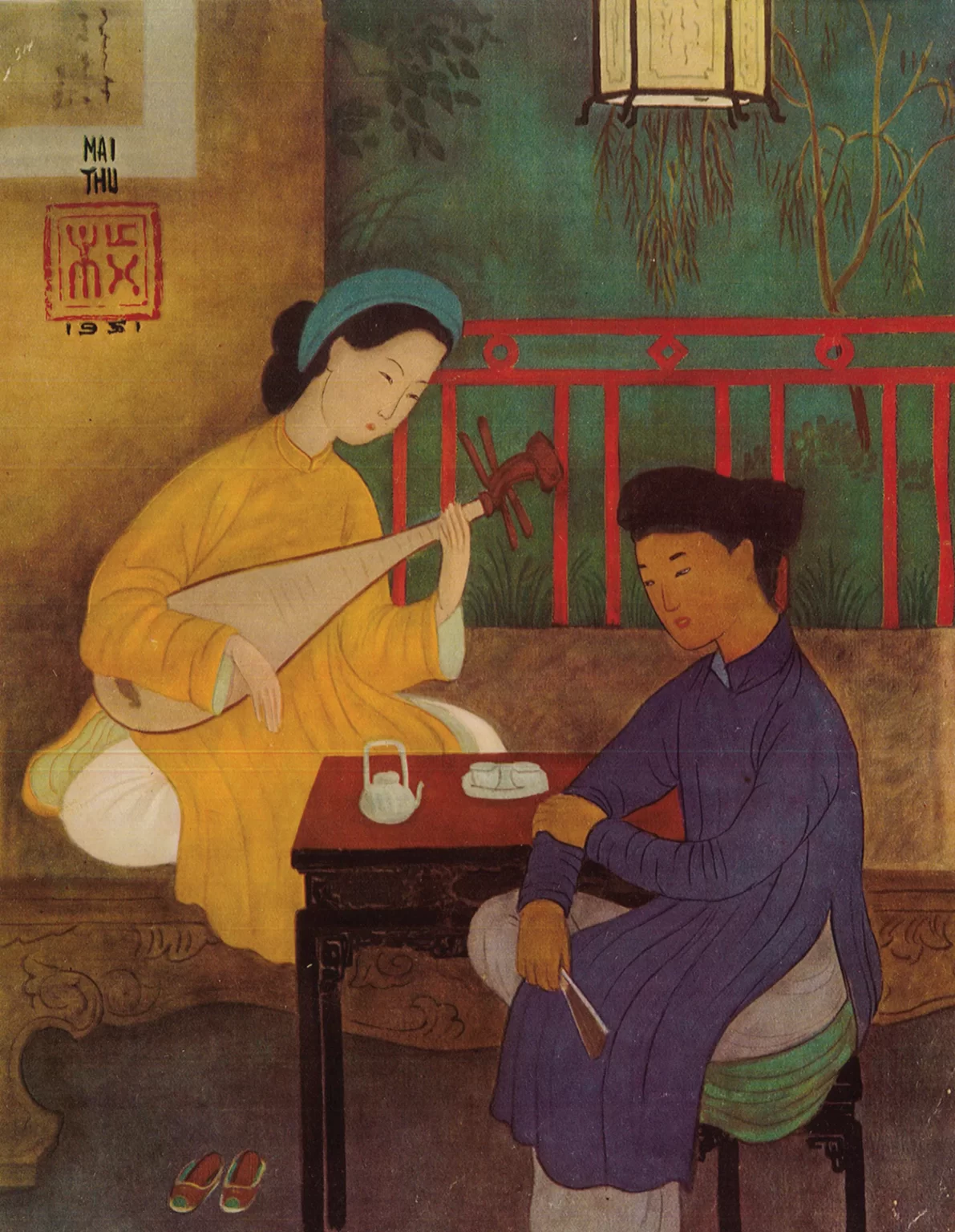
In contrast to the lively, buoyant compositions of the two previous paintings, Mai Trung Thu’s work captures with remarkable nuance the wistful ambiguity inflecting the characters’ expressions and gestures as he portrays Thuy Kieu playing the Vietnamese pipa for Kim Trong on a silvery night:
“He’d hug his knees or he’d hang down his head—
he’d feel his entrails wrenching, knit his brows.
‘Indeed, a master’s touch,’ he said at last,
‘But it betrays such bitterness within!’”
The scene comes to a still. Outside, drooping leaves hanging in suspension over the window, further accentuating the characters’ inner emotional turmoils, as if foreshadowing the tragic fate that would become entwined with Kieu’s artistic flair and temperament.
Le Thi Luu concludes the six-plate series with a painting of Thuy Kieu and nun Giac Duyen. The composition brings to mind the lines:
“She’s made her home within the Bodhi gate—
our grass-roofed cloister’s not too far from here.”

Writer Thuy Khue once remarked that Le Thi Luu’s subject matter can be distilled into the word “thieu” (young): the young woman (thieu phu), the young girl (thieu nu), and the young child (thieu nhi). Her illustration cements this insight, as it stands as the only work in the series that does not depict the romantic plotline but rather turn its gaze towards notions of human solidarity and compassion, conveying the Buddhist ethos central to Nguyen Du’s poetry. However, given the abundance of celebrated verses throughout “The Tale of Kieu,” the artists’ near-unanimous focus on young love – especially in a publication born from the ideal of “absolute beauty” – suggests an aesthetic orientation in the reception of the poem among the modern, Western-educated artistic milieu.
As one beautiful painting turns to the next, the concluding words of Literature Publishing House’s preface continues to echo: “Readers will easily discern each painter’s distinctive artistry and subjects of interest. If the ‘Book of Odes (Shijing)’ served as an inspiration for poets and artists of old, then ‘The Tale of Kieu’ is modern Vietnam’s very own ‘Shijing.’” And while Indochinese painters receded into a bygone era, their illustrations nonetheless still inform and percolate the contemporary imaginations of the poem, embodying the Eastern aphorism “poetry contains painting; painting contains poetry 诗中有画, 画中有诗” – all the while extending the compassion Nguyen Du bestows upon Kieu, one palimpsest at a time.
Words & Translation: Nhật Anh
[1] Nguyen Dang Tuyen, also known as Master of Temple Mong Lien, was a Confucian
scholar in the Nguyen dynasty. He penned the preface to “A new cry from a broken heart” (The Tale of Kieu) in 1820.
[2] Vuong Hong Sen, “Bibliophilia,” Tre Publishing House (2023), pp. 80-81.
[3] Nguyen Du, “The Tale of Kieu, a bilingual edition,” translated by Huynh Sanh Thong, Yale University Press (1983).
[4] Junquo Nimura, “Sekiguchi Shungo’s Vietnam – On the 1944 Exhibitions in Ha Noi and Saigon.” Journal of Shirayuri’s Women University, Vol. 57, Shirayuri Women’s University (2021), p. 114.
[5] Ukiyo-e (浮世絵 paintings of the floating world) was a genre that flourished in Japan from the 17th to the 19th centuries, depicting scenes of urban pleasures and beautiful landscapes.
[6] Tran Trong Kim, “Nguyen Du, The Tale of Kieu.” Edited and annotated by Tran Trong Kim and Bui Ky, Literature Publishing House (2023), p. 31.