In the early days of Western music history, art had permeated the realm of sound, exerting a profound impact on the processes of music creation, performance, and appreciation.
During the Baroque era, which spanned from the late sixteenth century to the first half of the eighteenth century, art emerged as a potent catalyst for transforming the methodology of music composition. Famous painters of the Baroque school such as Caravaggio (1571–1610) with “The Calling of Saint Matthew (Vocazione di san Matteo)” or Peter Paul Rubens (1577–1640) with “The Massacre of the Innocents” are known for their dramatic and skillful use of contrast between light and dark to create impressive depths. Likewise, Baroque music, featuring composers as Johann Sebastian Bach (1685–1750), George Frideric Handel (1685–1759), and Antonio Vivaldi (1678–1741), deployed this dramatic element in their compositions, characterised by robust rhythmic movements, distinct contrasts of intensity between sections, and a high level of technicality. Furthermore, the intricate and elaborate decorative ingredients seen in Baroque paintings were also evident in the music of this era through the use of ornamentation, involving numerous decorative touches around the main melody to elevate the piece to grandeur and sophistication.

Art also exerted an influence on the performance of classical music, as evidenced by compositions that highlighted precision and symmetry. Paintings of the time, such as “The Coronation of Napoleon (Le Sacre de Napoléon)” by the masterful Jacques-Louis David (1748–1825), stood out for their harmonious compositions and perfection in every detail. This inspired the great composer Wolfgang Amadeus Mozart (1756–1791), a representative of the Viennese classical school (1730–1820), who skillfully applied similar attributes to his music. Mozart’s Sonatas and Symphonies, notably Sonata No 10 in C Major or Symphony No 40 in G Minor, exemplified the balance of details found in classical painting through the construction of elegant melodies and clear musical structures. Such an approach demanded the performer to meticulously attend to every note and minute detail, enabling listeners to perceive the perfection in each work.


The Romantic paintings also incited the way of appreciating music in this period by eliciting imagery through elaborate brushwork, boundless imagination and realistic depictions. This revolutionised the experience of music by allowing the audience to perceive the visual and narrative elements that the composition aimed to convey. Paintings such as “The Statue of Liberty (La Liberté guidant le peuple)” by Eugène Delacroix (1798–1863) or “The Fighting Temeraire” by Joseph Mallord William Turner (1775–1851), with their vibrant colours and strong brushwork, inspired dramatic climaxes with dense harmonic accompaniment in the works of Frédéric Chopin (1810–1849) and Franz Liszt (1811–1886), where listeners experienced profound captivation, with the melody instantly etched into memory, sometimes after just a single hearing.

“The Romantic paintings also incited the way of appreciating music in this period by eliciting imagery through elaborate brushwork, boundless imagination and realistic depictions.”
Nevertheless, when discussing the integration of music and art, it is inevitable to mention Impressionism. Emerging in the late nineteenth and early twentieth centuries, Impressionism became a new breeze, not only in the field of visual arts but also in music.
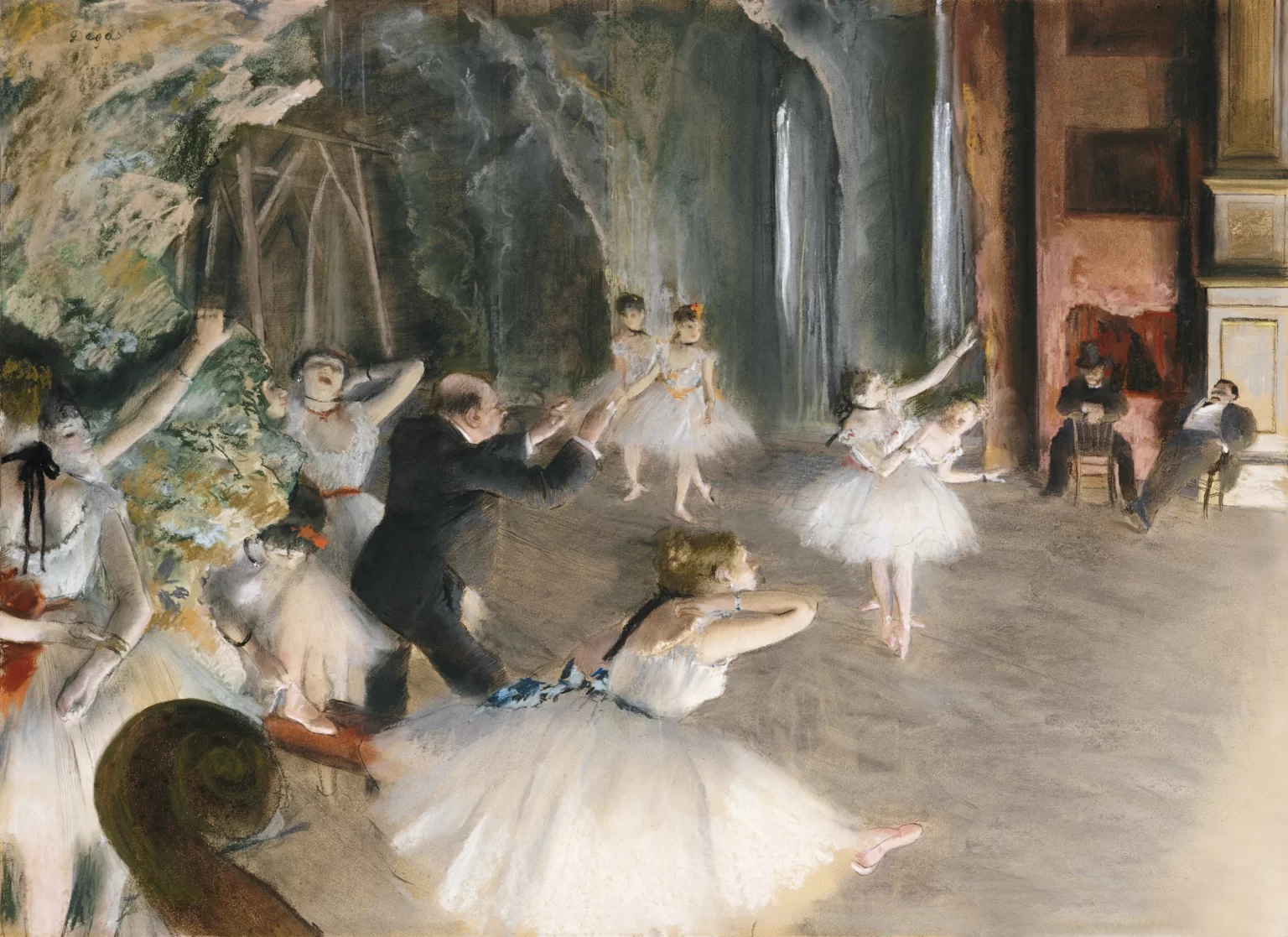
The signature features of Impressionist painting are its emphasis on light, colour, and immediate perception. Painters such as Claude Monet (1840–1926) and Edgar Degas (1834–1917) aimed to depict transitory moments of life with freedom and ambiguity, resulting in works that were emotionally charged and evocative, with Monet’s “Impression, Sunrise (Impression, Soleil levant)” being a prime example of this effort. This emphasis on sensation and visual impression served as a source of inspiration for composers, who aimed to convey these effects through the methods of sound composition. Claude Debussy (1862–1918) and Maurice Ravel (1875–1937), two exemplary figures of French Impressionist music, rigorously explored non-functional chord sequences, whole-tone scales, Asian pentatonic scales, and free rhythms to evoke an enigmatic atmosphere in their compositions. This innovation is akin to the manner in which Impressionist painters defied institutional frameworks, producing artworks that abandoned the emphasis on intricate details, as seen in the Realist school, and instead focused on depicting the essence of the human spirit. Every passage now transforms into a vibrant palette of colours, with each musical composition resembling an exquisite tapestry, abundant in both hues and poetry, transporting listeners into a realm of sentiments and aspirations.


Furthermore, the performance of Impressionist music also underwent a transformation in comparison to preceding eras. As the granddaughter of the late painter Le Van Xuong (1917–1988), violinist Le Hanh Nhi consistently stressed the need of attentively listening to and mentally envisioning the various hues present in Impressionist melodies during performances. For her, music in this era is not only a blend of loud and soft or fast and slow; rather, the performer has to guide the audience into a realm where sound transforms into an image and each note requires not only auditory perception but also visual sensation. This necessitates the artist to expertly employ performance techniques such as “legato” to generate sound lines that are seamless, resembling silk ribbons that are suspended in space, or “vibrato” to introduce subtle amplitude fluctuations, rendering each note ephemeral and transient, akin to an emotion that abruptly arises and dissipates. In addition, it is important to highlight the abrupt fluctuations in sound intensity (“subito”) during performances, similar to the continuous fluctuations in the listener’s mood. Occasionally, the sound persists softly like faint beams of light piercing through the clouds, while at other times it rapidly changes like lightning piercing through the darkness of night.
In contrast to earlier periods, which emphasised strength, balance, and meticulousness, the aforementioned elements also served as the foundation for developing an unparalleled way of appreciating music during the Impressionist era. Impressionist art revolutionised both painting and music appreciation by heightening the desire of listeners to experience ethereal and indeterminate sounds that could transport them to far-off horizons. The piece “The Sails (Voiles)” by Debussy acutely demonstrates such by portraying the image of drifting sails against a backdrop of the sea. This dreamlike quality is shaped by the painting technique of Impressionism. It is evident when examining the painting “Boats by the Cliffs, at Pourville (Bateaux devant les falaises de Pourville)” by Monet with its enchanting depiction of distant boats, which highlights the resemblance and correlation between music and painting. This era of music captivates the listener’s sensibility with a seamless progression of emotions, providing a greater sense of ease compared to the Baroque and Classical periods, when music mostly revolved around historical-political narratives.

The impact of Impressionism on music sparked a revolution in the manner of expression, leveraging emotions and establishing a new era of connection between the two art forms. Painting has remained a source of inspiration, influencing the development of music ever since. The influence of painting is consistently evident in the composition and performance of modern music, as evidenced by the following examples.
Igor Stravinsky (1882–1971), one of the most famous modern composers of the twentieth century, was also very passionate about painting. As a result, his compositional methods frequently demonstrated a close connection to arts. “The Rite of Spring (Le Sacre du printemps)”, his most renowned work, is well-known for its “chaos” in harmony and disruption of traditional structures, as influenced by the works of painter Nicholas Roerich (1874–1947). Stravinsky’s music was set against a distinctive visual backdrop of Roerich’s chaotic brushstrokes with vibrant colours and powerful depictions of ancient rituals. A multi-faceted piece of art, “The Rite of Spring (Le Sacre du printemps)” is a musical composition with accompanying visual elements, weaving together a narrative of birth, death, and resurrection.
In modern performing art, the relationship between music and painting is becoming more and more intricate, providing listeners with more profound and multidimensional experiences. A typical example of this is the famous work of Alexander Scriabin (1872–1915), “Prometheus: The Poem of Fire”, where he combined symphonic music with a brilliant light show, with the aim of creating an artistic experience that links vision and hearing. Additionally, live painting performances to classical music are becoming increasingly popular both domestically and internationally. A recent notable example is the performance of artist Ivan Shenvesky (born 1986), who painted large-scale paintings to symphonic music to inaugurate the Grand Opus International Piano Competition 2024 in Ho Chi Minh City. These events have not only enhanced the art landscape but also provided numerous individuals with the opportunity to experience the distinctive combination of music and painting, thereby establishing a youthful and energetic atmosphere.
The integration of music and painting in contemporary times has greatly enhanced the artistic experience, expanding the audience’s perception and emotional response to music. In addition to fostering a multi-sensory environment, the integration of visual elements such as light, colour, and animation with sound also facilitates emotional connection with the audience, igniting the imagination and transforming each performance into a journey that is not only academic but also more accessible to the contemporary public, thereby facilitating their engagement with the art of classical music.
Through the aforementioned, it is clear that visual art has had a significant impact on music. Painting has breathed life into every sound, enriching the nuances and depth of music. This magical interplay not only creates a symphony of colours and sounds, but it also serves as an eternal source of inspiration, capturing our hearts and imagination.
Words: Đức Minh – Anh Quân
Translation: Đức Minh