Henri Lefebvre described “abstract space” as a realm where, over a long process, senses like taste, smell, touch, and even hearing become blurred, while the visual gains dominance over the others [1]. As a certain counterpoint to this “visual formant,” rhythmanalysis has become essential for urban artists and scholars analyzing the production of space. It is an exploration of the temporalities and rhythms of everyday life, identifying the vibrations evoked by even the most humble objects and trivial practices. This doesn’t exist purely on the plane of theoretical discussion in Vietnam: many sound studies experiments, gatherings, and installations organized by art collectives and organizations such as The Onion Cellar, Á Space, Manzi, and DomDom have become known to the public throughout the years. These coincide directly with the development of a new generation of interdisciplinary experimental artists in the spatial context of accelerated (planetary) urbanization [2] and the need to look at the city with fresh senses.
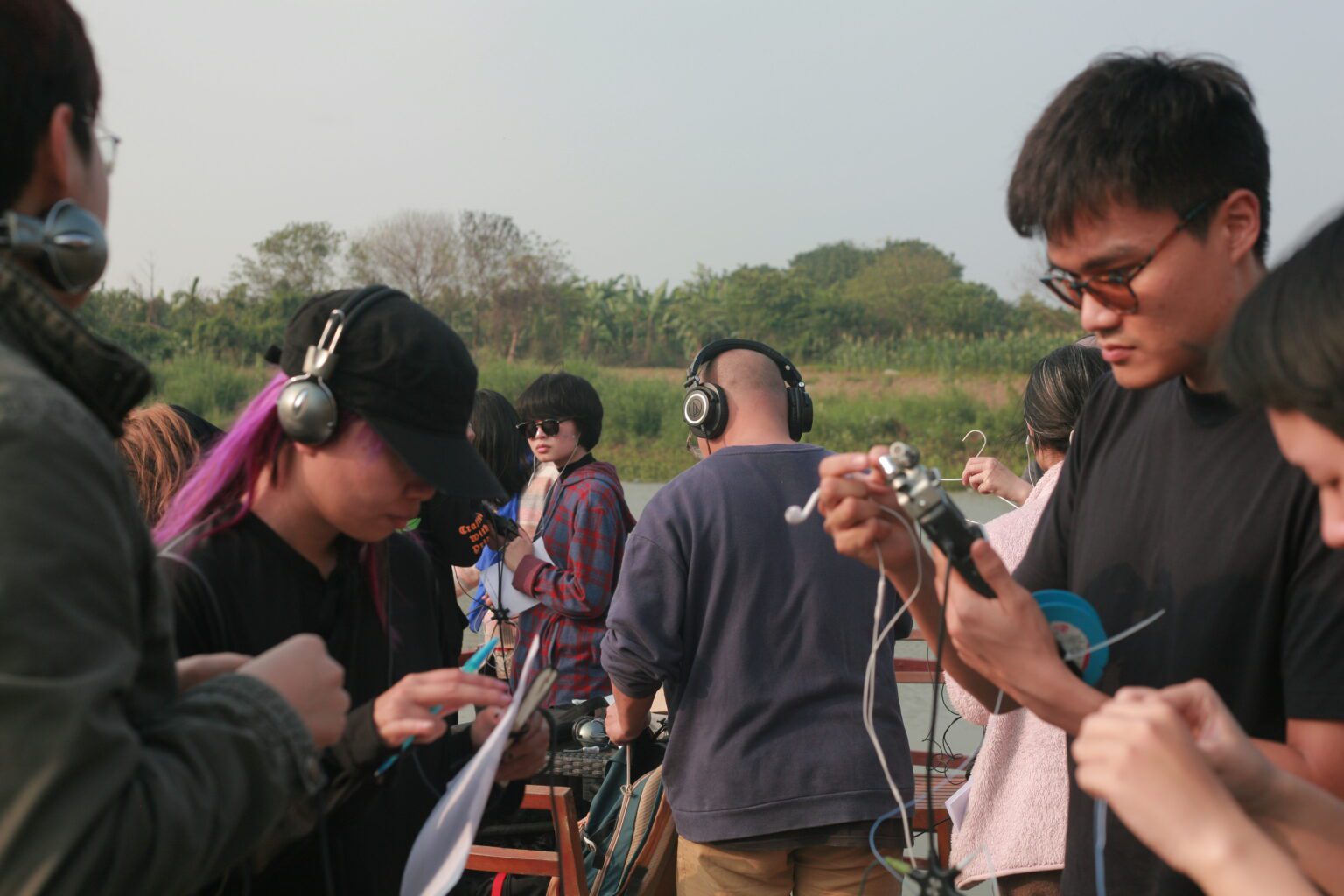
The workshop Amphibian Ears (Tai nổi – Tai chìm), facilitated by Kosmas Phan Ðinh and organized by ba-bau AIR with support from Think Playgrounds, which focuses on field recording and hybrid listening along the Red River riverside, is one of the newest examples that traces the production of these rhythms, of a differential sonic reality, in connection to the water, to informal lives, and to the mechanism of extraction that our devices employ. It is, in a sense, a sympoiesis [3] that helps us respond to the Anthropocene by fostering connections between human and nonhuman worlds.
And yet, funnily and coincidentally enough, I didn’t participate in this workshop solely on the basis of being a multimedia supporter: Kosmas and I were sharing the same venue in the olo mini-fest organized just last Saturday by Hanoi Bedroom Show and The Onion Cellar. In a way, even though I didn’t directly contribute to the materials dispersed by the workshop, I was privileged enough to have a special insight, as both an urban researcher, an employee of Think Playgrounds, and a musician myself, into the making of this spectacular occasion. An accidental auto-ethnographer: just as the converter of the recorder and the sensors of the microphones, including hydrophones and contact microphones, register the sonic affect of things, so is the job of an urban researcher to succumb themselves to the vibration of processes posed upon the spatial reality.
I still remember what I discussed with the owner of Anatolia that night, where we both agreed on the fact that what we seek on stage is not escapism, but a deeper exploration into sound, the materiality of it reverberating across the room, from the people that breathe the same air to the machines that run on the same power outlet. Looking out into the deep night of Hanoi on the seventh floor of the building where HUB resides, we wondered about how everything is going on in this world, and yet, by sharing sounds, we both immersed ourselves into that particular dimension, amidst the precarious urban landscape.
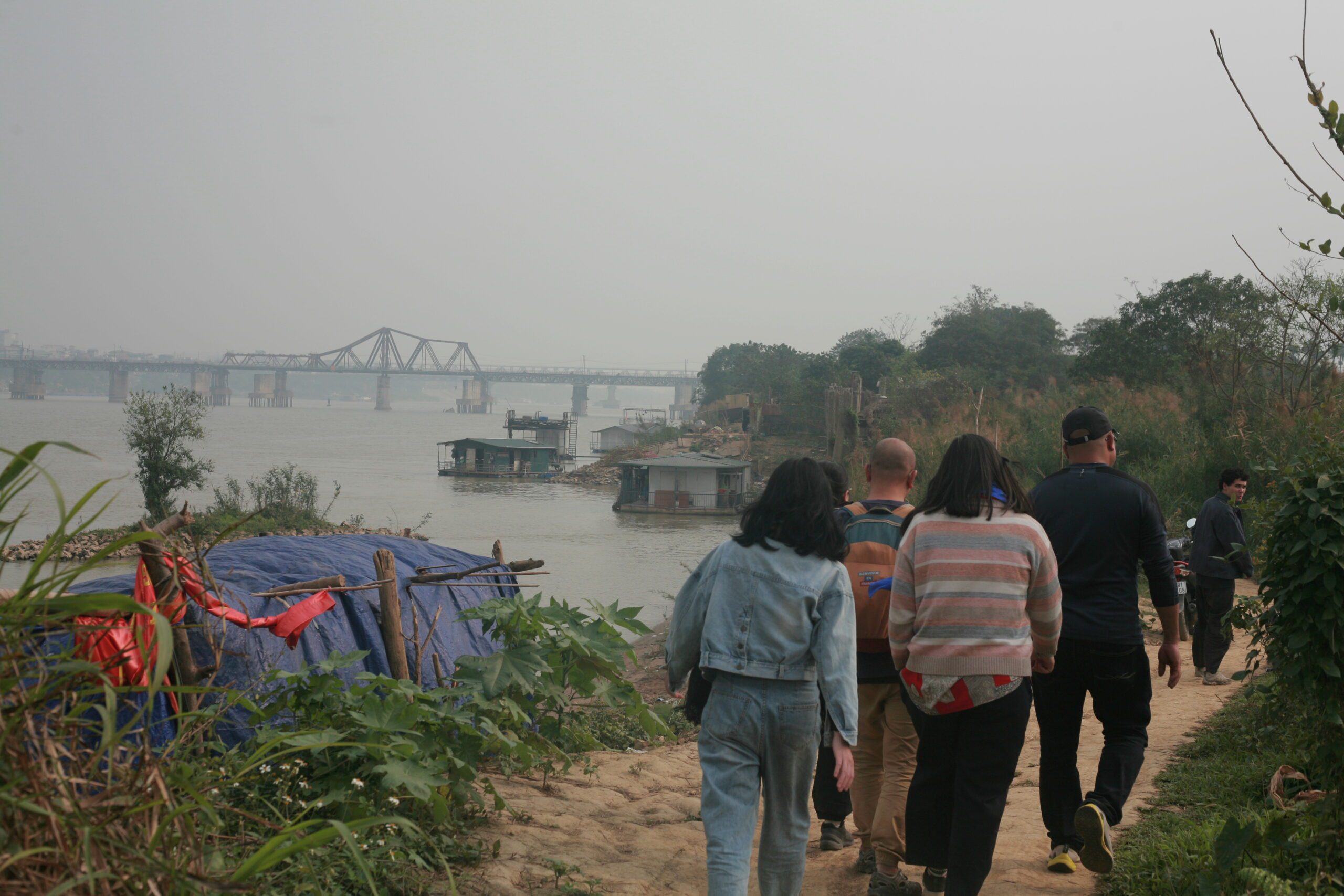
In a way, that sentiment was shared during the Amphibian Ears workshop. The (non-)place where it happened, Xóm Phao, or Floating Hamlet, is a poignant, informal settlement located just a stone’s throw from the bustling center of Hanoi, nestled along the banks of the Red River (specifically in the Phúc Xá and Ngọc Thuỵ ward areas). Populated by migrant workers, many partially undocumented, Xóm Phao is a tight-knit community consisting of around 25–35 households of mostly elderly people, families, and laborers who have slipped through the cracks of the city’s formal administration. Most residents earn a precarious living through informal labor, like collecting scrap metal and plastic (scavenging), washing dishes for restaurants, or doing manual labor at the nearby Long Bien wholesale market. With pulled power lines and drilled wells, these residents make their homes on floating houses made from barrels, plywood, corrugated iron, and repurposed scrap, anchored to the riverbed but rising and falling with the tide. It is therefore extremely vulnerable to the ongoing impact of climate change, with Typhoon Yagi in 2024 and Typhoon Bualoi in 2025 essentially sweeping through the area. Think Playgrounds has been supporting Xóm Phao for over 10 years, focusing on community support and living space renovation. With a history of inclusive urban interventions and service-learning organizations across prominent Vietnamese cities, our mission is to contribute to community development as well as area revitalisation. In Xóm Phao specifically, we have contributed to the renovation of 10 floating houses and maintained a crucial connection with the inhabitants. Thus, we were lucky to be contacted by ba-bau AIR for local and technical support for this workshop.
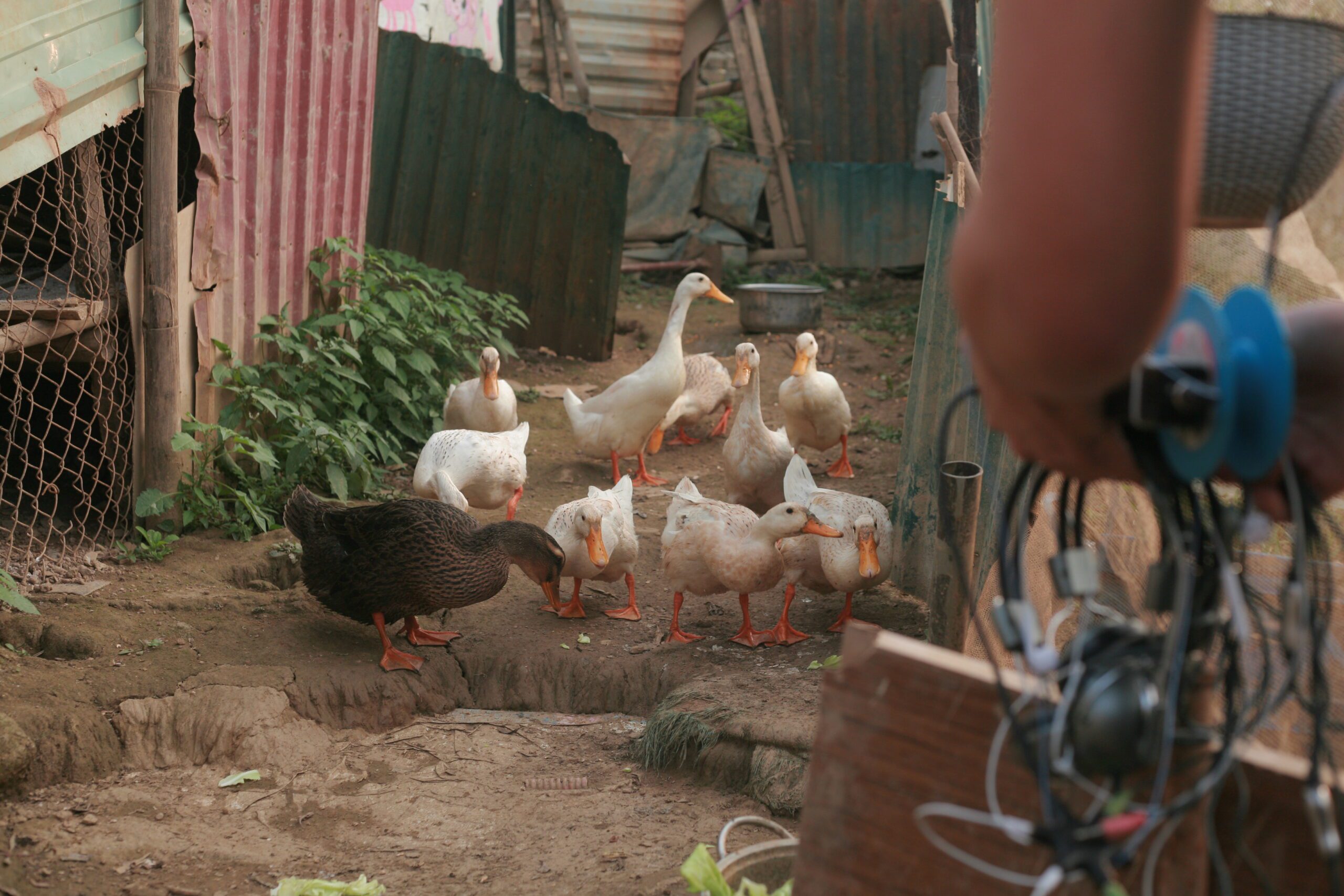
As the cyclical time, of the river waves running up and down out there on the water, the moving up and down of the houses, and of the creatures, geese, dogs, cats, bacteria, that live here and die here, that Lefebvre brought up in his work on Rhythmanalysis [4], cannot be more obvious, we, as participants, encountered a messy spatial configuration defined by the deep entanglement of all living things in the setting of ecological crises, or, named by Donna Haraway, the Chthulucene [3]. Every step we made along the way, witnessing construction waste encroaching on the shore and neighbors singing karaoke loudly in daylight, demonstrated a surprisingly vibrant way of living, as critters muddling through the mess together.
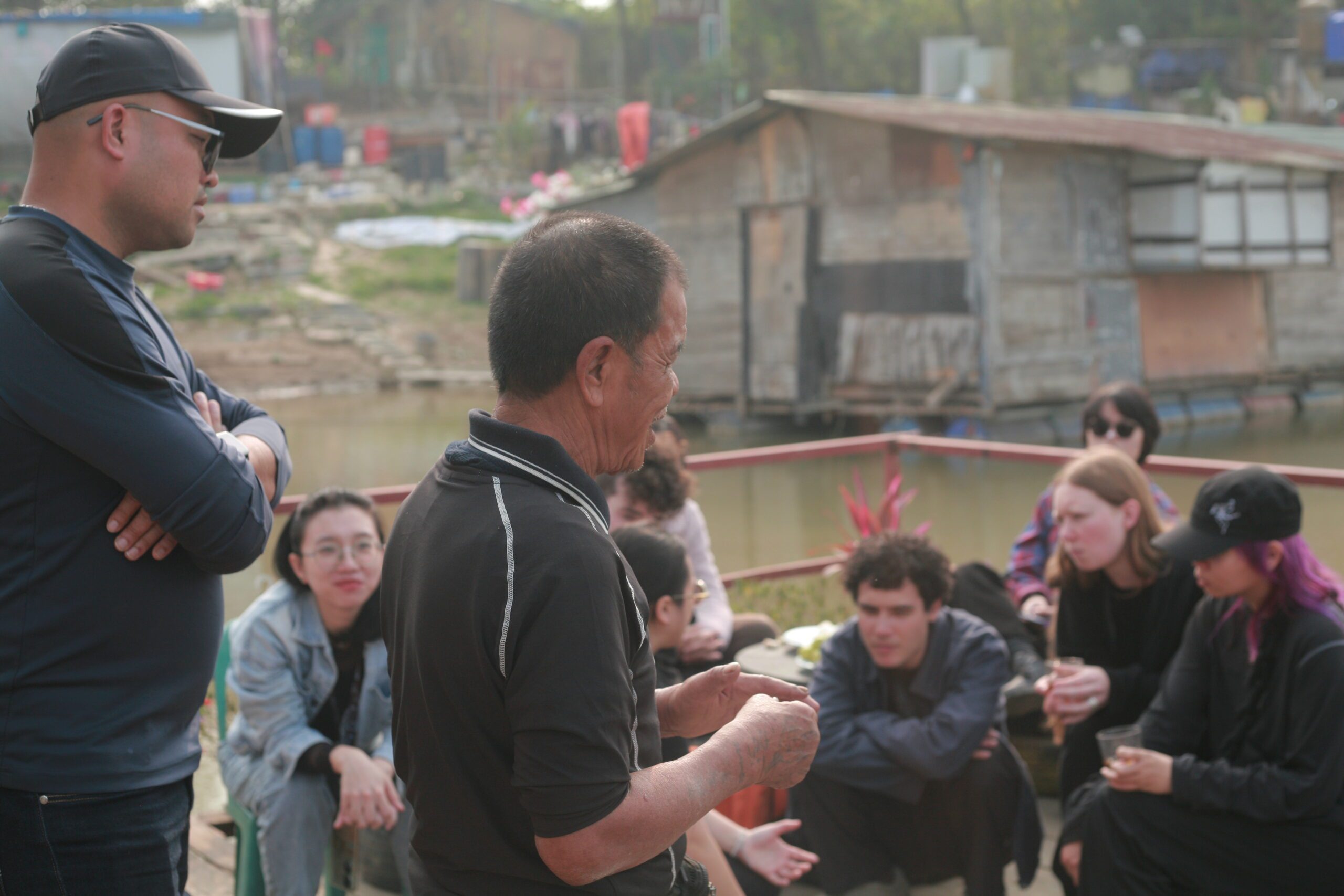
It was therefore fascinating to see the participants, some work in creative fields, with perhaps a preliminary purpose of networking and practicing field recording (a typical productive reason), become enchanted with the listening exercises and the recording equipment. We were instructed to hear, maybe for the first time, the nearest sound and the farthest sound, sitting on the floating house of Mr. Được, the de facto leader of the community. (Funnily enough, the listening exercise managed to bypass the deafening noise of Mr. Được fixing something inside the house, I presume). We were then taken on a tour to see the houses, the old ones and the new ones, with a bit of sociological context of the community (and somehow, a nude sport area nearby that we were careful enough not to approach). Along with a humbly heartfelt introductory speech by Mr. Được on the history of this place, how they live, how the children were able to go to school and are thankfully all eager to learn and to do well in school despite the hardships in both natural and administrative senses, we started to ease ourselves into exploring a hidden dimension of a “minor place” (in a Deleuzian sense [5]) with recorders and microphones carefully instructed by Kosmas. Among the microphones, there were some hydrophones, some contact microphones in stereo configurations, and weirdly enough, a converted accelerometer to record the vibrations. The participants were allowed to record, listen, and note down everything, from the micro-vibrations of decorative plants on the floating houses, the sound of footsteps on the floor, the sizzling sounds of roasting pork, the moving wire mesh outside, the pillars on the shore, the moving water from the river, or the atmosphere inside the floating house, all with extreme fascination. In this setting, the human ear, conditioned to listen to airborne sound and to understand semantics, couldn’t help but be deterritorialized [6] to listen to the water and material, in a becoming-post-human.
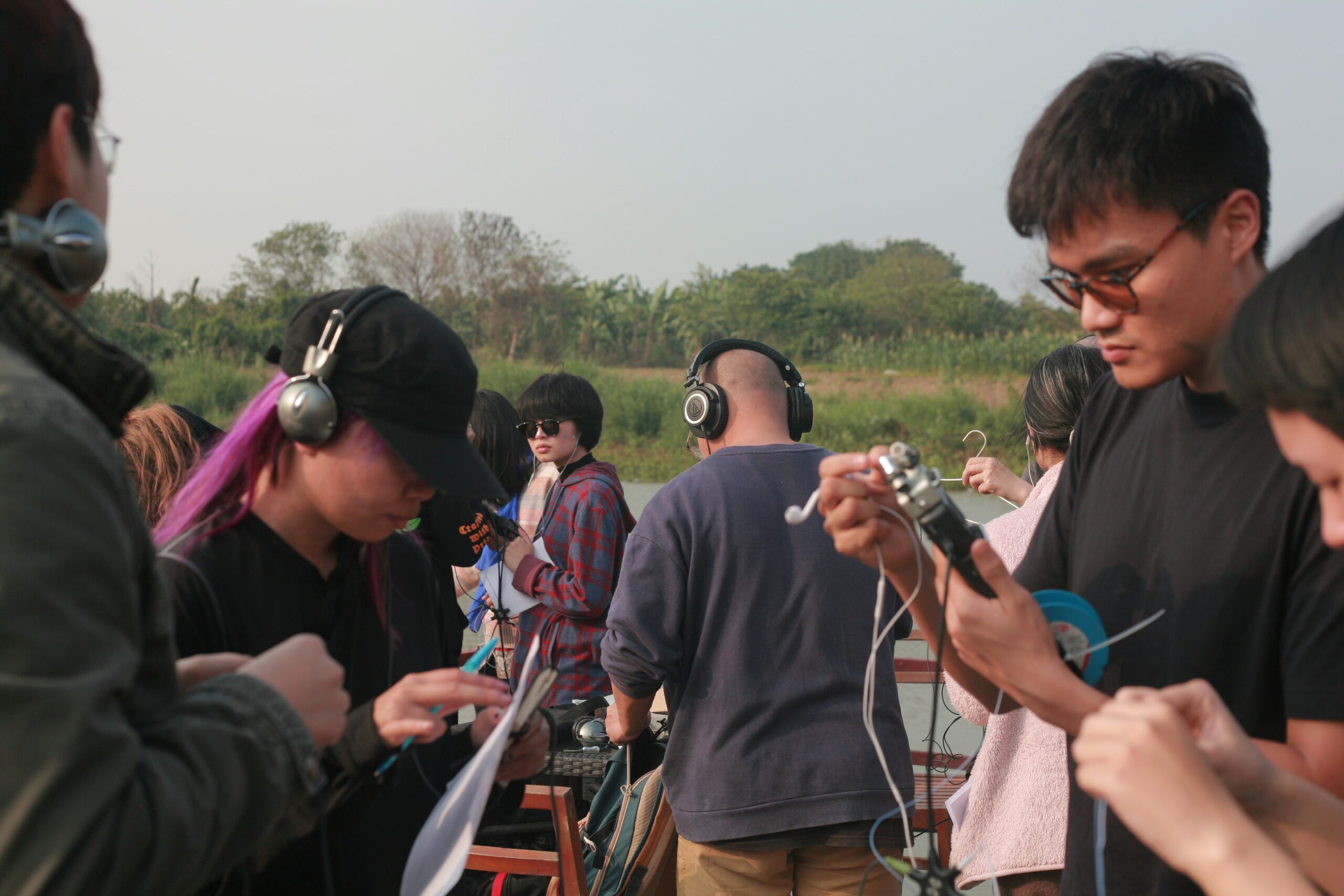
A crucial element briefly passed over by Kosmas’s instruction is the reminder of the sensitivity of the devices: too little and we can’t hear it well; too much and the noise starts to overwhelm the sense, and the smallest details get lost. In a way, this recognition stands in stark contrast to the curated soundscape made possible by the domesticated human sense in tuning out noise, mostly the trivial ones made by traffic and construction, and by the algorithms of music platforms and noise cancellations that allow for a linear movement in urban space, enjoying an artificial silence, or just the right amount of white noise and cosmopolitan cultural artifact (songs) to soothe our urban everyday life. This approach shares a certain DNA with the practice of ambient and noise artists regarding indeterminacy and unpredictability: Soliloquy for Lilith by Nurse with Wound comes to mind, or the recordings of Claire Rousay, but the most striking comparison must be Radio Amor by Tim Hecker, itself inspired by a fisherman and shrimper, and funnily enough, released under the label Mille Plateaux, of course referring to the work by Deleuze and Guattari [6].
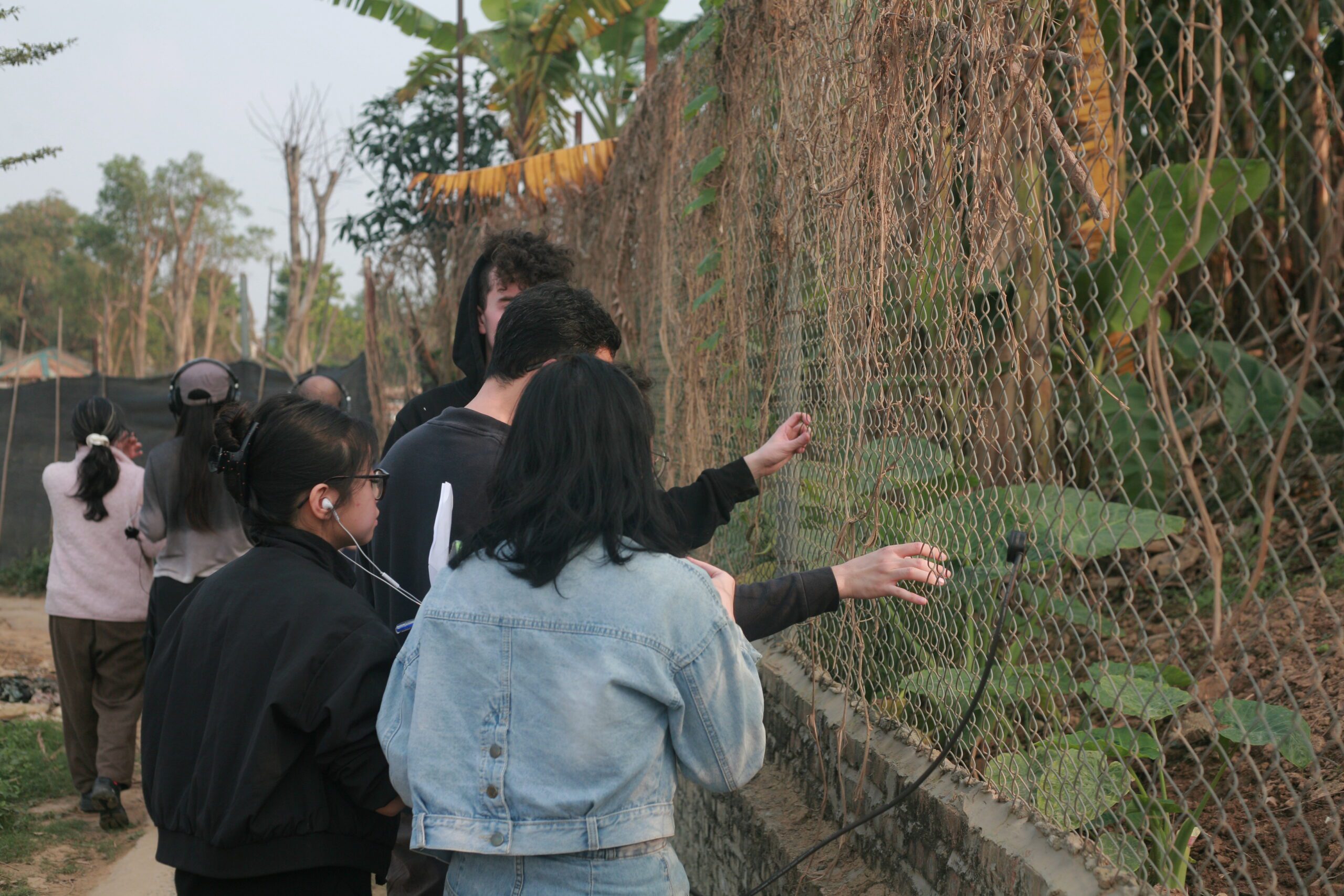
A funny story: after the session, we sat down and listened to the recordings that the participants made. I joked with Trần Uy Đức, also the person behind Hanoi Bedroom Show and one of the participants, that this sounds very similar to the music that they make. Well, to add to the fact that they are one of the few artists featured on Pitchfork with the 2021 album Came, I was privileged enough to see one of their very first performances in the Red Balloons cine-concert organized by The Onion Cellar and TPD Centre back in 2020, and to join them and Trần Duy Hưng during the last day of the olo mini-fest.
This also reminded me of the works of one of our favorite artists, Phil Elverum, with the prominent projects The Microphones and Mount Eerie, whose sonic trajectory went from the metaphor to the brutally real, grappling with the tension between the eternal indifference of nature and the crumbling, temporary structures of human life. Where The Moon and The Wind were centrally featured in The Glow Pt. 2 [7] as mystical, overwhelming forces of nature in the cold and vast universe, now it’s Toothbrush and Trash and Forest Fire in A Crow Looked At Me [8], or Huge Fire and Empty Paper Towel Roll and Non-Metaphorical Decolonization in Night Palace [9]. These works essentially brought the dream of impermanence to a sobering reality, one of wreckage and demolition, trying to build a home in the debris left behind, aptly enough. And in the unlimited postponement of the urban reality, in an imminent precarity of displacement with the upcoming Red River urban project, one with constructed landscapes, sanitized greenery, and the promise of modernization and economic growth, the name of the final song of Night Palace came to my mind: I Need New Eyes.
And so, the day ended with us enjoying a dinner together as a continuation of the sympoiesis, with a hot pot of chicken and tầm bóp (physalis angulata), an indigenous plant which was mentioned at least three times during the meal that we cannot buy in the market. This further displayed a certain cultural capital that we, the urban creative class perhaps, share with each other to self-indulgently appreciate a precious natural entity in our endless quest to (ethically) consume the commercially unavailable, in the same vein as field recording records. Self-deprecating humor aside, it was an affective atmosphere that workers from multiple disciplines shared. An amphibian one: we were ourselves on the floating house, surrounded by unstable lights powered by a DIY power line, its intensity gently oscillating to the urban rhythm, out there and in here, in a deterritorialized and reterritorialized zone.
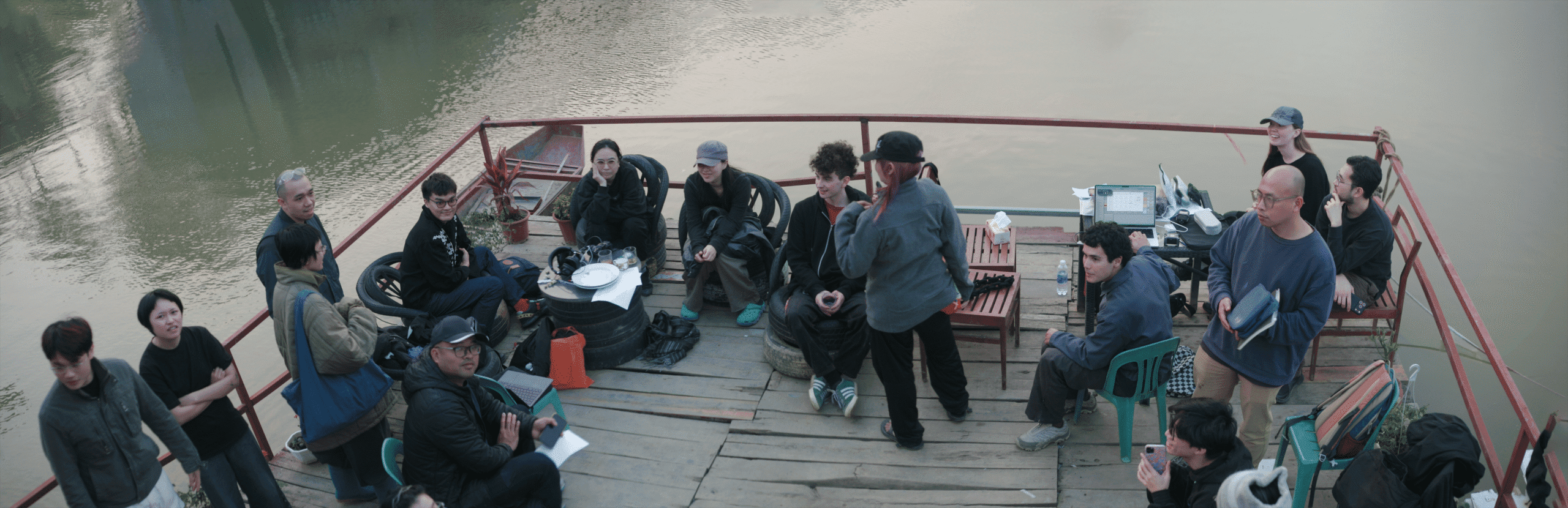
I guess it’s one of the ways that we can stay with the trouble [3], and to unmute the hidden living, to give presence to the entities, to the critters, that flow in the silent shadow of urbanization processes.
Bibliography:
[1] C. Schmid, Henri Lefebvre and the Theory of the Production of Space. Verso Books, 2022.
[2] N. Brenner, Implosions /Explosions: Towards a Study of Planetary Urbanization. Jovis Verlag GmbH, 2015.
[3] D. J. Haraway, Staying with the Trouble: Making Kin in the Chthulucene. Duke University Press, 2016. doi: 10.1215/9780822373780.
[4] H. Lefebvre, Rhythmanalysis: Space, Time and Everyday Life. Continuum, 2004.
[5] G. Deleuze and F. Guattari, Kafka: Toward a Minor Literature. University of Minnesota Press, 1986.
[6] G. Deleuze and F. Guattari, A Thousand Plateaus: Capitalism and Schizophrenia. University of Minnesota Press, 1987.
[7] The Microphones – “The Glow” Pt. 2. 2001. Accessed: Jan. 29, 2026. [Online]. Available: https://www.discogs.com/master/54873-The-Microphones-The-Glow-Pt-2
[8] Mount Eerie – A Crow Looked At Me. 2017. Accessed: Jan. 29, 2026. [Online]. Available: https://www.discogs.com/master/1154519-Mount-Eerie-A-Crow-Looked-At-Me
[9] Mount Eerie – Night Palace. 2024. Accessed: Jan. 29, 2026. [Online]. Available: https://www.discogs.com/master/3645021-Mount-Eerie-Night-Palace
Words: Vũ Thục Khuyên